

The single most powerful way to find new clients is to show up when they're actively searching for legal help. When it comes to SEO for a personal injury attorney, it's not about tricks or shortcuts. It's about a smart, layered strategy built on solid research that puts your firm front-and-centre the moment a potential client needs you. This is your blueprint for generating leads consistently in a very crowded market.
Building Your Foundational SEO Strategy
A winning digital strategy doesn't start with building a website. It starts with a deep dive into your market, your competitors, and the clients you want to attract. Before you can even think about ranking, you have to map out the terrain.
Frankly, this initial stage is the most important part of the entire process. It dictates every single thing you'll do later—from the blog posts you write to the links you try to earn. Skipping this is like building a house without a blueprint. You might end up with something that looks like a house, but it's going to be unstable and won't serve its purpose.
The core of this foundation is keyword research, competitor analysis, and site architecture. Each piece informs the next, creating a solid plan to capture the people who are ready to pick up the phone.
Deconstructing Keyword Research for Personal Injury Law
Effective keyword research for a PI firm goes way beyond targeting "personal injury lawyer." Sure, it seems obvious, but that term is incredibly competitive and usually way too broad. The real gold is in uncovering the specific phrases people use when they have an immediate need, often tied to a location or a specific type of accident.
Put yourself in the searcher's shoes. Someone typing "car accident lawyer in Vancouver" is much closer to making a call than someone who's just browsing "what is negligence." Your job is to find and prioritize these high-intent keywords.
- Practice Area Keywords: This is your bread and butter. Think "motorcycle accident attorney Burnaby" or "slip and fall lawyer Surrey."
- Long-Tail Keywords: These are the specific questions your clients are asking. Things like "how long do I have to file an ICBC claim" or "what to do after a hit and run in BC."
- "Near Me" Searches: On mobile, these are huge. You absolutely have to be optimized for local searches, as people often look for help right after an incident.
Analyzing Your Competitors' Digital Footprint
Your top competitors have already left you a roadmap. By analyzing what they're doing online, you can see what’s working, spot gaps in their strategy, and figure out how they got to the top. This isn’t about copying them; it's about gathering intel to build a much better plan.
Take a hard look at the firms ranking for your most important keywords and dissect everything they're doing.
A proper competitor analysis doesn't just show you what keywords your rivals rank for, it tells you why. It uncovers their content strategy, who links to them, and how their site is structured. This gives you a clear picture of what it's going to take to beat them.
This process gives you a clear path forward for everything from content planning to your website's layout. This simple workflow shows how everything connects—research informs your analysis, which then dictates your site's structure.
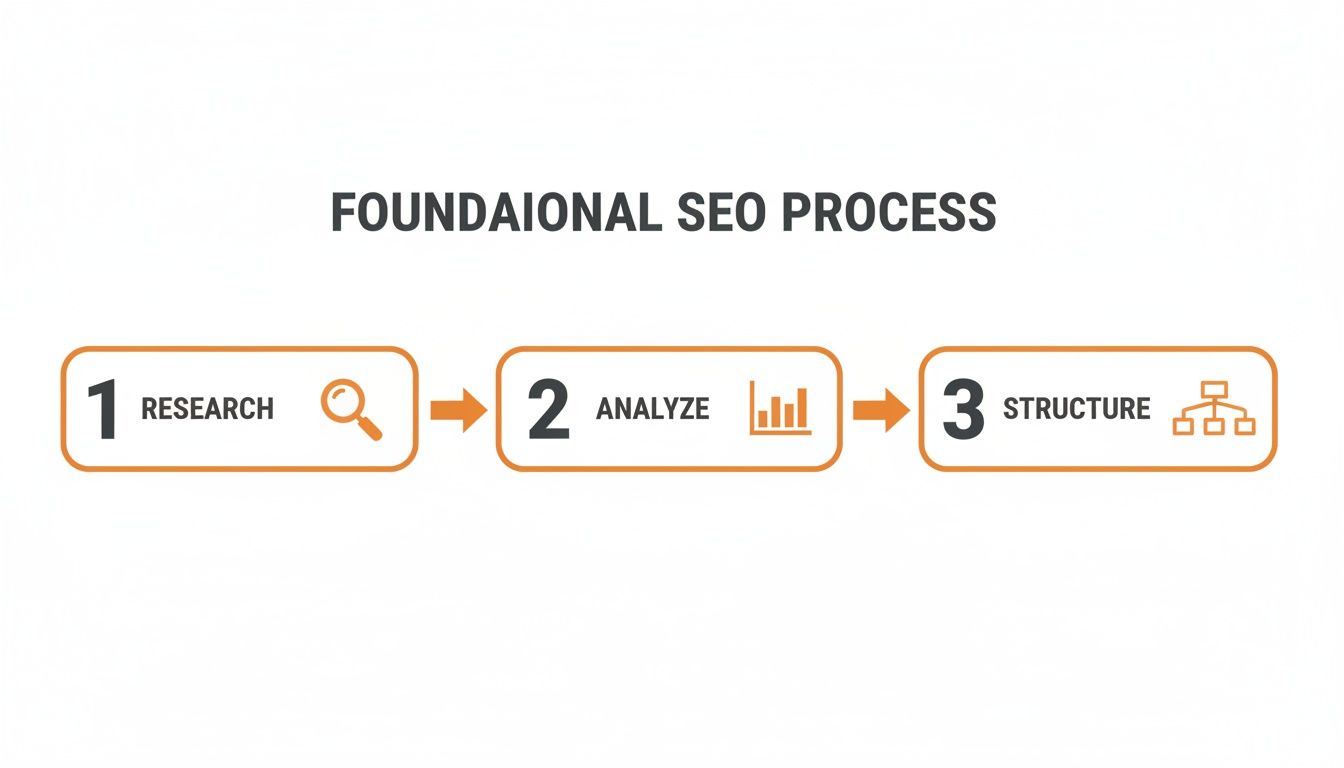
Following a proven process like this ensures your firm's SEO foundation is built to last.
Structuring Your Site for SEO Success
Think of your website's architecture as its skeleton. A clean, logical structure doesn't just help potential clients find what they need; it helps Google understand your site, spread authority, and ultimately rank you higher.
For personal injury firms, this means creating distinct, highly-optimized pages for every core practice area and every geographic location you serve.
A classic mistake is cramming all your services onto a single page. Don't do it. You need dedicated pages like /car-accident-lawyer/ and /medical-malpractice-attorney/. If you have more than one office, each one needs its own page, like /vancouver-office/ and /richmond-office/. This targeted approach makes you far more relevant for specific searches and is absolutely fundamental to effective SEO for personal injury attorney campaigns.
Putting in this effort up front also pays off financially. When you look at the personal injury market, there are huge cost differences between marketing channels. SEO consistently offers the lowest average cost-per-lead, and it's an asset that grows in value over time. While it can take 4-9 months to see significant traction, it’s a sustainable investment compared to the endless, high costs of paid search. You can discover more insights about personal injury cost-per-lead analysis to get a better handle on the long-term ROI.
Mastering Your Hyper-Local Search Presence
While a broad online presence has its place, the real fight in personal injury SEO is won on a much smaller battlefield: the local neighbourhood. When someone’s been in an accident, they aren't looking for a lawyer across the country; their first search is almost always for help "near me." This simple fact makes dominating your hyper-local search results the single most important thing you can do to attract valuable, ready-to-sign clients.
The goal here is to land in Google's coveted "map pack"—that block of three listings paired with a map that shows up right at the top of local search results. Getting into this spot means your firm is one of the very first options a potential client sees, often at the exact moment they need you most.

Google decides who gets these prime spots based on a mix of relevance, distance, and prominence. It's essentially asking: how well does your firm match the search, how close are you to the person searching, and how well-known is your firm online? The foundation for all of this is your Google Business Profile (GBP).
Your Google Business Profile Is Your Local SEO Hub
Stop thinking of your GBP listing as just another online directory entry. It's more like a mini-website hosted directly on Google, and it's often the first—and sometimes only—impression a potential client will have of your firm. An incomplete or neglected profile isn't just a missed opportunity; it’s a signal to Google that your competitors might be a better answer for its users.
A fully optimized profile is non-negotiable. This goes way beyond just listing your firm's name and address.
- Get Your Categories Right: Your primary category must be Personal Injury Attorney. From there, add secondary categories for every specific type of case you handle, like Car Accident Lawyer or Workers Compensation Attorney. This tells Google exactly what you do.
- Define Your Service Area: Don't just list your office address. Clearly define the specific cities, neighbourhoods, and postal codes you serve. This helps you show up in searches even when the user isn't right next door.
- Use Every Feature: Don't let your profile get stale. Regularly upload high-quality photos of your team and office. Use the Q&A feature to answer common client questions before they even have to ask. And make it a habit to create GBP Posts to share case results, firm news, or links to your latest blog articles.
Your GBP profile is the single most powerful local ranking factor you can directly control. Every field should be filled out, every feature used, and all information must be 100% consistent with your website and other online listings.
For a deeper dive into turning this asset into a client-generating machine, our guide on optimizing your Google Business Profile provides advanced tactics you can start using today.
Build Trust with Citations and Reviews
Beyond your own profile, Google scours the web for consistent mentions of your firm to verify that you are a legitimate and prominent local business. These mentions are called citations, and they are simply listings of your firm's Name, Address, and Phone number (NAP) in reputable online directories.
Consistency is everything here. Even a tiny variation like using "St." on one site and "Street" on another can confuse search engines and water down your local authority. You need to be listed in high-authority legal directories (like Avvo and Justia) and major local business platforms (like Yelp and Yellow Pages). A clean, consistent digital footprint proves to Google that you’re a real, established local entity.
But the most powerful signal of all is social proof: your client reviews.
A steady stream of recent, positive reviews is a massive ranking factor and the primary tool potential clients use when deciding who to call from the map pack. A firm with 4.9 stars from 85 reviews will almost always get the call over a competitor with 4.2 stars from 12 reviews. It's just human nature.
Create a System for Earning Reviews
You can't just hope for good reviews; you have to build a process to get them. It needs to be simple, ethical, and something your team can do every single time.
- Time it Right: The absolute best time to ask for a review is right after a successful case resolution when the client is happiest with the outcome.
- Make It Painless: Send a direct link to your GBP review page via email or text message. The fewer clicks it takes, the more likely they are to follow through.
- Manage Your Reputation: Always respond to reviews—both good and bad. Thanking clients for positive feedback shows you appreciate them. Addressing criticism professionally shows potential clients that you value service and are committed to making things right. This active management builds a tremendous amount of trust.
To keep your efforts on track, it helps to prioritize. Not all local SEO tasks carry the same weight.
Local SEO Priority Checklist for Personal Injury Firms
Here’s a breakdown of where to focus your time and energy for the biggest impact on your local visibility and client intake.
| Task | Impact Level | Frequency | Key Action |
|---|---|---|---|
| GBP Profile Optimization | High | Ongoing | Fully complete all sections; add new photos and Q&As quarterly. |
| Review Acquisition | High | Ongoing | Systematize asking for reviews from every satisfied client. |
| Review Response | High | Daily | Respond to all new reviews (positive and negative) within 24-48 hours. |
| Local Citation Building | Medium | Annually | Audit existing citations for NAP consistency; build 5-10 new high-quality citations per year. |
| GBP Posts | Medium | Weekly | Publish at least one GBP Post per week with a link to your content or a call to action. |
| Location-Specific Pages | Medium | As Needed | Create a unique page for each physical office location or major service area. |
| Local Link Building | Low-Medium | Quarterly | Sponsor a local event or charity to earn a link from a local organization's website. |
By focusing on the high-impact, ongoing tasks first—namely your GBP profile and reviews—you build a strong foundation that makes all other local SEO efforts more effective.
Creating Content That Converts Injured Clients
Your site's architecture and local signals lay the groundwork, but it's the content that truly convinces a potential client you're the right firm for their case. In the high-stakes world of personal injury law, your words have to do more than just target keywords. They need to show real empathy, establish authority, and genuinely help people who are going through a traumatic time. This is non-negotiable for any effective SEO for personal injury attorney strategy.

Ultimately, your content has to pull double duty. It must be structured to appeal to search engines, but more critically, it has to connect with an actual person who is hurt, confused, and desperately looking for an expert they can trust.
Building Authoritative Practice Area Pages
Your practice area pages are your digital storefronts. A generic "Our Services" page with a simple list of "car accidents, slip and falls, medical malpractice" is a massive missed opportunity. Don't do it. Every single service you offer deserves its own comprehensive, deeply informative page that stands as the go-to resource on that topic.
Put yourself in the client's shoes. Someone who just took a nasty fall on a wet floor in a grocery store isn't looking for a generalist lawyer. They're searching for a specialist in slip and fall cases. Your page has to prove you're that specialist.
A truly powerful practice area page needs to include:
- A clear explanation of the case type: Break down what legally constitutes a "slip and fall" or "medical malpractice" case in plain, accessible language.
- Common causes and real-world scenarios: Get specific. Talk about icy sidewalks, poorly maintained flooring, or surgical errors. This lets potential clients see their own situation reflected in your work.
- Local statutes and critical deadlines: Explain the statute of limitations for that case type right here in your jurisdiction (e.g., British Columbia). This adds immediate value.
- What to do right now: Give them actionable steps to take immediately after an incident to protect their rights.
- Potential compensation: Discuss the kinds of damages they might be able to recover, from medical bills and lost wages to pain and suffering.
- Proof of your firm's experience: This is huge. Add anonymized case studies or testimonials directly related to that practice area to build undeniable social proof.
Following this blueprint turns a basic service page into an authoritative guide that anticipates and answers a client's every question. It builds incredible trust and sends strong signals to Google that your site is a top-tier authority on that legal subject.
The Hub and Spoke Model for Your Blog
While practice area pages are the pillars, your blog is where you build true topical authority and capture a much wider net of search traffic. Just writing random articles here and there is a waste of time. The single most effective strategy I've seen is the "hub and spoke" model.
Think of your main "Car Accidents" practice area page as the "hub." All your blog content then becomes the "spokes"—a series of in-depth articles that all link back to and support that central hub page.
The hub and spoke model creates a logical content structure that both users and search engines can easily understand. It funnels authority to your most important pages, giving them a significant boost in ranking potential.
This framework is perfect for targeting long-tail keywords and answering the very specific, nuanced questions people are actually typing into Google. For instance, your "Car Accidents" hub could be supported by spoke articles like:
- "What to Do Immediately After a Car Accident in BC"
- "A Step-by-Step Guide to Navigating ICBC Claims"
- "Common Injuries Sustained in Rear-End Collisions"
- "Determining Fault in a Multi-Car Pileup in Vancouver"
Every one of these spoke articles must link back to your main car accident hub page. This internal linking is crucial. It tells Google that your hub page is the definitive resource on the topic, channelling ranking power to the page you want to rank most. When you write with this model in mind, you can apply smart SEO copywriting tips that naturally guide both people and search engine crawlers through your expertise.
This isn't just about organizing posts. It's about building a powerful, interconnected library of resources that cements your firm as the undeniable authority in your field, turning informed readers into qualified leads.
Fine-Tuning Your Technical and Mobile SEO
Beyond the content you write and the local listings you claim, the raw mechanics of your website play a massive role in whether you rank at all. This is the world of technical SEO—the behind-the-scenes work that makes sure search engines can actually crawl, understand, and index your firm's site.
Let's be clear: this part is non-negotiable. You can have the most persuasive, well-written content on the web, but it’s completely useless if Google can’t find it or has a hard time processing it.
Think of your website like a high-performance vehicle. Your content is the powerful engine, but your technical setup is the finely tuned chassis, transmission, and aerodynamics. Without a solid foundation, that engine can’t deliver its full power, and you’ll get left in the dust by competitors whose sites just work better. This process boils down to a few critical areas, from site speed and security to the structured data that helps Google make sense of who you are.
Prioritizing a Mobile-First Experience
Picture this: someone has just been in a car wreck. Their first move isn't to go home and fire up their desktop to research lawyers. They're pulling out their smartphone right there on the side of the road or in a hospital waiting room, searching for immediate help. That single moment has completely reshaped legal marketing.
In California, for instance, we’ve seen a massive shift. As of 2026, roughly 70% of all legal service searches now happen on mobile devices. It gets even more specific for your practice area—data shows that a staggering 75% of personal injury searches occur on mobile. You can read more about the rise of mobile search for legal services in California.
This means your website absolutely must load quickly and be a breeze to navigate on a small screen. And I'm not just talking about a "responsive" site that simply shrinks to fit. A genuine mobile-first experience means:
- Lightning-Fast Load Times: Every second you make a potential client wait is a second they're considering calling your competitor instead.
- Click-to-Call Buttons: Don't make them hunt for your number. It should be a prominent, tappable button that’s always visible.
- Thumb-Friendly Navigation: Are your menu items and buttons big enough to be easily tapped without zooming in? They need to be.
- Simple Forms: Nobody wants to fill out a 15-field form on a tiny keyboard. Keep your contact forms short, sweet, and to the point.
If you want to dig deeper, our guide on understanding mobile optimization best practices breaks down exactly what you need for a high-performing mobile site.
Using Schema Markup to Speak Google's Language
Ever wonder how some search results show star ratings or other cool features right on the results page? That’s often the work of Schema markup. It’s a special kind of code you add to your website to give search engines more context about your content.
Think of it like adding labels to your information, telling Google things like, "Hey, this is our law firm's name," "This is our address," and "These are our client reviews."
For any personal injury firm, two types of Schema are absolutely critical:
- Attorney Schema: This markup specifically identifies the lawyers at your firm, outlining their specializations, bar admissions, and other qualifications. It signals expertise.
- LocalBusiness Schema: This reinforces your firm’s physical location, hours, phone number, and other key details. It’s a powerful signal for your local SEO efforts.
By implementing Schema correctly, you stand a much better chance of earning "rich snippets" in search results—those eye-catching listings with star ratings or FAQs. These snippets don't just look good; they significantly boost click-through rates, funnelling more qualified traffic straight to your site.
Core Technical SEO Checklist
While technical SEO can feel overwhelming, a few foundational elements are must-haves for every law firm's website. Have a frank conversation with your web developer to ensure these are buttoned up.
| Technical Element | Why It Matters | Key Action |
|---|---|---|
| HTTPS Security | Builds trust with potential clients and is a confirmed (though minor) ranking signal. Browsers like Chrome will actively flag non-secure sites. | Ensure your entire site runs on an SSL certificate (you'll see https:// in the URL). |
| Core Web Vitals | These are Google's own metrics for user experience, measuring load speed, interactivity, and visual stability. They are a direct ranking factor. | Use Google PageSpeed Insights to test your pages and tackle the performance issues it identifies. |
| Logical Internal Linking | Spreads authority (or "link equity") through your site, guiding both users and search engines from your blog posts to your key practice area pages. | Whenever you write a blog post, look for opportunities to link back to your main service pages using descriptive anchor text (e.g., "our car accident lawyers"). |
| Clean XML Sitemap | This is literally a roadmap of your website that you hand directly to Google, ensuring its crawlers don't miss any of your important pages. | Generate an XML sitemap (most modern websites do this automatically) and submit it to Google Search Console. |
Getting these technical details right creates a stable, secure, and user-friendly platform. It's the essential groundwork that allows your brilliant content and local SEO strategies to truly shine and connect you with the clients who need your help the most.
Forging Authority with Ethical Link Building
If your content and technical SEO are the engine, then backlinks are the high-octane fuel that makes it roar. In the dog-eat-dog world of legal marketing, backlinks—links pointing to your site from other websites—are powerful endorsements. Google sees every quality link as a vote of confidence, a signal that your firm is a credible, authoritative voice.
Let's be clear: the old days of buying a bunch of spammy links from sketchy directories are long gone. Those tactics aren't just useless now; they're a fast track to a Google penalty that can make your website disappear from search results entirely. The game today is about earning high-quality, relevant links that build your firm's reputation and drive not just rankings, but actual client referrals.
This is a long-term play, no doubt about it. But it's also one of the most durable competitive advantages you can build.
Create Legal Resources People Actually Want to Link To
The most sustainable way to attract backlinks is to create something so valuable that other websites can't help but reference it. Instead of begging for links, you give them a compelling reason to link to you on their own. This approach shifts your position from a simple service provider to a genuine thought leader.
Think about creating real assets, not just blog posts. For example:
- Local Accident Data Reports: Dig into public data and create a report on the most dangerous intersections in your city or region. You can even visualize it with a map. Local news outlets, community bloggers, and safety advocates are always hungry for this kind of specific, localized information.
- Definitive Legal Guides: Go deep on a complex topic. Imagine a comprehensive, plain-English guide like "A Complete Guide to Navigating the ICBC Claim Process in British Columbia." Other legal blogs, resource sites, and even lawyers in different practice areas might point to it as the go-to resource.
- Scholarship Programs: This is a classic for a reason. Launching a small, annual scholarship for local students heading into law is a fantastic way to earn links. University and college websites often have dedicated pages listing scholarship opportunities, and those .edu links carry a lot of weight with Google.
A single, high-value resource that naturally attracts dozens of quality links over many years is worth more than months spent chasing one-off guest posts. You're building an asset, not just a link.
Turn Community Engagement into Digital Authority
Your firm is part of a real-world community, not just a digital one. Your offline activities can be a goldmine for generating powerful, locally relevant backlinks that search engines love. This strategy reinforces your local expertise and proves you're a trusted fixture in the community.
Start thinking about how your community involvement can translate into online authority.
- Sponsor a Local Event: Getting behind a local charity fun run, a kids' sports team, or a community festival almost always gets you a link from the event organizer's website. These are the kinds of hyper-relevant local links that scream "local authority" to Google.
- Host a Free Legal Workshop: Why not partner with a local library or community centre? You could host a free seminar on "Understanding Your Rights After a Workplace Injury." The host organization will promote the event online and link back to your site as the expert source.
- Join the Local Chamber of Commerce: This is an easy win. Most chambers of commerce feature an online member directory, which includes a link back to your firm’s website. It’s both an authoritative local citation and a quality backlink.
Master the Art of Digital PR and Outreach
Simply creating great content isn't enough; you have to let the right people know it exists. Digital PR is the proactive process of promoting your firm and its content to journalists, bloggers, and publications to earn media coverage and the links that come with it.
When you create one of those link-worthy resources we talked about, don't just publish it and hope for the best. For that report on dangerous intersections, for instance, you'd build a targeted list of local news reporters who cover traffic and safety. Then, you'd send them a personal email highlighting your most surprising findings.
The secret to successful outreach is providing genuine value. Never just ask for a link. Offer them a unique story, a compelling piece of data, or an expert quote that makes their job easier and their article better. When you get this right, a single Digital PR push can land you links from major news sites you could never get any other way.
Answering Your Personal Injury SEO Questions
It's completely understandable to have a lot of questions before diving into SEO for your personal injury firm. It's a big investment of time and money, and you need to know what you're getting into. Let's tackle some of the most common questions we hear from lawyers who are just starting to think seriously about their online presence.
How Long Does SEO Take to Work for a Law Firm?
This is the big one, and the honest answer is: it's a marathon, not a sprint. SEO is all about building a long-term, sustainable asset for your firm, not getting a quick hit of traffic that disappears when you stop paying.
In a moderately competitive city, you can realistically expect to see some meaningful movement and a real increase in qualified leads within 6 to 9 months. But if you're in a major, hyper-competitive market like Vancouver or Toronto, you're looking at a longer timeline—closer to 12 to 18 months to really crack the top rankings for those high-value "car accident lawyer" type keywords.
The key is consistency. Unlike a PPC ad, every piece of content you create and every link you earn builds on itself, compounding over time.
Is Local SEO or Content SEO More Important?
I get this question a lot, and it's a bit of a false choice. They're two parts of a whole, but if I had to pick one to start with, local SEO is your absolute day-one priority.
Think about it: your best potential clients are in a moment of distress, searching on their phone for "personal injury lawyer near me." Winning the Google Map Pack is everything. That means your Google Business Profile has to be perfect, your local citations need to be consistent everywhere, and your client reviews need to be stellar. This is how you capture people who need help right now.
Your broader content SEO—the detailed practice area pages and helpful blog posts—is what supports that local foundation. It proves your expertise, answers client questions before they even ask them, and builds the kind of authority that makes Google see you as the go-to expert in your city.
A winning strategy weaves them together seamlessly. Use local SEO to win the immediate, high-intent searches. Use content SEO to build the long-term topical authority that cements you as the undeniable expert in your practice area.
Can I Do My Law Firm SEO Myself?
Technically, yes, you can handle some of the basics yourself. But the reality is that personal injury law is one of the most cutthroat online battlegrounds there is. We're talking about a space where your competitors are investing heavily and have been for years.
Effective SEO today is a full-time job that requires a ton of specialized knowledge in technical site health, sophisticated keyword analysis, high-level content strategy, and ethical link building. Most successful firms find it's far more effective to partner with a specialized agency that lives and breathes legal marketing.
This kind of partnership lets you focus on what you're best at—winning cases for your clients—while your agency handles the complex, relentless work needed to get you to the top of the search results and keep you there.
What Are the Biggest SEO Mistakes to Avoid?
Over the years, I've seen a few common mistakes that can really kneecap a firm's marketing efforts, even when they have the best intentions. If you can sidestep these, you’re already ahead of many of your competitors.
- Targeting keywords that are way too broad. Going after a term like "personal injury lawyer" without a city attached is like shouting into the wind. It's almost impossible to rank for and the traffic you do get is rarely relevant.
- Forgetting about mobile users. This is a huge one. Most of your potential clients are looking you up on their phone, often right after an accident. If your site is slow or a pain to navigate on a mobile device, you're losing leads. Period.
- Letting your website go stale. A website that hasn't been updated in months (or years) sends a bad signal to Google. You need to consistently publish valuable, client-focused content to show you're an active authority in your field.
At Juiced Digital, we specialize in turning these complexities into a clear roadmap for growth. Our team builds data-driven SEO strategies that help personal injury firms dominate their local markets and attract the cases they want most. To see how we can build a sustainable lead-generation engine for your firm, book a free consultation with our experts today.