
Think of your SEO strategy as your company's digital sales centre. It's the first stop for high-intent buyers typing queries like "new homes in Calgary" or "custom builder near me" into Google. This isn't just another marketing channel; it's a core business strategy that builds a predictable, cost-effective pipeline of qualified leads, freeing you from endless ad spend.
Why SEO Is Your Most Valuable Lot
Let's cut to the chase: your website is just as important as your show home. The modern homebuyer’s journey almost always starts online, well before they ever think about speaking to a sales agent. They’re not just window shopping—they're doing serious research, comparing builders, and creating shortlists based entirely on what they find in search results.
If your new development or custom home business doesn’t show up for these critical local searches, you’re essentially invisible to a huge chunk of your market. This is where a rock-solid SEO foundation becomes the blueprint for your company's growth.

Connecting with Buyers at the Perfect Moment
A smart SEO plan puts you directly in front of prospects right when they need you most. Unlike old-school ads that interrupt people, good SEO provides answers and solutions. When someone searches for "laneway homes in Vancouver," they have a specific, urgent need. Ranking at the top for that search allows you to meet that need instantly, which dramatically boosts your chances of turning a searcher into a lead.
This initial connection builds trust right from the first click. You're not just another ad—you're the helpful, authoritative resource they were looking for. The advantages are obvious:
- Be Seen: Get found for the high-value keywords your future customers are using every single day.
- Better Leads: Attract buyers who are actively looking to build or purchase a new home right now.
- Build Trust: A strong search presence establishes your brand as a credible leader in your local market.
- Long-Term Growth: Generate a steady stream of organic traffic and leads that doesn't disappear when you turn off your ad budget.
The Investment in Local Dominance
Smart builders are already making this shift. Over in California, smaller homebuilding companies are doubling down on SEO, with 65% already working with agencies to capture their share of the 53.3% of website traffic that comes from organic search. But there's a catch: builders who only budget around $500 per month report a 75% dissatisfaction rate. This just goes to show that a realistic investment is needed to get the expertise that actually drives results. You can dig into more SEO spending statistics to see the trends.
SEO is the digital equivalent of securing the best lot in a new development. It gives you the premier location, the highest visibility, and the greatest opportunity to attract the right buyers. Neglecting it means building a beautiful model home on a dead-end street.
Building a Website That Sells Homes
Your website is your digital sales centre. For nearly every potential buyer, it's the very first impression they'll have of your brand and your homes. Its structure isn't just a design choice—it's a critical SEO signal that tells Google what you build, where you build it, and why you’re the best choice in the neighbourhood. A well-built site guides both users and search engines logically from a broad interest right down to a specific home.
Think of your website's architecture like a master-planned community. The homepage is the main entrance, establishing your brand and showing your general service area. From there, clear roads lead to distinct communities, and within each of those, visitors can explore specific model homes and floor plans.
This organized approach, often called content siloing, is the bedrock of good SEO for homebuilders. It works because it groups related content together, creating a clear topical authority that search engines love. When a potential buyer searches for "new homes in Oakridge Estates," a dedicated, in-depth page for that community will always have a much better chance of ranking than a generic page that just lists all your projects.
Laying the Foundation with Your Core Pages
The foundation of your entire site rests on a clear hierarchy of pages, with each one optimized for a specific purpose. This isn't just about organizing your content; it’s about perfectly matching your site's layout to the homebuyer's journey.
Your primary pages should be structured in a logical flow:
- Community Pages: These are the heart and soul of your local SEO. Every community you're actively building absolutely needs its own dedicated landing page. This is where you'll target keywords like "new construction homes in [Community Name]" or "[Community Name] homes for sale."
- Floor Plan Pages: Nestled directly under their respective community pages, each floor plan also gets its own unique page. This lets you target specific, long-tail keywords like "[Plan Name] model in [City]" or "four-bedroom new home [Community Name]."
- Service Area Pages: Are you a custom builder operating across multiple cities or neighbourhoods? Create specific pages for each one. A page titled "Custom Home Builder in North Vancouver" will capture far more qualified traffic than a single, generic "Services" page ever could.
This structure creates clean, easy-to-follow pathways for Google's crawlers. More importantly, it provides an intuitive experience for your visitors, letting them find exactly what they're looking for without getting frustrated or lost.
A disorganized website is like a sales office with no signage. Buyers will walk in, get confused, and leave. A logical site structure acts as your digital concierge, effortlessly guiding prospects to the information that will turn them into a lead.
Nailing Your On-Page SEO for Maximum Impact
With your structure firmly in place, it's time to optimize the on-page elements of each core page. This is where you tell Google precisely what each page is about. Every element—from the title to the alt text on an image—is an opportunity to reinforce your target keywords and location.
Let's get tactical and focus on these key on-page optimizations:
- Title Tags: Every page needs a unique, compelling title tag. For a community page, it should be something like:
Oakridge Estates | New Single-Family Homes in Calgary. - Meta Descriptions: Think of this as the ad copy for your search result. Write a short, persuasive summary of the page's content to entice clicks. While it doesn't directly impact rankings, it has a massive influence on your click-through rates.
- Headings (H1, H2, H3): Use your primary keyword in the main H1 heading and use related terms in subheadings (H2s, H3s) to break up your content and create a logical flow.
- Image Alt Text: Don't neglect this! Describe your images for visually impaired users and for search engines. Instead of naming a file "house1.jpg," use descriptive alt text like, "The Ashton floor plan exterior at our Riverside community."
- URL Structure: Keep your URLs clean, short, and descriptive. A URL like
yourbrand.com/communities/riverside-vancouveris infinitely better for both users and SEO thanyourbrand.com/page-id=123.
Finally, don't forget the technical basics. A slow-loading page will send potential buyers clicking away in frustration. Having a fast, mobile-responsive website is completely non-negotiable for user experience. You can go deeper by optimizing website speed for better performance and keeping those potential buyers on your site.
Stand Out in Search with Schema Markup
If you really want an edge in crowded search results, you need to speak Google’s language directly. That’s where Schema markup (also called structured data) comes in. It’s a code vocabulary you add to your website to help search engines understand your content on a much deeper level.
For homebuilders, this is a genuine game-changer. By implementing specific schema types, you can unlock "rich snippets" in search results—those eye-catching listings that show price ranges, availability, and other key details right on the Google results page. This grabs a searcher's attention, gives you more digital real estate, and instantly answers their most pressing questions.
Here’s a quick rundown of the most important schema types to get started with.
Essential Schema Markup for Homebuilder Websites
| Schema Type | Purpose | Where to Implement |
|---|---|---|
| RealEstateListing | Describes a specific property for sale, enabling rich snippets for price, availability, and property details. | On individual Floor Plan or Quick Move-In Home pages. |
| Residence | Details the features of a dwelling, such as the number of rooms, square footage, and floor plan specifics. | On Floor Plan pages to complement the listing schema. |
| Offer | Specifies the price, price currency, and availability of the home listing. | Used within the RealEstateListing schema on home pages. |
| LocalBusiness | Provides Google with your business name, address, phone number, and hours. Crucial for local map pack rankings. | On your main Contact page and in the website footer. |
| Subdivision | Defines a housing development or community, including its location and the properties within it. | On your main Community landing pages. |
Implementing these on your community and floor plan pages is one of the fastest ways to turn a standard search listing into a powerful sales tool, all before the user even clicks through to your site.
Winning the Local Search Battleground
For a homebuilder, nearly every lead comes from your own backyard. Your clients aren't searching for a builder three provinces over; they’re looking for an expert in their city, their suburb, and often a very specific neighbourhood. This is why mastering local search isn't just part of your SEO strategy—it's the whole game.
Your most powerful weapon in this fight is your Google Business Profile (GBP). Think of it as your digital storefront. When someone searches "custom home builder near me," the businesses in that coveted "map pack" at the top of the results get almost all the attention. A fully optimized GBP is your ticket to that prime real estate.
Mastering Your Google Business Profile
An incomplete or neglected GBP is a huge missed opportunity. You have to treat it like an active marketing channel, not some static listing you set up once and forget about. The goal is to fill out every single section with accurate, compelling information that speaks directly to homebuyers.
Here's how to turn your profile into a lead-generating machine:
- Nail Your Categories: Your primary category must be "Home builder." But don't stop there. Add secondary categories like "Custom home builder," "Real estate developer," or "Construction company" to show up in a wider range of relevant searches.
- Get Creative with the Products Feature: Don't just list "homes." Use this feature to spotlight each of your developments or even individual floor plans. For each one, add great photos, a price range, a detailed description, and a direct link to that community's page on your website.
- Use GBP Posts Consistently: This is essentially a mini-blog right on your Google profile. Post weekly updates about construction progress, announce new quick move-in homes, or highlight a "floor plan of the week." Every post you make sends a positive signal to Google that your business is active and relevant.
I've seen firsthand how much this matters. A builder I worked with in a competitive market saw a 21% increase in local search impressions after just three months of consistent GBP updates—that means new photos, weekly posts, and answering questions in the Q&A section. It works.
The Power of Local Reviews and Citations
Trust is everything when someone is about to make the biggest purchase of their life. Your online reputation, built mainly through customer reviews, is a massive ranking factor and an even bigger conversion tool. A steady stream of recent, positive reviews on your GBP tells both Google and potential buyers that you deliver quality work.
Make asking for reviews a standard part of your closing process. The best time to ask is right after a positive milestone, like the final walkthrough or when you hand over the keys. Send a simple, direct link to your GBP review page to make it dead simple for happy clients to leave feedback.
Beyond reviews, you need to build local citations. A citation is just a mention of your business's name, address, and phone number (NAP) on another website, like Houzz, Yelp, or your local chamber of commerce directory.
Google sees these citations as votes of confidence from the local community. The more consistent and authoritative your citations are, the more Google trusts that you’re a legitimate, active local business.
Consistency here is non-negotiable. Your business name, address, and phone number must be identical everywhere. Even a small variation can confuse search engines and weaken your local authority. To really get into the weeds on this, check out our guide on optimizing Google My Business for local success.
Creating Geo-Targeted Landing Pages
The final piece of your local SEO puzzle is building dedicated pages on your website for the specific areas you serve. This is how you capture those high-value, "near me" searches with surgical precision. If you build in multiple cities or even distinct neighbourhoods, each one deserves its own landing page.
A page titled "Custom Home Builder in North Vancouver," for example, will always outperform a generic "Our Service Areas" page. This targeted page should be packed with:
- Content that speaks directly to that community.
- Testimonials from clients who live there.
- Photos of your completed projects in that neighbourhood.
- Details about local amenities, schools, and the lifestyle.
This approach creates a clear site structure that both users and Google can easily understand. This diagram shows how a simple, hierarchical site architecture can be incredibly powerful.
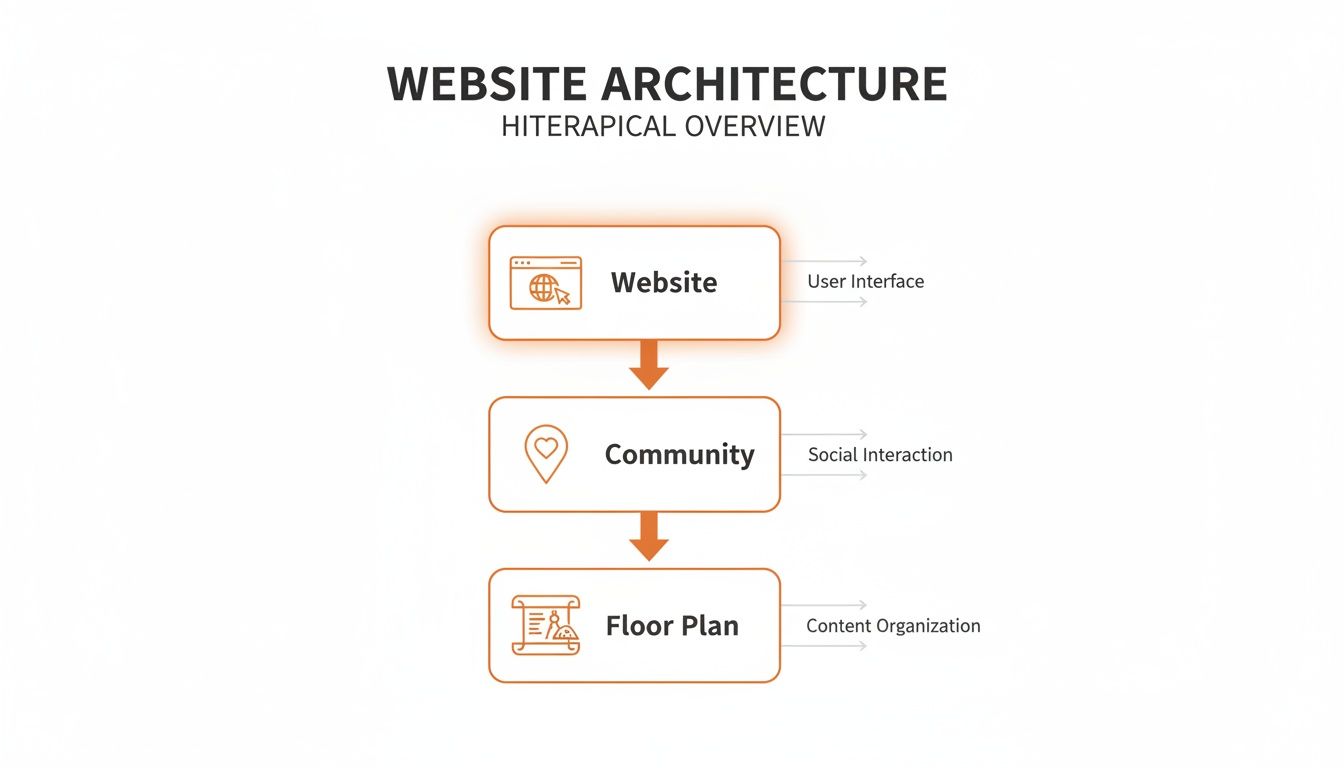
This structure ensures that every community and floor plan gets its own dedicated, optimized page, which maximizes its chances of ranking for those hyper-local searches. When you combine a powerful GBP, a stellar reputation, and geo-targeted website content, you create an unstoppable local SEO presence that puts you right in front of buyers the moment they're ready to build.
Creating Content That Builds Buyer Trust
Good SEO gets potential buyers to your website. But it's your content that convinces them to stay, trust you, and pick up the phone. A home is the single biggest purchase most people will ever make, and that decision is built entirely on a foundation of confidence. Your content strategy is how you build that confidence, piece by piece.

For homebuilders, effective content does more than just describe a product. It needs to sell a vision, answer those deep-seated questions buyers have, and position your company as a knowledgeable, reliable partner in their journey. The goal is to move past simple listings and create a resource hub that supports buyers at every single stage.
This really boils down to three core content types: project showcases that inspire, neighbourhood guides that inform, and blog posts that educate.
Showcase Your Work With Immersive Project Pages
Think of your community and floor plan pages as your digital show homes. They can't just list square footage and bedroom counts; they have to forge an emotional connection and let a buyer truly picture themselves living there. A flat, text-heavy page will send a visitor packing in seconds.
To make these pages actually work for you, they need to be rich, visual, and dead simple to explore. They are your digital sales kit, offering everything a prospect needs before they're ready to take that next step.
Your project pages absolutely must include:
- A High-Quality Photo Gallery: This is non-negotiable. Invest in professional photography that shows off finished homes, key architectural details, and lifestyle shots of the community.
- Immersive Virtual Tours: Tools like Matterport allow buyers to "walk through" a model home from their couch. It's a hugely powerful engagement tool that keeps people on your site much longer.
- Detailed Specifications and Floor Plans: Provide clear, downloadable floor plans. List all the key features, finishes, and available upgrades in a clean, scannable format.
These pages are perfect for targeting those specific, high-intent keywords like "new homes in the Uplands community" or "The Cambridge model home by [Your Brand]." Every detail helps you rank for the exact terms motivated buyers are typing into Google.
Become the Local Expert With Neighbourhood Guides
Let's be honest—buyers aren't just purchasing a house; they're choosing a community and a lifestyle. By creating in-depth neighbourhood guides, you position your brand as the true local expert, not just another builder. This is a brilliant strategy in SEO for homebuilders because it catches buyers much, much earlier in their research.
People search for things like "best family neighbourhoods in Kelowna" or "top schools in North Vancouver" long before they even think about looking at specific builders. A comprehensive guide that ranks for these terms puts your brand on their radar from day one.
Your goal is to become the go-to resource for anyone considering a move to your area. When you provide immense value upfront, you build trust that pays off when it’s time for them to choose a builder.
Your neighbourhood guides should be a one-stop shop for community info:
- School Information: Detail the local school districts, including ratings and unique programs.
- Amenities and Lifestyle: Talk about nearby parks, restaurants, shopping centres, and community events.
- Commute Times: Provide realistic commute times to major employment hubs in the area.
- Real Estate Insights: Discuss the character of the neighbourhood and local market trends.
Creating this kind of genuinely helpful content attracts a broad audience and builds powerful topical authority around your service areas, which is exactly what Google loves to see.
Answer Their Questions With an Authoritative Blog
Finally, a strategic blog is your tool for answering the countless questions that pop into a homebuyer’s head. This is where you can address their concerns, explain complex processes, and really demonstrate your expertise on a deeper level. Remember, every question is a keyword opportunity.
Think about the most common questions your sales team gets day in and day out, and turn those answers into detailed blog posts. This tactic establishes your authority and generates leads from people who are just starting to think about building a new home.
Consider posts on topics like:
- The Custom Home Building Process from Start to Finish
- Key Differences Between a Spec Home and a Custom Build
- How to Secure Financing for a New Construction Home
- Energy-Efficient Features to Look for in a New Home
These posts attract organic traffic from long-tail keywords, build a library of valuable content you can share across social media, and prove that you understand the buyer’s journey inside and out.
Building Authority and Managing Your Reputation
What happens off your website is often just as important as what’s on it. Off-page SEO—which really boils down to link building and reputation management—is how you show Google that you’re a legitimate, authoritative voice in the local building community.
Think of it like this: a strong backlink profile is your digital referral network, and a stellar collection of reviews is your word-of-mouth reputation. Both are absolutely critical for landing high-value projects, and they work hand-in-hand to build trust with both search engines and potential homebuyers.
Earning High-Value Local Backlinks
Forget about chasing hundreds of random links. For a homebuilder, the goal is quality over quantity, always. We're talking about earning mentions from relevant, local websites.
Each backlink is a vote of confidence. A link from a prominent local real estate blogger or a design publication carries infinitely more weight than a random directory listing.
The best strategy is to immerse yourself in your local ecosystem. Build real relationships, and the links will follow.
Here are a few tactics I've seen work time and again:
- Local Influencer Partnerships: Connect with established real estate agents or lifestyle bloggers in your area. Offer them an exclusive hard-hat tour of a new development. A feature on their blog is a powerful local signal.
- Supplier and Trade Features: Your suppliers, trades, and subcontractors often have their own blogs or partner pages. It's a natural fit. Ask to be featured in a case study or testimonial—just make sure they link back to your site.
- Community Event Sponsorship: Sponsoring a local charity fun run or a community festival almost always gets you a link from the event's website. These are highly trusted local domains.
- Industry Association Memberships: Don't just join your local Home Builders Association—make sure your profile is completely filled out and points directly back to your website.
These aren't one-off tasks. They're about building a durable web of local authority that insulates your brand and consistently signals your relevance to Google.
Systematizing Your Review and Reputation Management
In this market, your online reputation is one of your most powerful sales assets. Simply doing great work and hoping for good reviews isn't a strategy. You need a proactive system to generate a steady stream of fresh, positive feedback on the platforms that matter, like Google and Houzz. This is a non-negotiable part of modern SEO for homebuilders.
For builders, especially in competitive markets like California, Google is paying more attention to review signals like volume and recency. I've seen a service professional’s rankings completely rebound after they got just ten new reviews following a long dry spell. Freshness signals trust.
A single negative review can turn away countless leads. On the flip side, a page full of recent, glowing five-star reviews can be the one thing that convinces a buyer to choose you over a competitor.
Building a powerful reputation means making it incredibly easy for happy clients to share their experience. A key part of this is understanding online reputation management and knowing how to respond to feedback, both good and bad.
The trick is to ask for a review when client satisfaction is at its peak. Turn it into a repeatable process.
Here are the perfect moments to make the ask:
- After the Design Phase: A client has just signed off on the plans for their dream home. They’re excited and invested. This is an ideal time to ask for feedback on the design experience.
- During a Major Milestone: The framing is up, and they can finally see their vision taking shape. A quick check-in call followed by a review request can capture that positive momentum.
- At the Final Walkthrough: This is the emotional high point. As you hand over the keys, also hand them a simple card (or send a follow-up email) with a direct link to leave a review on your Google Business Profile.
When you systematize review generation, you ensure your online reputation is an accurate, up-to-date reflection of your quality work. That social proof is precisely what you need to attract your next great client.
Common SEO Questions from Homebuilders
Stepping into the world of digital marketing can feel like trying to read a new set of blueprints. You know how to build a great home, but figuring out how to get that expertise to show up on Google brings up some very real questions. We get it. Here are the most common things we hear from builders just like you, with straightforward answers to help you invest with confidence.
How Long Until I Actually See Leads from SEO?
This is always the first question, and the honest answer is that SEO is a long-term play, not an overnight fix. Think of it like pouring a foundation. You have to do the groundwork properly before you can even think about framing the walls.
You’ll often see some early wins within 3 to 4 months, especially in your local map rankings. This initial traction usually comes from getting your Google Business Profile dialled in and fixing any technical hiccups on your website.
But for the big, competitive keywords that drive serious business—like "custom homes Calgary"—you're looking at a 6 to 12-month journey of consistent effort. The timeline really depends on how competitive your market is, where your website is starting from, and how committed you are to creating content and building links. The right way to see it is as building a valuable asset that pays you back for years, not a short-term ad campaign.
Should I Focus on My Company Brand or My Individual Developments?
The best strategy isn't choosing one over the other; it’s about doing both at the same time. A hybrid approach lets you capture homebuyers at every stage of their search, whether they're just starting to look or are ready to buy in a specific neighbourhood.
Here’s how we break it down:
-
Your Main Brand Website (
YourBuilderName.ca): This is your home base. It's where you build overall authority and trust. We optimize this site for broader searches like "homebuilder in British Columbia" or "luxury home builder Vancouver." This is how you catch people in the early research phase. -
Specific Development Landing Pages (
YourBuilderName.ca/communities/oakwood-estates): These are your money pages, laser-focused on local searches. Each one is intensely optimized for keywords like "new homes in Oakwood Estates" or "townhomes for sale in Kelowna." This strategy intercepts buyers with high intent who know exactly where they want to live.
By building up your main brand, you create a rising tide that lifts all your development pages. The authority flows from your primary domain down to these community pages, helping them rank faster and higher.
What's a Realistic SEO Budget for a Homebuilder?
It's tempting to shop for the lowest price, but with SEO, you absolutely get what you pay for. In our experience, any budget under $500 per month is a recipe for disappointment. It simply doesn't cover the time, tools, and expertise needed to make a real impact.
A realistic and effective starting point for a small to medium-sized builder is somewhere in the $1,500 to $5,000 per month range. This level of investment allows for a comprehensive strategy covering technical SEO, consistent content creation, active Google Business Profile management, and strategic link building.
At that point, SEO stops being just another marketing expense and starts becoming a predictable engine for generating qualified leads and growing your business.
How Do I Know If My SEO Is Actually Working?
Measuring your return on investment is about more than just watching your website traffic go up. The real goal is to connect your SEO efforts directly to sales opportunities. To do that, you need to track the right Key Performance Indicators (KPIs).
Focus on these core metrics to see the full picture:
- Growth in Qualified Leads: This is the big one. Using call tracking and setting up goals in Google Analytics, you can see exactly how many form fills and phone calls are coming from organic search.
- Improved Keyword Rankings: Are you climbing the ladder for high-intent local searches like "quick move-in homes [Your City]"? We monitor these closely.
- Increased Organic Traffic: You should see a steady climb in visitors landing on your most important pages—your development pages, floor plans, and contact form.
- More Branded Searches: When you see a rise in people searching for your company name, it's a fantastic sign that your brand awareness and authority are growing in the market.
By setting up proper conversion tracking from day one, you can assign a real dollar value to each lead and calculate your SEO ROI with genuine clarity.
Ready to turn your website into your most effective sales tool? The expert team at Juiced Digital designs data-driven SEO strategies that help homebuilders dominate their local markets and build a predictable pipeline of qualified leads. Schedule your free consultation today!