

The real purpose of marketing, its core objective, is to set specific, measurable goals that steer everything you do. It’s the difference between just “doing marketing” and strategically growing your business. These objectives are your finish line—they tell you exactly what success will look like, whether that’s boosting brand awareness, getting more leads, closing sales, or keeping customers coming back.
What Are the Core Objectives of Marketing
Imagine trying to build a business without clear marketing objectives. It’s like setting sail without a compass or a map. Sure, you’re moving and burning through fuel, but you have no real direction and no idea if you’re getting closer to your destination. Clear objectives are the bedrock of any solid campaign, transforming random tasks into a focused, powerful engine for growth.
These goals aren’t just fuzzy concepts; they are tangible targets that get your team on the same page, justify your budget, and let you actually measure what’s working. They provide the “why” behind every blog post, ad campaign, and social media update. Without them, you’re just making noise, hoping something sticks.
The Foundation of Strategic Planning
When you sit down to set clear objectives, you’re forced to shift from a reactive mode to a proactive one. Instead of jumping on every new trend, you start with the end goal in mind and work backward to map out the smartest way to get there. This disciplined approach ensures you put your resources where they’ll have the most impact.
Think about it: a company wanting to grab more market share will use entirely different tactics than one focused on retaining its existing customer base. The objective always dictates the strategy—not the other way around. This kind of clarity is what stops you from wasting time and money on activities that don’t move the needle.
A marketing objective is the destination on your map. Your marketing strategy is the specific route you choose to get there. One cannot exist effectively without the other.
Aligning Actions with Outcomes
Well-defined objectives act as a rallying cry for your entire team. When everyone knows the main goal—whether it’s to generate 500 qualified leads this quarter or increase repeat purchases by 15%—their efforts naturally become more coordinated and effective. This keeps different departments from pulling in opposite directions.
More importantly, these objectives are directly linked to how you measure success. They give you the key performance indicators (KPIs) you need to track progress and prove your return on investment (ROI). Each objective aligns with a specific stage of the customer journey, from that first flicker of awareness to the final purchase and beyond. To see how these stages connect, you can learn more by understanding the digital marketing funnel and how it guides customers from prospect to advocate. This crucial link makes your marketing measurable, accountable, and ultimately, far more profitable.
The 6 Essential Marketing Objectives for Any Business
Now that you see why objectives are your strategic compass, the next step is picking the right destination. While every business has its own unique path, most winning marketing campaigns are built around a handful of core goals. These are the foundational pillars that support real, sustainable growth, turning a bunch of scattered efforts into a focused, powerful plan.
Think of these objectives like a menu at a restaurant. You don’t order everything at once. Instead, you pick the one or two dishes that will make the biggest impact on your business right now. A brand-new startup will likely zero in on brand awareness, whereas a more established company might be focused on capturing a larger slice of the market.
This diagram shows you exactly how specific marketing objectives act as the critical link between your big-picture business growth goals and the day-to-day tasks your team is actually doing.
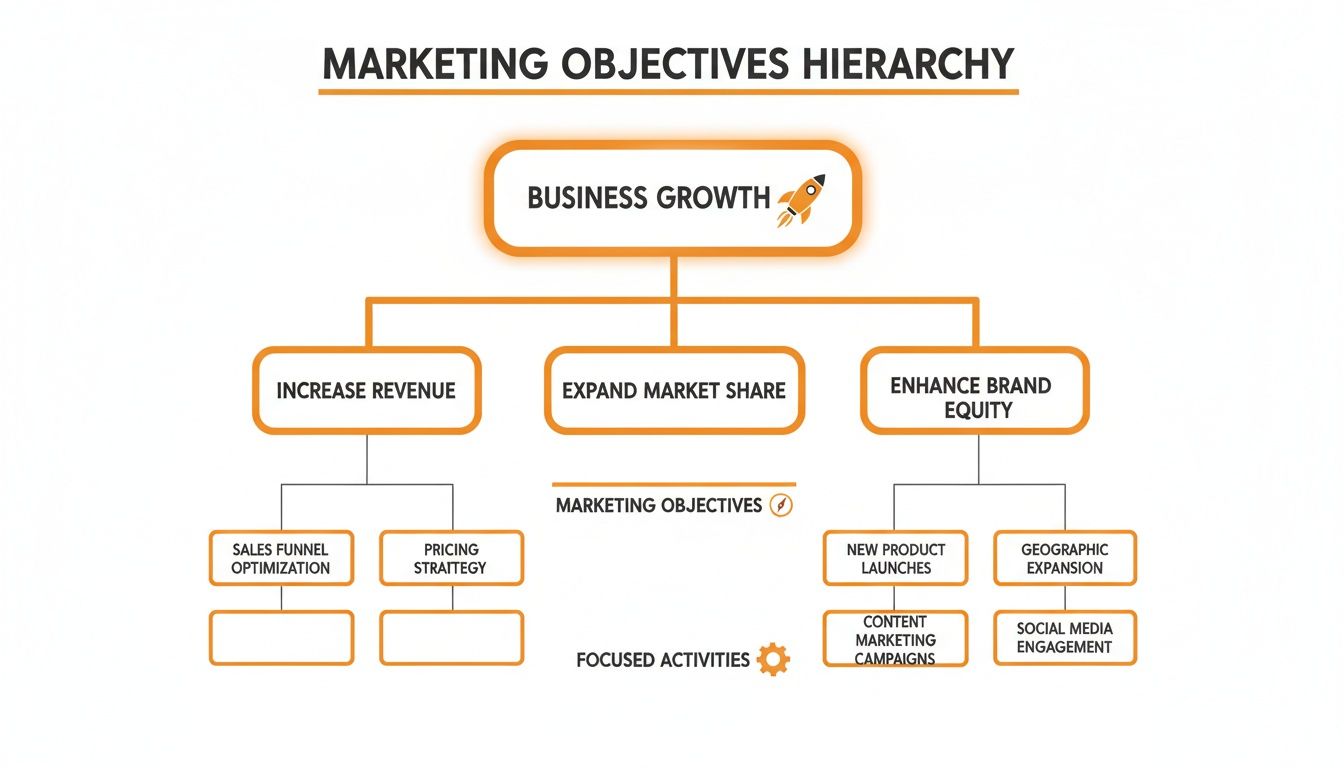
As you can see, that big ambition for growth only becomes reality when clear objectives guide your marketing activities. It’s what ensures every email, every post, and every ad has a real purpose.
To help you choose the right focus, we’ve broken down the six core objectives every business should consider.
Core Marketing Objectives and Their Business Impact
Here’s a quick look at the main objectives and how they connect directly to your bottom line. Think of this as your cheat sheet for aligning marketing efforts with tangible business outcomes.
| Marketing Objective | Primary Goal | Direct Business Impact |
|---|---|---|
| Build Brand Awareness | Become memorable and recognizable to the right audience. | Creates a foundation for future sales by building familiarity and trust. |
| Master Lead Generation | Capture contact info from interested prospects. | Fills the sales pipeline with qualified potential customers, enabling direct follow-up. |
| Drive Sales and Conversions | Persuade potential customers to make a purchase. | Directly increases revenue and contributes to the company’s bottom line. |
| Improve Customer Retention | Keep current customers happy and coming back for more. | Increases customer lifetime value (CLV) and generates word-of-mouth referrals. |
| Increase Market Share | Capture a larger percentage of sales within your industry. | Establishes market leadership and creates a competitive advantage. |
| Educate and Ensure Compliance | Inform customers and adhere to industry regulations. | Builds authority and trust while mitigating legal and financial risks. |
Each of these objectives serves a distinct purpose, but they all work together to drive your business forward. Now, let’s dig into what each one really means for you.
1. Build Brand Awareness
Before anyone can buy from you, they have to know you exist. Simple as that. The goal of brand awareness is to make your business the first name that pops into a potential customer’s head when they have a problem you can solve.
This isn’t just about plastering your logo everywhere. It’s about building a sense of familiarity and trust. When people recognize your brand, they’re far more likely to choose you over a name they’ve never heard of. Things like smart content marketing, genuine social media engagement, and digital PR are your best friends here.
2. Master Lead Generation
Awareness is the first handshake, but lead generation is where you ask for their number. This objective is all about capturing the contact information of interested people, turning anonymous website visitors into actual, identifiable leads for your sales team.
A lead could be someone who subscribes to your newsletter, downloads a helpful guide, or fills out a form for a free quote. For a local plumber, a qualified lead is that phone call from a homeowner with a leaky pipe. For an e-commerce brand, it might be an email signup in exchange for a 10% discount code.
Lead generation is the bridge between marketing and sales. It’s the systematic process of warming up potential customers and guiding them closer to making a purchase.
The beauty of this objective is that it’s highly measurable. You can track clear key performance indicators (KPIs) like Cost Per Lead (CPL) and your lead-to-customer conversion rate, making it a favourite for any business focused on direct ROI.
3. Drive Sales and Conversions
At the end of the day, marketing needs to make the cash register ring. This is the most direct of all objectives, centred on one thing: persuading potential customers to pull out their wallets and buy. All the other roads—awareness, engagement, lead nurturing—eventually lead here.
Optimizing for conversions just means making the path to purchase as smooth and irresistible as possible. This involves nailing the fundamentals:
- Clear Calls-to-Action (CTAs): Tell people exactly what to do next. No guesswork.
- Optimized Landing Pages: Create focused, persuasive pages designed for one single action.
- Streamlined Checkout Processes: Reduce any friction that might cause someone to abandon their cart.
For an e-commerce store, success is counted in sales volume and average order value. For a service business, a conversion might be a signed contract or a paid-for appointment.
4. Improve Customer Retention
Here’s a fact: it costs a whole lot more to find a new customer than it does to keep an existing one happy. This objective is all about nurturing the relationships you already have, keeping your current customers engaged and coming back for more. Loyal customers don’t just spend more over time; they become your most powerful brand advocates.
Marketing activities that nail retention include email campaigns with exclusive offers for existing customers, loyalty programs that reward repeat business, and genuinely excellent customer service. The goal is to build a long-term relationship that goes far beyond a single transaction.
5. Increase Market Share
This objective is all about growing your slice of the pie. Increasing your market share means you’re capturing a bigger percentage of the total sales in your industry, directly at the expense of your competitors. It’s an aggressive, ambitious goal, often pursued by businesses ready to scale up.
Tactics here can range from competitive pricing and big promotional campaigns to innovating so well that your product or service is simply the best option. Success doesn’t just mean you’re growing—it means you’re outperforming everyone else and cementing your position as a leader in your field.
6. Provide Education and Ensure Compliance
For businesses in complex or regulated industries—like cannabis, CBD, or holistic health—marketing has an extra, crucial job: education. This objective focuses on clearly and responsibly informing potential customers about your products, their benefits, and how to use them safely and effectively.
Getting this right builds immense trust and positions your brand as a responsible authority, not just another seller. It’s also non-negotiable for compliance, making sure every marketing message you put out there follows strict industry regulations. In-depth guides, factual blog posts, and transparent product information are the keys to winning here.
Setting SMART Goals for Actionable Marketing Plans
Having a list of objectives is a great start, but it’s only half the battle. A goal like “increase brand awareness” is too vague to be useful—it’s like telling a GPS your destination is simply “somewhere north.” To turn those broad ambitions into a concrete roadmap, you need a framework that builds clarity and accountability right into the plan.
This is where the SMART framework comes in.
Great ideas are everywhere, but what really separates successful campaigns from forgotten ones is disciplined execution. The SMART methodology takes your marketing objectives from wishful thinking and turns them into a detailed, actionable plan. It makes sure every goal you set is Specific, Measurable, Achievable, Relevant, and Time-bound.

This simple but powerful structure forces you to think through all the critical details, making your path to success clear and your progress easy to track.
Breaking Down the SMART Framework
So, let’s unpack what each letter in the SMART acronym actually means for your marketing goals. This isn’t just theory; think of it as a practical filter for creating goals that actually get results.
- S – Specific: Your goal has to be crystal clear. Vague goals lead to vague results. Instead of saying, “get more website traffic,” a specific goal would be, “increase organic search traffic from users in British Columbia.”
- M – Measurable: You have to be able to track your progress with actual numbers. How will you know when you’ve won? A measurable version of our goal is: “increase organic search traffic from BC by 25%.”
- A – Achievable: Your goal should stretch you, but it needs to be realistic. Aiming to double your traffic in one month with a brand-new website is just setting yourself up for failure. Is a 25% increase genuinely possible with your current resources and timeline?
- R – Relevant: The goal has to matter to your bigger business objectives. Does driving more organic traffic from BC actually support your primary goal of booking more local service appointments? If yes, it’s relevant.
- T – Time-bound: Every goal needs a deadline. This creates a sense of urgency and gives you a clear finish line for evaluation. For example: “increase organic search traffic from BC by 25% over the next fiscal quarter (Q3).”
By running your ideas through this framework, you move from a fuzzy concept to a precise, tactical objective that your whole team can get behind.
From Vague Ideas to Actionable Goals
Let’s see this transformation in action. A common but useless goal we hear all the time is “improve our social media.” It’s a nice thought, but it gives you absolutely no direction.
Now, let’s run that through the SMART filter for, say, an e-commerce skincare brand:
- Original Goal: “Improve our social media.”
- SMART Goal: “Increase our Instagram engagement rate from 2% to 4% by launching three interactive Stories per week and one user-generated content campaign per month. We will achieve this by the end of Q4 to support our main business objective of building a more loyal customer community.”
See the difference? This version is specific (engagement rate, content types), measurable (2% to 4%), achievable (with a dedicated effort), relevant (builds community), and time-bound (end of Q4).
The whole point of the SMART framework is to kill ambiguity. It replaces guesswork with a clear definition of what success looks like, how you’ll measure it, and when it needs to happen.
This level of detail is non-negotiable for modern marketing. It’s what allows you to properly use analytics and automation to track progress and prove your return on investment. In Canada, for instance, the marketing automation market is a perfect example of this in action—it generated USD 712.4 million in revenue and is projected to hit USD 1,587.9 million by 2030. The fastest-growing part of that market? Reporting and analytics, which just goes to show how critical measurable, data-driven goals have become.
Your SMART Objective Template
Ready to build your own? You don’t need to start from a blank page. Use this simple template to structure your own objectives of marketing and make sure you’ve covered all the bases.
Our goal is to [Specific Action You Will Take] in order to [Measurable Outcome or KPI] by [Specific Percentage or Number]. We will accomplish this by [End Date or Timeframe]. This is achievable because [Reason for Achievability] and it supports our larger business goal of [Relevant Business Objective].
Following this structure helps you consistently create goals that are built for action. To take this a step further, check out our guide on how to leverage data-driven digital marketing for explosive growth, which dives deeper into the analytics behind great campaigns.
Connecting Marketing Objectives to Business ROI
It’s one thing to set clear marketing objectives, but proving they actually make the business money? That’s the real endgame. This is where you connect the dots between your campaign activities and the company’s bottom line, translating all that hard work into the one language every CEO understands: profit.
The goal is to shift the conversation away from surface-level metrics like “likes” or “impressions.” While those might show some level of engagement, they don’t pay the bills. The true measure of your success lies in the numbers that define financial health and sustainable growth.

Making this leap means getting laser-focused on business-centric key performance indicators (KPIs) that directly reflect your marketing’s financial impact.
Moving Beyond Vanity Metrics
To really demonstrate value, you have to track metrics that tie directly to revenue and profitability. These are the numbers that justify your marketing spend and prove that your strategies are a powerful investment, not just another business expense.
Here are the core metrics that truly matter:
- Customer Acquisition Cost (CAC): How much does it cost, in total, to win a single new customer? A lower CAC means your marketing is getting more efficient.
- Customer Lifetime Value (CLV): This number predicts the total revenue you can expect from a single customer over the entire time they do business with you. A high CLV shows you’re attracting and keeping the right kind of profitable customers.
- Return on Ad Spend (ROAS): For every dollar you put into advertising, how many dollars do you get back in revenue? ROAS gives you a clear, immediate look at the profitability of your paid campaigns.
When your marketing objective is to “increase sales by 20%,” tracking these three KPIs shows you exactly how efficiently you’re hitting that goal and whether the customers you’re bringing in are actually profitable for the long haul.
Using AI and CRO to Boost Financial KPIs
Today’s marketing toolkits offer powerful ways to directly influence these crucial financial metrics. Two of the most effective are AI-powered Search Engine Optimization (SEO) and Conversion Rate Optimization (CRO).
AI-driven SEO is much more than just ranking for keywords. It uses predictive analytics to pinpoint the search terms and content topics most likely to attract high-intent, profitable customers. This precision helps drive down your CAC by focusing your efforts on traffic that’s already primed to buy.
By targeting the right audience with the right message at the right time, AI-powered marketing ensures you’re not just getting more traffic—you’re getting the right traffic.
At the same time, you can’t ignore your website’s performance. Small tweaks can lead to major revenue gains, a process we dive into in our expert guide on Conversion Rate Optimization. It’s all about systematically testing and improving parts of your website to increase the percentage of visitors who take a desired action, like making a purchase or filling out a form.
Data Analysis Reveals Your Path to Profitability
Ultimately, the goal of marketing is to fuel business growth, and this is increasingly happening through digital channels. In Canada, the digital marketing market’s explosive expansion vividly illustrates this priority. Valued at USD 14.01 billion, this sector is forecasted to surge to USD 43.62 billion by 2034, driven by a powerful 13.4% compound annual growth rate as businesses intensify their online strategies to connect with a digitally native audience. You can explore the full report on Canada’s digital marketing market to see these trends in detail.
This growth underscores just how critical it is to use data to find and fix the leaks in your sales process. Analytics tools can show you precisely where potential customers are dropping off, allowing you to make targeted improvements. Is your checkout process too complicated? Is a key landing page failing to persuade visitors?
By answering these questions with data, you can make informed decisions that directly boost your conversion rates, lower your CAC, and increase your overall ROI. This data-first approach transforms marketing from a creative guessing game into a measurable science of growth.
Real-World Marketing Objectives in Action
Knowing the theory is one thing, but seeing marketing objectives work in the wild is where things get interesting. Let’s shift from abstract concepts to concrete, actionable SMART goals for the kinds of businesses we work with every single day.
Think of these scenarios as a practical blueprint you can adapt for your own industry. You’ll notice a common thread: every objective is built to drive a measurable business outcome, not just to check a task off a list.
Local Service Business: Turning Clicks into Calls
For a local business, marketing often comes down to one thing: getting the phone to ring or the contact form filled out. Let’s imagine a plumbing company in Vancouver that wants to become the go-to service in their area.
- The Vague Idea: “We need more plumbing leads from our website.”
- The SMART Objective: “Increase qualified plumbing leads from organic search by 30% within the next six months. We’ll do this by ranking in the top three on Google for 10 high-intent local keywords (like ’emergency plumber Vancouver’) and boosting calls from our Google Business Profile by 25%. This directly supports our main business goal of growing local service revenue.”
See the difference? This goal is specific (qualified leads, top-three spots), measurable (30% lead increase, 25% call increase), achievable (with a focused local SEO plan), relevant (it drives revenue), and time-bound (six months).
E-commerce Brand: Growing Sales Through Content
An online skincare brand has a different battlefield. The ultimate prize isn’t just a lead; it’s a sale. The strategy often involves building trust and proving your product’s value before asking for the credit card.
- The Vague Idea: “We should probably do more content marketing to get sales.”
- The SMART Objective: “Increase online sales directly attributed to our blog by 20% over the next fiscal quarter (Q3). We’ll get there by publishing four in-depth, SEO-optimized articles targeting problem-focused keywords (e.g., ‘best serum for dry skin in Canada’) and hitting a 5% click-through rate from these articles to our product pages. This supports our business objective of improving customer lifetime value through education.”
This approach ties every piece of content directly to revenue, ensuring that blogging isn’t just about traffic—it’s about sales.
The most effective marketing objectives aren’t just about activity; they’re about impact. They answer the question, “What specific business result will this marketing effort produce?”
Getting these kinds of tangible results requires a skilled team. In fact, a major marketing objective for many companies is now simply finding the right people. Recent job market data shows a serious talent crunch for marketers skilled in analytics, automation, and user experience. These are the very skills needed to craft and execute the hyper-focused strategies that today’s consumers expect. Find out more about which marketing roles are in highest demand and see how the market is shifting.
Regulated Industry: Building Trust Through Education
For a CBD company, the usual hard-sell tactics are off the table. Pushing for a sale too aggressively isn’t just bad form; it can be a compliance nightmare. Here, the main goal shifts to building trust through responsible education, which then clears the path for future sales.
- The Vague Idea: “We need to educate people about CBD.”
- The SMART Objective: “Grow organic traffic to our educational ‘Learn’ section by 40% in the next six months. We’ll measure success by ranking on page one for 15 non-branded, informational keywords (like ‘how to use CBD oil for sleep’) and achieving an average time on page of over three minutes for our core educational content. This supports our long-term business goal of becoming a trusted, compliant authority in the wellness space.”
In this case, the focus is on top-of-funnel metrics that signal trust and engagement. In a regulated market, these are the leading indicators of future revenue.
Holistic Health Clinic: Filling the Appointment Book
Finally, let’s look at a holistic health clinic. Their success is measured by how many appointments are on the schedule. The objective has to draw a straight line from online visibility to actual bookings.
- The Vague Idea: “Get more people to find our clinic online.”
- The SMART Objective: “Increase online appointment bookings from organic search by 25% by the end of Q4. We will achieve this by optimizing our main service pages for booking-intent keywords (like ‘acupuncture clinic near me’) and improving the conversion rate on our online booking form from 3% to 5%. This is directly tied to our business goal of increasing patient intake and clinic revenue.”
Each of these examples shows how a well-crafted marketing objective acts as a precise tool for growth, perfectly tailored to the unique context and goals of the business.
A Few Common Questions About Marketing Objectives
Setting your marketing objectives is a game-changer, but it almost always brings up a few questions. That’s a good thing. Nailing down the details is what separates a plan that actually works from one that just sits on a shelf. To help you get it right, we’ve answered some of the most common queries we hear from business owners and marketing leaders.
Think of this as your quick-start guide to fine-tuning your approach. We’ll clear up the fuzzy spots and give you some solid advice to make sure your goals are not just well-defined, but powerful enough to drive real results.
How Often Should I Review My Marketing Objectives?
This is a big one. The short answer? Not just once a year. Your marketing objectives aren’t meant to be carved in stone. They’re more like the sails on a ship—they need constant adjustments to catch the shifting winds of the market, your customers’ needs, and your own business performance.
As a general rule, a deep dive into your main objectives every quarter is a smart move. That’s enough time to see real trends in your data, but it’s also short enough to let you pivot before a small problem becomes a big one.
Of course, for specific campaigns, you’ll want to check in much more often.
- Weekly Check-ins: Perfect for keeping an eye on the tactical stuff, like your ad spend, click-through rates, and early conversion numbers. This isn’t about rewriting the strategy; it’s about making small tweaks to stay on course.
- Monthly Reviews: This is your moment to see if you’re on pace to hit your quarterly goals. Are the numbers heading in the right direction? Do you need to challenge any of your initial assumptions?
- Annual Planning: Here’s where you zoom out and look at the big picture. You’ll set the high-level business goals for the year ahead, which will then become the foundation for your new quarterly marketing objectives.
Regular reviews keep your goals relevant and realistic. It’s the best way to make sure you’re not pouring time and money into a plan that’s out of sync with reality.
What Is the Difference Between an Objective and a Strategy?
This is probably the most common point of confusion we see, but the distinction is actually pretty simple—and getting it right brings a ton of clarity to your team.
I always find a road trip analogy works best here.
Your marketing objective is the destination you type into your GPS. It’s “Get to Banff National Park.” It’s the specific, measurable thing you want to achieve. It’s the what.
Your marketing strategy, on the other hand, is the route you choose. Are you taking the direct highway to get there as fast as possible, or are you taking the scenic backroad to see the sights? The strategy is your high-level plan for reaching your destination. It’s the how.
So, if your objective is to “Increase qualified leads by 25% in Q3,” your strategy might be to “Develop a content marketing plan focused on bottom-of-the-funnel topics that attract high-intent search traffic.” The tactics are the specific turns and actions you take along the way—writing certain blog posts, creating a guide, and promoting it with an email campaign.
How Many Marketing Objectives Should I Focus On at Once?
It’s tempting to try and do everything at once. We all feel it. But chasing every shiny object is the fastest way to dilute your focus and end up with a lot of half-finished projects and mediocre results. When it comes to setting marketing objectives, focus is your superpower.
For most small and medium-sized businesses, the sweet spot is one to three primary objectives at a time.
This forces you to be ruthless about what really matters and directs your resources—your team, your budget, your energy—to where they’ll have the biggest impact. Trying to boost brand awareness, generate leads, improve retention, and launch into a new market all at the same time is a recipe for burnout.
Here’s how to think about it practically:
- One Primary Objective: If you’re a startup or running a lean team, locking in on a single, critical goal (like pure lead generation) is almost always the smartest play.
- Two or Three Complementary Objectives: An established business might be able to juggle a few goals, but make sure they support each other. For example, pairing a lead generation objective with a sales conversion objective makes perfect sense—one feeds the other.
The key is to avoid setting goals that fight each other. An aggressive push for market share, for example, might drive up your customer acquisition costs, which would clash with a goal to improve marketing efficiency. Choose wisely and give your team a clear, unified direction to run toward.
Ready to define—and crush—marketing objectives that deliver real ROI? The team at Juiced Digital uses AI-powered SEO and data-driven strategies to turn your goals into measurable revenue. Book your free consultation today and let’s build a growth plan that works.