
Smart marketing in the construction world always starts with a rock-solid digital foundation. Think about it: your website isn't just a fancy online brochure anymore. It's your top salesperson, a full-blown project portfolio, and the first handshake you have with a potential client, all working for you 24/7. A well-built site is the engine that drives every other marketing effort you'll make.
Building Your Digital Job Site
I always tell my clients to think of their website as their digital job site. Just like a real-world project, it needs to be organized, safe (that means secure), and impressive to everyone who stops by. It’s the one place where potential clients, business partners, and even future hires will go to judge your credibility and the quality of your work.
If your site is slow, hard to use, or looks like it was built ten years ago, what does that say about your company? It sends the wrong message, plain and simple.
Your website has to be built on a modern framework that’s all about the user experience and, most importantly, turning visitors into leads. This isn't about adding flashy animations; it's about pure function that gets a curious browser to pick up the phone. The goal is to build an online presence as reliable and impressive as the structures you build in the real world.
Mobile-First Design Is No Longer Optional
Let's get straight to the point: over 60% of all website traffic now comes from a phone or tablet. Your potential clients are looking you up on their lunch break or scrolling through their options from the couch at night. If your site is a mess to navigate on a small screen, you are actively losing business. It’s that simple.
A mobile-first approach means you design for the phone screen first, then adapt it for desktops. This makes sure the most important things are always front and centre:
-
Click-to-call buttons so contacting you is as easy as a single tap.
-
Clean, simple menus that don't make people pinch and zoom just to find what they need.
-
Fast-loading images that show off your incredible work without making someone on a spotty connection give up and leave.
Structure Your Service Pages to Actually Convert
Generic "Our Services" pages are a waste of space. To attract the kind of high-quality clients you actually want, you need to create a dedicated page for each core service you provide. This is a game-changer for construction marketing because it helps you show up in searches for specific, high-intent keywords.
For example, instead of a single page, you should have detailed, separate pages for:
-
Custom Home Builder in Vancouver
-
Commercial Tenant Improvements in Burnaby
-
Kitchen Renovations in Surrey
Each of these pages needs to be its own sales pitch. Talk about your process for that specific service, show off relevant projects you’ve completed, and sprinkle in testimonials from clients who hired you for that exact type of work. This strategy tells both Google and your ideal customer that you're the go-to expert in that field. If you're not sure where to start, looking into professional website building services can give you a solid blueprint for a lead-generating structure.
Your website isn't just a portfolio; it's a strategic asset. Every single page, from the homepage to your project galleries, should be designed with one clear goal in mind: guiding the visitor to take that next step and book a consultation.
Project Galleries That Tell a Story, Not Just Show Pictures
Your project gallery is easily your most powerful sales tool. It’s where you prove you can walk the walk. But here’s where many contractors go wrong: they just dump a bunch of photos onto a page and call it a day.
Instead, think of your gallery as a collection of compelling case studies.
For every project you feature, build out a dedicated page that includes:
-
High-quality "before-and-after" photos to create that "wow" factor.
-
A quick description of the project, including the client's goals and any challenges you overcame.
-
A summary of your solution, maybe highlighting a unique technique you used or a specific material that made the difference.
When you take this narrative approach, your gallery stops being a simple photo album and becomes a library of success stories. It helps potential clients see themselves in your work and builds the trust they need to finally make that call.
2. Dominate Local Search and Get Found on Google
For any contractor, the best jobs are almost always local. Your marketing has to be built on that simple truth, which means an intense focus on showing up when someone in your service area searches for what you do. This is where mastering local search engine optimisation (SEO) isn't just a good idea—it's essential for survival and growth.
Getting local SEO right is so much more than just having a website. It's an ongoing process of proving to Google that you are the most relevant, active, and trusted contractor in your city. It's about being right there, front and centre, the moment a homeowner finally decides to renovate their kitchen or a business owner needs to expand their office space.
Your Google Business Profile Is Your Digital Showroom
Let's get one thing straight: your Google Business Profile (GBP) is probably your single most important marketing tool. It’s that info box that pops up on Google Maps and in local search results, showing your company name, address, phone number, hours, reviews, and photos. Neglecting it is like boarding up the windows of your main office.
Treat your GBP like an active social media profile, not a static business listing you set up once and forget. To really stand out, you need to be using its features all the time.
-
Google Posts: Share quick updates on recent jobs, announce a special offer, or post company news. A simple post with a great photo of a finished deck or a new kitchen tells Google (and customers) that you're active and busy.
-
Q&A Section: Get ahead of your customers' questions. If you're a roofer, add and answer common queries like, "Do you offer free estimates?" or "What shingle brands do you use?" This instantly builds your authority and saves everyone time.
-
Photo and Video Uploads: This is huge. Regularly upload high-quality photos of your finished projects, your team on-site (with their permission!), and your branded vehicles. Visuals are incredibly powerful for proving the quality of your work.
For a much deeper dive into turning your profile into a lead-generating machine, our guide on optimizing your Google My Business listing lays out all the advanced tactics.
To help you get started, here's a quick checklist that breaks down where you should be putting your energy for the best results. I've seen contractors follow this exact prioritization and go from invisible to the top of the local map pack.
Local SEO Priority Checklist for Contractors
| Action Item | Priority Level | Expected Impact | Example Tactic |
|---|---|---|---|
| GBP Optimization | High | Immediate increase in calls and website clicks from local search. | Fully complete every section; upload 10+ new photos and a Google Post weekly. |
| Review Generation System | High | Builds trust, improves rankings, and drives conversions. | Send a direct review link via text/email immediately after a successful project walkthrough. |
| Location-Specific Pages | Medium | Captures high-intent searchers looking for services in their specific town. | Create a "Deck Builder in Surrey" page with photos of local projects and relevant content. |
| Local Citation Building | Medium | Reinforces your geographic relevance and authority to Google. | Get listed on Houzz, HomeStars, and your local Chamber of Commerce with consistent NAP info. |
Focus on the "High" priority items first, as they deliver the biggest bang for your buck. Once those are dialled in, move on to the "Medium" priority tasks to solidify your position and expand your reach.
How to Get a Flood of Five-Star Reviews (The Right Way)
Online reviews are the new word-of-mouth, plain and simple. A consistent flow of positive, detailed reviews is the most powerful signal you can send to both potential customers and Google. But you can't just sit back and hope they roll in—you need a dead-simple, repeatable system.
The secret is to ask when your client is happiest. This is almost always right after the final walkthrough when they're absolutely buzzing about the finished product. Don't overthink it. Send a simple, direct email or text message with a link that takes them straight to your Google review page. The easier you make it, the more likely they are to do it.
Don't be shy about asking for reviews. Happy clients are almost always willing to leave one if you make the process frictionless. A simple follow-up system will completely transform your online reputation and keep your project pipeline full.
Build Local Authority with Citations and Hyper-Local Service Pages
Beyond your Google profile, you need to stamp your company’s name all over the local web. A key part of this is building local citations—which are just mentions of your business Name, Address, and Phone number (NAP) on other respected websites. Think directories like Yelp, Houzz, HomeStars, and your local chamber of commerce site. The golden rule here is consistency; your NAP info must be absolutely identical everywhere.
Another game-changing tactic is creating location-specific service pages on your website. Instead of having one generic "Basement Finishing" page, you build out targeted pages like:
-
Basement Finishing in Surrey
-
Custom Deck Builder in Burnaby
-
Commercial Renovations in Vancouver
Each page should be packed with content tailored to that specific area, showcasing projects you’ve actually done there. This strategy is pure gold because it intercepts highly motivated clients searching for a contractor in their town, which massively boosts your chances of getting the call.
In the ridiculously competitive construction market here in British Columbia, these strategies are no longer optional. Recent data shows that local SEO tactics have driven a 45% increase in qualified leads for Vancouver-based construction firms over the past two years. Agencies that specialize in local SEO for BC trades have seen their clients hit the top of Google for valuable searches like 'Vancouver commercial builders,' leading to a 30% lift in project inquiries in just six months. You can see more data on BC's construction market trends in the BCCA Spring 2025 Stat Pack.
Driving Immediate Leads with Smart Paid Ads
Look, SEO is a fantastic long-term play, a real asset for your business. But sometimes, you just need the phone to ring right now. This is where a smart paid advertising strategy comes in—it’s the fastest way to get in front of paying clients.
Think of it like a tap you can turn on to fill your project pipeline whenever things get a little quiet. With platforms like Google Ads or Meta (that's Facebook and Instagram), you can skip the line and put your company directly in front of people actively searching for your exact services. It’s all about being seen at the precise moment a potential customer has a problem you can solve.
But let's be clear: this isn't about just throwing money at ads and hoping for the best. It's about a calculated investment designed to bring in a predictable return. When done right, a good ad campaign isn't an expense; it's a reliable engine for growth.
Google Ads: Your High-Intent Lead Machine
When a homeowner's pipe bursts or they finally decide to pull the trigger on that dream kitchen remodel, what’s the first thing they do? They Google it. Google Ads lets you show up at the very top of those search results, capturing high-intent prospects who are ready to make a decision.
The real secret sauce is in the keywords you target. Forget generic, broad terms like "construction company." The gold is in hyper-specific, local phrases that scream "I need to hire someone now!"
Get inside the head of your ideal client. What would they actually type?
-
"Emergency roofer in Burnaby"
-
"Custom home builder North Vancouver"
-
"Best contractor for bathroom remodel"
When you bid on these kinds of terms, your ad shows up for people who have a specific problem that you are perfectly positioned to fix. Your ad copy needs to match that intent, speaking directly to their pain point with a clear solution, like "24/7 Emergency Repairs" or "Book a Free Design Consultation." It makes the click—and the call—almost a no-brainer.
Hyper-Targeting on Social Media Platforms
While Google is great for capturing people who are already looking, platforms like Facebook and Instagram let you find potential clients before they even start their search. This is where you can get incredibly strategic, showing your brand to the right people based on their location, life events, and interests.
Imagine you're a renovation contractor. You could run an ad showcasing a stunning kitchen remodel and target people who:
-
Live in specific, affluent postal codes.
-
Are homeowners between the ages of 35-65.
-
Have shown interest in things like home improvement shows or high-end interior design brands.
This kind of precision means your budget isn't wasted on people who are a poor fit for your services. You're proactively creating demand by showing the right people what's possible for their home.
Your ad spend should never feel like a gamble. With the right targeting, compelling ad copy, and a landing page built to convert, paid advertising becomes a predictable system for winning new projects and scaling your construction business.
And remember, your paid ads don't exist in a vacuum. They are supercharged by a strong local foundation.
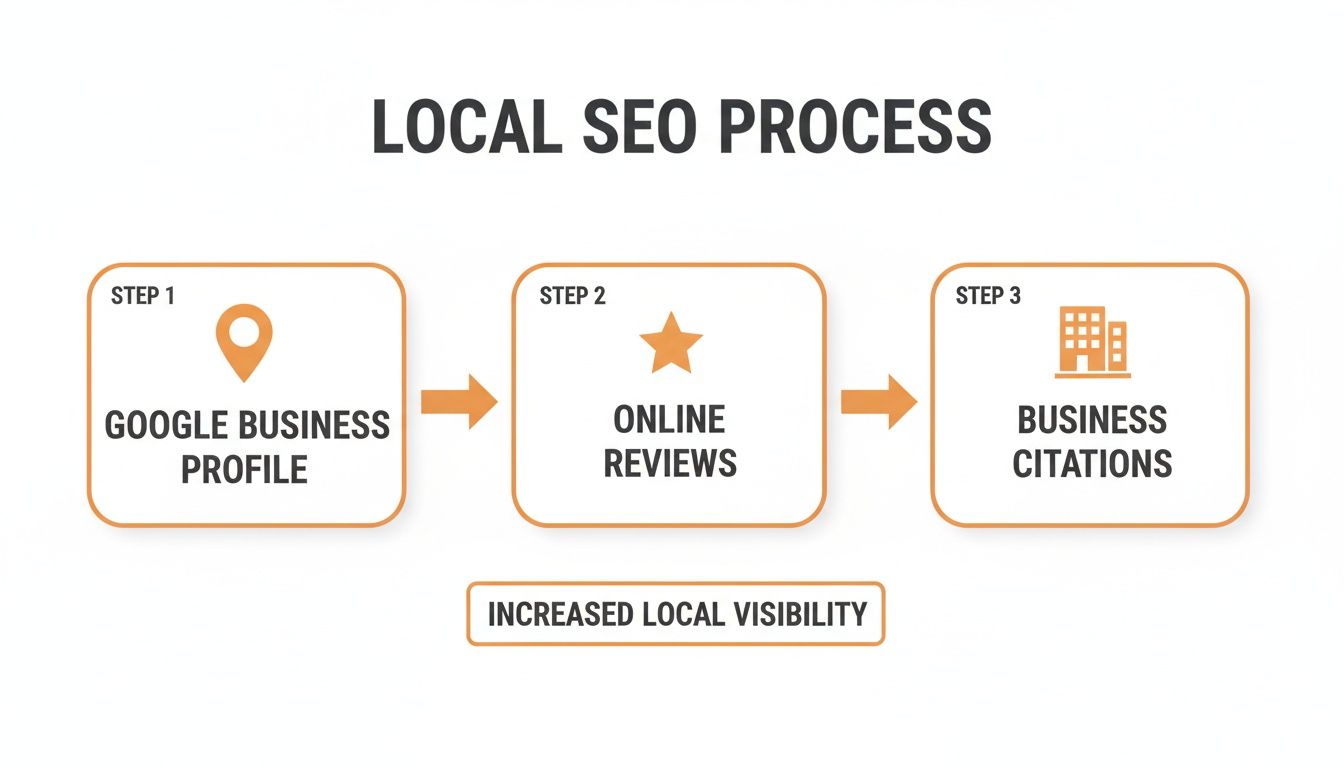
When a potential client clicks your ad, they're going to check you out. A solid Google Business Profile packed with positive reviews and consistent local citations builds the trust needed to turn that ad click into a signed contract.
Optimizing Your Ad Spend for Maximum ROI
The construction market in Canada is heating up, with forecasts showing an expected output expansion of 2.2% in 2025. To get a piece of that pie, the top-performing firms in BC are already investing 15-20% of their budgets into digital marketing and seeing great results.
In fact, recent data shows that construction companies using AI-powered paid ad strategies have cut their customer acquisition costs by 40% while boosting conversions by 28%. It’s proof that a data-driven approach pays off. You can read more about Canada's construction industry forecast on BusinessWire.com.
Ultimately, success with paid ads comes down to making the path from ad click to lead as simple and frictionless as possible. One of the biggest mistakes I see is sending ad traffic to a generic homepage. Don't do it.
Instead, build dedicated landing pages for each campaign, laser-focused on a single call to action—like "Request a Quote" or "Call Us Now." This simple step ensures every dollar you spend is working as hard as it possibly can to bring you new business.
Building Trust with Project Showcases and Content
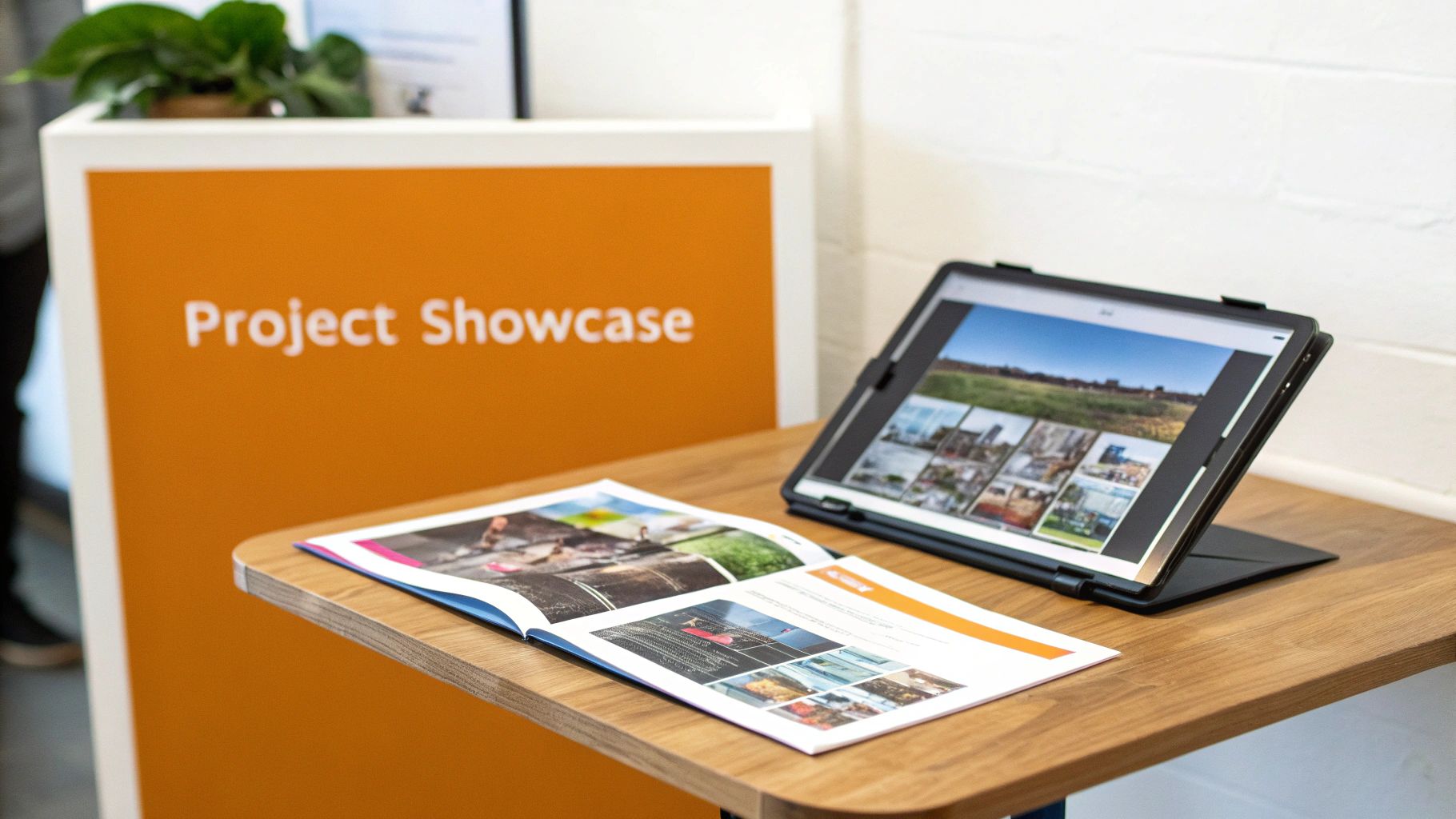
In the construction business, trust is everything. It's the foundation of every project, long before a single shovel hits the ground. Potential clients need to believe in your craftsmanship and your ability to bring their vision to life. Your marketing needs to be a trust-building machine, and nothing does that better than content that genuinely proves your expertise.
This isn't about churning out generic blog posts just to have something on your site. It's about creating valuable resources that showcase your best work and answer the real, pressing questions your ideal clients are typing into Google. When you shift your mindset from selling to educating, you become a trusted advisor, not just another contractor in the running for a job.
Go Beyond Photos with Detailed Case Studies
A glossy photo of a finished reno is nice, but the story behind it is what truly sells. This is where detailed project case studies become your most powerful marketing tool. They pull back the curtain and show potential clients exactly what it’s like to work with you and the quality you consistently deliver.
Don't just create a simple gallery of images. Treat each project showcase like a mini-documentary that walks a visitor through the entire journey. This simple shift can transform a passive browser into an engaged prospect who starts picturing their own project in your hands.
For every case study, make sure you include these key elements:
-
The Client’s Vision: What was the end goal? A more functional kitchen for a growing family? A commercial space designed for better workflow? Start with the "why."
-
The Challenge: Every project has its hurdles. Maybe it was a tight timeline, a tricky structural issue, or a completely unique design request. Highlighting these shows off your problem-solving skills in a real-world context.
-
Your Solution: Get into the specifics of how your team tackled the challenge. Explain the materials you chose, the techniques you employed, and how you managed the project to a successful finish.
-
The Stunning "After": This is where your high-quality photos and video walkthroughs really shine. Capture the final result from multiple angles to create that all-important "wow" factor.
Create Content That Answers Real Client Questions
One of the smartest marketing for construction strategies is creating content that directly answers the questions people are already asking. Think about the common queries you get from clients every single day. Those are absolute content goldmines.
Instead of writing about broad topics, get hyper-specific and local. A blog post titled, "How Much Does a Kitchen Remodel Cost in BC?" is going to attract far more qualified leads than a generic article on renovation budgets. This kind of content establishes your authority and pre-qualifies your leads before they even pick up the phone. Planning this out is key; learn more about how by building a content calendar to organize your topics and publishing schedule.
Your content's job is to build confidence. When a potential client reads your detailed project breakdown or finds a helpful answer to their specific question, you’ve already started building a relationship based on expertise and transparency.
Amplify Your Reach Through Strategic Partnerships
Creating great content is only half the battle; you also need to get it in front of the right eyeballs. This is where digital PR and strategic partnerships come in, helping to amplify your voice and put your work in front of a whole new audience of high-value prospects.
Try reaching out to local design blogs, real estate publications, or even architects and interior designers for collaborative content. A feature in a respected local outlet acts as a powerful third-party endorsement of your work.
This strategy has a direct, measurable impact on growth. For example, recent case studies from Vancouver show construction firms using this approach have seen a 35% year-over-year growth in organic traffic from local searches. This translates to real business, correlating with a 22% increase in contract wins. Some local builders even secured media features that generated 18% more leads from the backlinks alone. By showcasing your projects through trusted channels, you build a brand that attracts premium clients who value true expertise.
Turning Happy Clients into Your Best Sales Team

Your best marketing assets aren't your paid ads or even your slick website. They're the finished projects you’re proud of and the genuinely happy clients you leave behind. This is all about creating simple, repeatable systems to turn that past success into a steady stream of future work.
The key is to be proactive. You can't just cross your fingers and hope word-of-mouth happens on its own. Instead, you need to build an engine that consistently generates reviews and referrals. This creates a pipeline of high-quality leads who already believe you’re the right choice before you even shake their hand.
Systematize Your Review Requests
Online reviews are the new word-of-mouth, and they're absolutely essential for building trust. The secret to getting a steady flow of five-star reviews is to ask at the moment of peak client happiness. This is almost always during the final project walkthrough, right when their vision has become a reality.
The whole process has to be frictionless. Don’t just mention it in passing; build it right into your project close-out checklist. The second you get that final sign-off, your system should fire off a follow-up. A simple, personal email or text message with a direct link to your Google Business Profile review page is incredibly effective.
Think about a template that feels personal, not robotic:
-
Subject: We're so glad you love the new [kitchen/deck/office]!
-
Body: "Hi [Client Name], it was a real pleasure bringing your project to life. If you have a moment, sharing your experience on Google would mean a lot and help other homeowners find us. Here's a direct link to make it easy: [Your Review Link]."
This simple, timely request removes all the hurdles and makes it incredibly easy for a satisfied client to share their positive experience. This is a non-negotiable part of effective marketing for construction companies today.
Building a Referral Program That Actually Works
While reviews build broad public trust, a structured referral program brings in high-intent, pre-qualified leads directly from your trusted network. The data doesn't lie: referral marketing can deliver an ROI well over 500%, thanks to almost zero acquisition cost and sky-high close rates.
Your program shouldn't be a complicated mess of points and tiers. Keep it straightforward and make sure it’s valuable for everyone involved. The best referral systems are built on clear incentives and are dead simple to use.
A great referral comes from a trusted source. When a past client, architect, or designer recommends you, they are lending you their credibility. Your job is to make it easy and worthwhile for them to do so.
To build a program that gets real results, you first need to decide who you want referrals from and what you’re going to offer them.
Key Referral Sources to Target
-
Past Clients: These are your biggest fans. A simple thank-you gift card ($100-$250) or a credit toward future maintenance for a successful referral is a fantastic incentive.
-
Architects and Designers: These pros can become a consistent source of high-quality projects. A percentage-based commission (1-3% of the project value) for a signed contract is a powerful motivator here.
-
Real Estate Agents: They are constantly talking to new homeowners who are planning renovations. Offer a flat finder's fee for any lead that turns into a paying project.
Make It Easy for People to Refer You
Once your incentives are in place, you have to equip your network with the tools to send business your way. Don't make them do the heavy lifting.
Create a simple, dedicated page on your website with a form where they can easily submit a referral's contact information. This page should clearly outline the terms and the reward.
When a referral comes in, follow up immediately—both with the new prospect and with the person who sent them to you. A quick "thank you" shows you value their trust and encourages them to keep you in mind for the next one.
Your Top Construction Marketing Questions, Answered
Jumping into marketing can feel like a distraction when your real work is on the job site. You know you need more leads, but figuring out where to start—and where to put your hard-earned money—is the tough part.
Let's clear things up. Here are some straightforward answers to the questions I hear most often from contractors and construction business owners.
How Much Should We Actually Budget for Marketing?
There’s no magic number, but a good rule of thumb for an established construction firm is to set aside 5-10% of your annual revenue for marketing. If you're a newer company or you're aiming for aggressive growth in a competitive area, you might need to push that closer to 10-15%.
But honestly, thinking in percentages is the old way. A much smarter approach is to work backward from what it costs you to land a new job—your Customer Acquisition Cost (CAC).
For instance, let's say your average custom home build nets you $75,000 in profit. If you decide you’re comfortable spending up to $7,500 to win that project, then that’s your target. That single number gives you a real-world budget to work with.
Stop thinking about marketing as an expense. It's an investment. The right budget isn't a fixed percentage; it's whatever amount generates a profitable return. Start with what you're comfortable with, track every dollar, and pour more fuel on the fire when you find what's making the phone ring.
This mindset shift changes the entire conversation. You stop asking, "How much are we spending?" and start asking, "What are we getting for our money?"
What Marketing Numbers (KPIs) Actually Matter for a Contractor?
It’s way too easy to get bogged down in data that looks impressive but doesn't mean a thing for your bottom line. Website traffic, social media likes, impressions—these are mostly noise. Forget the vanity metrics.
For any contractor, there are really only a handful of Key Performance Indicators (KPIs) you need to live and die by. These are the numbers that tell you if your marketing for construction is actually working.
-
Cost Per Lead (CPL): How much, exactly, does it cost you to get one person to call, email, or fill out a form on your website?
-
Lead-to-Client Conversion Rate: Of all the leads you get, what percentage actually sign on the dotted line and become a paying client?
-
Return on Ad Spend (ROAS): This one's simple. For every dollar you put into ads, how many dollars in revenue do you get back?
-
Search Engine Rankings: When someone in your area searches "kitchen remodeller in Surrey" or "commercial contractor Vancouver," where do you show up? Are you on page one or lost on page five?
If you track just these four things, you'll have a crystal-clear picture of what's working and what's not. It lets you make decisions based on facts, not guesswork.
Should We Do SEO or Paid Ads?
This is probably the most common question I get, and it’s based on a false choice. It's not an "either/or" scenario. The most successful construction companies I've worked with use both, and they make them work together.
Here’s how to think about it:
-
Paid Ads (like Google Ads) are like a faucet. Need to fill the project pipeline, and fast? You turn them on for an immediate flow of leads. They get you to the top of Google today.
-
SEO (Search Engine Optimization) is a long-term asset you're building. It's like framing a custom home—it takes time, skilled work, and a solid foundation. But once it’s done, it delivers a steady stream of high-quality, "free" organic leads for years to come.
The best strategy is to run them in tandem. Use paid ad campaigns to bring in business and cash flow right now while your SEO efforts are gaining traction in the background. Over time, as your organic rankings climb, you can start to pull back on your ad spend. This creates a much more stable, profitable, and resilient business for the long haul.
At Juiced Digital, we build ROI-focused marketing systems that turn your budget into measurable growth. If you're ready to see how a data-driven strategy can fill your project pipeline, book a free consultation with our team today.