
Raising bids is the most popular answer to improving Ad Rank. It's also an expensive way to avoid diagnosing the problem. A higher bid won't repair an irrelevant ad, a confusing booking page or a campaign that treats an out-of-area enquiry as a valuable lead.
The practical answer to how to improve Ad Rank in Google Ads starts with identifying what's limiting visibility for a particular keyword. Then decide whether more visibility would actually help. A lower position that produces cheaper qualified calls can be a better commercial result than appearing first.
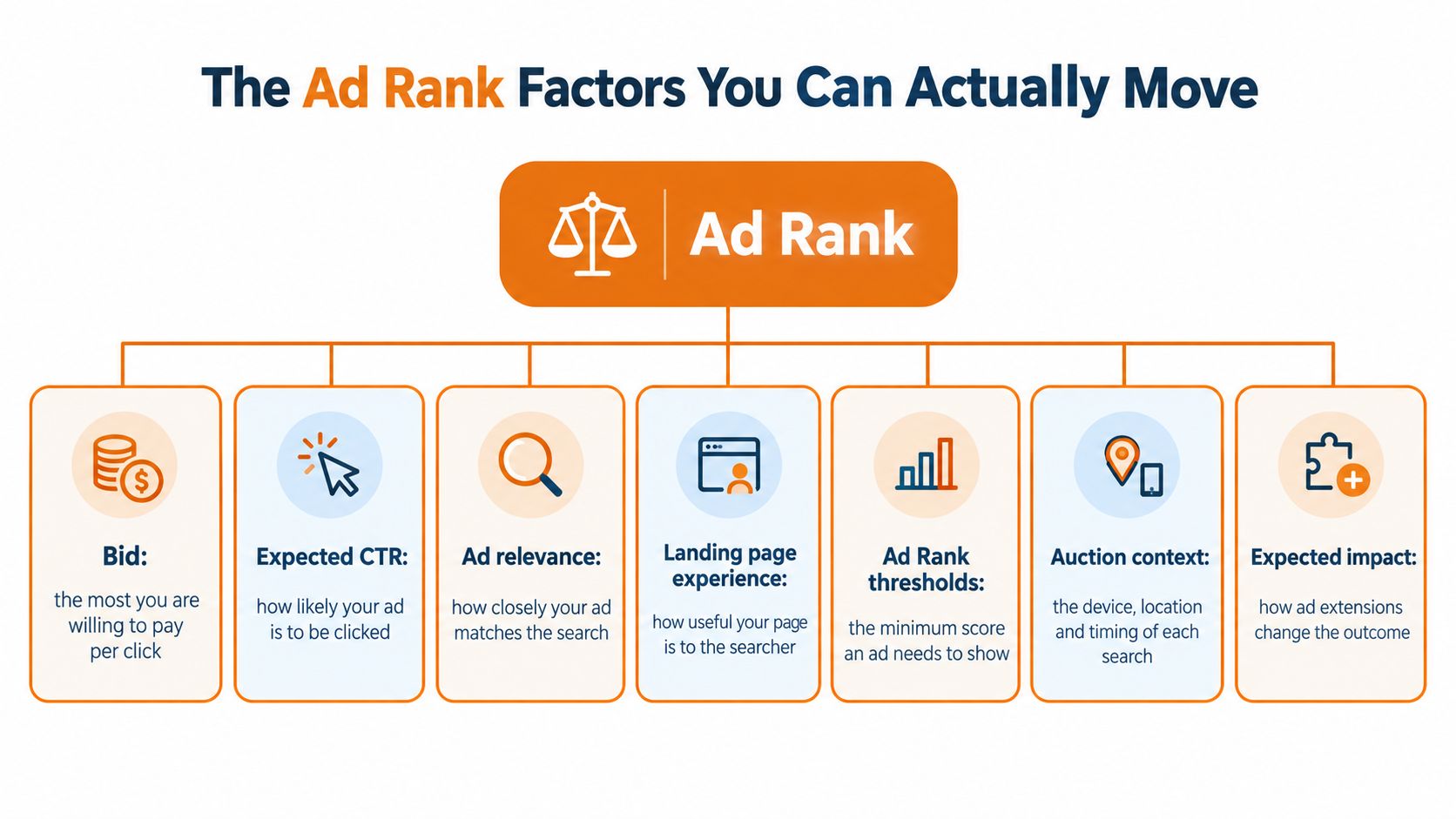
The Ad Rank Factors You Can Actually Move
Bid is only part of the auction. Google's Ad Rank documentation identifies bid, ad and landing-page quality, thresholds, auction competitiveness, search context and the expected impact of assets as inputs.
Google doesn't publish a weighted formula you can reproduce in a spreadsheet. Expected CTR, ad relevance and landing-page experience are useful diagnostic estimates, but the displayed Quality Score isn't an auction input.
Ad Rank factors and the lever you control
| Factor | What It Measures | Your Lever |
|---|---|---|
| Bid | Your maximum CPC or the auction bid generated by a strategy | Bid settings and bid strategy choice |
| Expected CTR | How likely a searcher is to click your ad | Ad copy, assets and keyword-to-headline match |
| Ad relevance | How closely the ad matches search intent | Tight ad groups and query-led headlines |
| Landing-page experience | Whether the page delivers the promise and is easy to use | Page message, speed and form placement |
| Ad Rank thresholds | The minimum requirements for eligibility and placement | Stronger ad quality and more useful pages |
| Auction context | Location, device, timing, query and competing ads | Geographic targeting and device/schedule analysis |
| Expected impact of assets | The anticipated usefulness of sitelinks, callouts and other assets | Relevant, accurate assets |
| Auction competitiveness | The strength of competing ads in that auction | Choose commercially viable queries and bids |
These inputs interact rather than operating as independent switches.
The same keyword can perform differently in Vancouver, Surrey or Victoria, and on mobile versus desktop. Each search brings a different context, so an account-wide average can hide a local weakness.
If you need the auction fundamentals, this explanation of how Google Ads works provides useful context. Higher quality can improve eligibility and position without relying entirely on higher bids, but neither quality work nor bidding guarantees a particular placement.
Confirm Conversion Data Before You Chase Position
More recorded conversions don't necessarily mean better measurement. Duplicate calls, spam forms and visits to a confirmation page can make a campaign look productive while sales staff struggle to find genuine prospects.
Ad Rank and Smart Bidding are separate mechanisms. Better conversion signals can improve automated bidding decisions; they don't directly guarantee higher Ad Rank.
Google's Canadian privacy planner recommends first-party measurement supported by sitewide tagging, enhanced conversions, Consent Mode and Google Analytics. Consent Mode changes tag behaviour according to consent status and can support conversion modelling when direct measurement is unavailable; the ad_user_data consent signal is required for measurement uses such as enhanced conversions.
Check what the bidding system receives
- Validate the outcome: Submit test forms and place test calls. Confirm that successful enquiries register without counting repeated actions as new prospects.
- Separate intent levels: Keep newsletter sign-ups and informational downloads separate from booked consultations or verified sales enquiries.
- Document consent: For a Vancouver business expanding into Quebec, record consent behaviour by province and distinguish observed reporting from modelled results where available.
- Check attribution: Don't reject a keyword solely because it contributes little last-click volume.
Health, wellness and cannabis advertisers need particular care because consent and platform-policy restrictions can limit usable measurement. Consent Mode isn't a substitute for an appropriate consent process or legal advice.
Decision rule: If you can't trust conversions, fix tracking before changing bids.
Use a Google Ads conversion tracking review to structure the checks. Alongside an internal review or implementation specialist, a free Juiced Digital audit can examine tracking, consent setup and search terms before a bid change goes live.
Diagnose the Limiting Factor and Run the 30-Day Test Routine
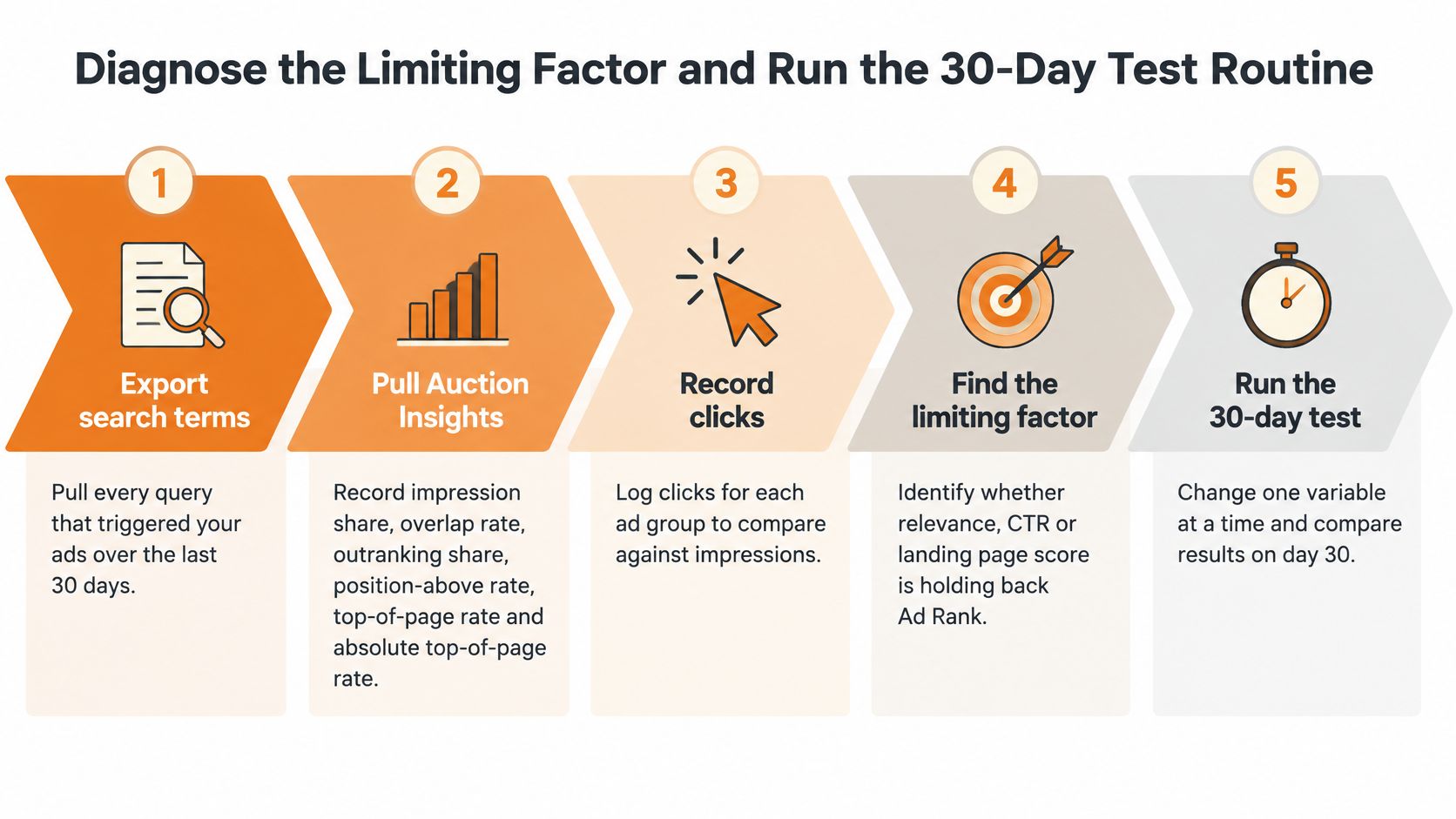
Start with a baseline rather than a list of account changes. Export search terms, clicks, costs, conversions, call and form quality, and device and location performance for a representative trading period.
The competitive context matters, but it isn't a reason to spend indiscriminately. Statistics Canada reported that Canadian businesses spent approximately $6.5 billion on online advertising in 2021. Your task is to identify which eligible searches are worth competing for, not to match everyone else's spending.
Work through the diagnostic sequence
Record the auction picture. Open Auction Insights for each eligible Search campaign. Google's Auction Insights report provides impression share, overlap rate, outranking share, position-above rate, top-of-page rate and absolute-top-of-page rate. Use these to understand competitive visibility, not to infer competitors' budgets or profitability.
Separate budget loss from rank loss. Add Search lost impression share due to budget and rank in campaign reporting. These aren't interchangeable with Auction Insights metrics. Investigate funding constraints before raising bids, because more expensive clicks can exhaust a restricted budget sooner.
Inspect the weak keyword. For keywords affected by rank loss, display expected CTR, ad relevance and landing-page experience in the keyword view. A below-average component gives you a starting hypothesis, not proof that it's the sole cause. Check approval status and use Ad Preview and Diagnosis if the ad isn't showing.
Read the actual queries. Compare search terms with the service, location and customer you intended to reach. Negate clearly unsuitable searches, especially jobs, training, unrelated products and locations outside the service area. Review negative match types carefully so you don't accidentally block useful demand.
Compare visibility with qualified leads. Join advertising results with call dispositions or CRM outcomes by ad group. Separate enquiries that sales staff can pursue from spam, duplicates and unsupported services. Only then decide whether a visibility gap deserves investment.
Keep campaign-level and keyword-level evidence distinct. Budget loss tells you about campaign funding; a keyword diagnostic helps you investigate quality. Neither gives you a complete auction-level explanation on its own.
Use this workflow to keep the investigation ordered.
Symptom, likely limiter and first action
| Symptom | Likely Limiter | First Action |
|---|---|---|
| High impression share lost to budget | Daily budget or campaign funding | Review caps on commercially productive campaigns before changing bids |
| High impression share lost to rank, low expected CTR | Ad copy and assets | Rewrite query-led headlines and add relevant assets |
| High impression share lost to rank, weak relevance | Ad group structure | Split the group into distinct search intents |
| High impression share lost to rank, weak landing-page experience | Landing page | Match the headline to the ad and simplify the path to contact |
| Strong position, few qualified leads | Search terms or landing page | Negate off-intent queries and audit the page message |
| Good leads but high cost per lead at the top | Bid level | Test a lower bid or adjusted strategy target and monitor lead quality |
Treat the matrix as a hypothesis generator. For example, weak relevance might come from mixed services within an ad group, but it could also come from headlines that never explain the actual offer.
A competitor appearing above you isn't evidence that you should outbid them. You don't know whether their next click becomes a sale.
Say a Vancouver heating company already receives suitable repair enquiries but pays heavily for prominent placement. A controlled lower-bid test might reduce absolute-top visibility while preserving enough qualified bookings. That's a valid result, provided the business can still fill its schedule profitably.
Run the testing calendar without mixing causes
Use a month-long operating routine, but don't mistake the calendar for a guarantee of statistical certainty. Low-volume campaigns may need longer observation, especially when enquiries take time to become booked work.
- Baseline week: Export the reports, validate lead classifications and write down the suspected limiter for each campaign. Record promotions, staffing constraints and unusual demand.
- Query and creative week: Choose the priority supported by the diagnosis. Remove clearly irrelevant queries or test the weakest headline, rather than treating both changes as a single experiment.
- Landing-page week: Test the headline or form length on a suitable traffic split. Keep the service promise and traffic source consistent so the comparison remains interpretable.
- Bidding or asset week: Test a bid setting, strategy target or asset change, not all of them. Review the accumulated evidence before deciding what stays.
These are work queues, not deadlines for ending experiments. If the headline test hasn't produced usable evidence, don't overwrite it with a new page and bidding strategy just because another week has started.
Judge results on qualified conversion rate and marginal CPA, meaning the additional spend required for additional qualified outcomes. A higher CTR isn't a win if it brings more unsuitable enquiries. Likewise, a lower CPA can conceal a decline in booking quality.
For genuinely local services, use location settings focused on people in or regularly in the target area rather than presence-or-interest targeting. Don't import unqualified form fills as primary bidding conversions or count repeat calls from the same prospect as separate acquisitions.
Keep a short decision log: symptom, suspected cause, change, expected outcome and review condition. Without that record, account managers tend to reverse useful changes when visibility fluctuates.
How to Lift Relevance, CTR and Landing Page Scores
Once the diagnosis points to quality, improve the specific customer experience rather than chasing a score. Google's Quality Score guide describes a 1–10 diagnostic scale based on expected CTR, ad relevance and landing-page experience, not a target to maximise mechanically.
Keep the ad, page and enquiry process together during your review.

Make the promise precise
Group keywords by a shared intent. Emergency furnace repair in Vancouver needs different messaging from planned furnace installation. Split when the service promise or destination page changes, but avoid fragmenting every minor wording variation into its own thin ad group.
Write responsive search ad headlines that answer the query naturally. For a hypothetical local repair service, Vancouver Furnace Repair establishes relevance; Same-Day Appointments Available adds value only when the business can honour it. Generic claims such as Quality You Can Trust explain little.
Pin only for a reason. Compliance language or essential message control may justify pinning. Otherwise, leave room for different asset combinations instead of forcing every impression into an unnecessarily rigid format.
For regulated services, check the offer before polishing the wording. Cannabis, CBD and health-related claims must meet applicable platform policies; careful copy can't make an ineligible product eligible.
Deliver what the ad offered
Send repair traffic to a repair page, not a homepage covering every service. Repeat the service promise prominently, make the phone number or booking form easy to find, and test the page on a real mobile device. Compress oversized images, remove obstructive overlays and check that validation errors don't trap users.
Provide verifiable local proof. Show genuine service areas, business hours, an appropriate address and legitimate reviews. A Surrey customer needs to know whether the company serves their property, not merely whether the website mentions British Columbia.
Use a landing-page optimisation review to examine message continuity, navigation and the contact path. Shortening a form can increase submissions, but removing every qualifying field may leave staff handling enquiries they can't serve.
This video offers another format for reviewing the optimisation process.
Evaluation principle: Keep the change that improves qualified outcomes, even if the visible diagnostic doesn't move immediately.
Don't promise a fixed turnaround for diagnostic changes. Allow enough relevant traffic and conversion maturation before judging the result, and avoid repeatedly rewriting a useful ad because its status hasn't refreshed.
Bid Strategies That Lift Position Without Overspending
Change bids when the evidence points to bidding as the constraint. Manual CPC gives direct control; automated strategies translate a traffic, visibility or conversion objective into auction bids. They don't all optimise for the same outcome.
Bid strategies compared for Ad Rank
| Strategy | Effect on Position | Best Used When | Main Risk |
|---|---|---|---|
| Manual CPC | Direct control over keyword bids | New accounts or limited conversion history needing close supervision | Slow reaction across many keywords |
| Maximize clicks | Adjusts bids to pursue more clicks within budget | Traffic acquisition with a firm lead-quality check | Cheap but unqualified traffic |
| Target impression share | Bids toward a chosen visibility level and placement | Deliberate brand-defence campaigns | Excessive spend without budget and CPC controls |
| Target CPA | Adjusts bids towards an average conversion-cost target | Reliable conversion tracking and consistent outcomes | Restrictive targets can suppress delivery |
| Target ROAS | Adjusts bids towards a conversion-value return target | E-commerce with dependable values | Thin data or inaccurate values distort decisions |
Target CPA and target ROAS need useful outcome history, not just an impressive conversion counter. Depending on campaign setup, these targets may sit within Maximize conversions or Maximize conversion value. Large target changes can require recalibration, so don't assume every fluctuation warrants another adjustment.
Brand defence deserves its own spending decision. Target impression share can support visibility on branded searches, but visibility isn't unlimited value. Set budget and bid controls, then examine whether the incremental clicks justify their cost.
Give assets a specific job
Relevant assets can support the auction's expected-impact assessment, but adding more isn't automatically better.
- Sitelinks: Direct searchers to useful destinations such as repair booking, service areas or installation information.
- Callouts: State accurate differentiators, such as emergency availability when it genuinely exists.
- Call assets: Connect callers during hours when someone can answer and qualify the enquiry.
- Structured snippets: List supported services without turning them into promotional claims.
Review asset relevance, approvals, scheduling and destination pages. An asset that rarely shows isn't automatically harmful; investigate eligibility and usefulness before removing it. Replace assets that attract irrelevant clicks or describe offers the business no longer provides.
A strategy has succeeded when it buys worthwhile outcomes at an acceptable cost. Prominence is a means, not the final score.
Get a campaign review that connects lost impression share with tracking quality, search intent and qualified lead costs. Visit Juiced Digital to discuss a free audit and a prioritised Google Ads testing plan before committing more budget to higher positions.
