

Canada's retail e-commerce market reached $73.7 billion in revenue in 2024, growing 9.0% year over year, while total retail spending rose 3.0% to $865.2 billion, according to Statistics Canada's annual retail trade data. Online retail is growing roughly three times faster than the broader market. That changes the role of an ecommerce category page: it isn't a digital folder for products, but a commercial landing page that can capture demand, guide comparison, and move shoppers towards revenue.
The strongest category pages do three jobs at once. They help search engines discover and understand product collections, help shoppers choose among alternatives, and give the business a measurable path from organic visibility to purchase. The hard part is balancing those jobs without creating thousands of duplicate URLs, burying products behind JavaScript, or filling the page with copy that gets in the way of shopping.
The Revenue Case for Category Architecture
A product page answers, “Is this the item I want?” A category page answers an earlier and commercially important question: “Which type of item is right for me?” That distinction makes category pages especially valuable for searches such as women's running shoes, natural supplements, or Vancouver skincare. The shopper has a clear need, but is still comparing brands, sizes, ingredients, prices, or use cases.
Canada's online retail growth gives this comparison stage substantial commercial weight. The $73.7 billion e-commerce figure covers Statistics Canada's retail e-commerce measure, which excludes some transactions such as travel, accommodation bookings, tickets, and financial services. It still represents a large and expanding pool of covered digital retail demand, and category architecture determines how effectively a retailer can compete for it.
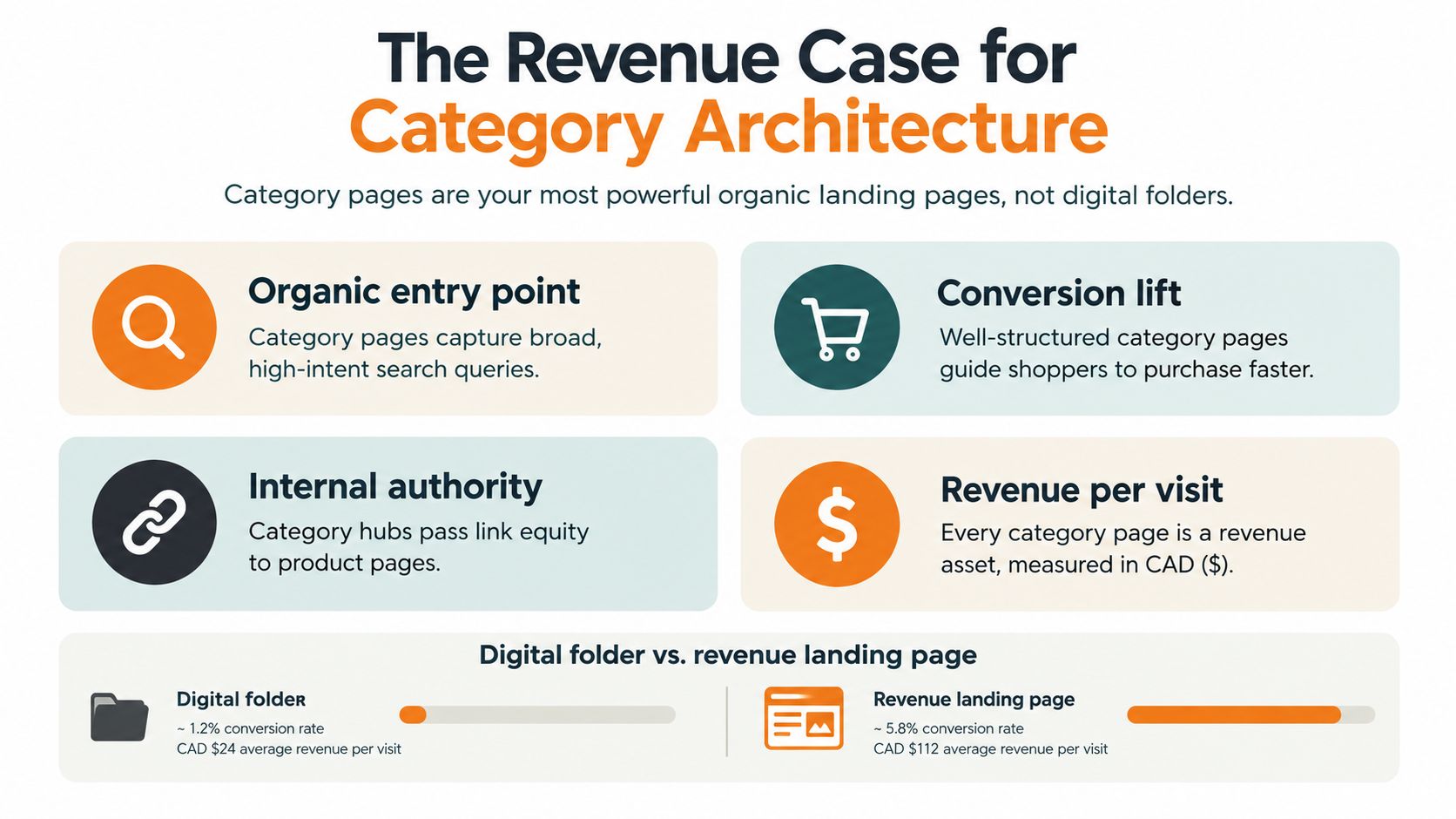
Why category hubs outperform isolated product URLs
A well-built category page consolidates relevance around a product family. It can rank for the broad commercial term, support related searches through subcategories and useful attributes, and link directly to the products that satisfy the demand. The page also remains useful when individual SKUs sell out or disappear, because the category can continue directing shoppers to available alternatives.
That resilience matters in ecommerce. Product inventories change constantly, while the underlying need often remains stable. A discontinued product URL may return an unavailable message, but a category such as waterproof women's hiking boots can keep serving shoppers as products are replaced, reordered, or reprioritised.
Commercial rule: Build category pages around durable customer demand, not around the temporary shape of the inventory feed.
Navigation also determines how authority moves through the site. A category page linked from primary navigation can pass internal relevance to subcategories and product pages. Descriptive anchors from buying guides, editorial content, and related collections reinforce those relationships. This creates a useful hierarchy for both shoppers and crawlers, provided the links point to the canonical destinations.
What success should look like
Rankings are an input, not the final outcome. Measure category pages through Canadian organic impressions, non-brand clicks, generic commercial queries, organic revenue, assisted conversions, add-to-cart activity, and checkout progression. A page ranking for a broad term but attracting visitors who can't find relevant stock, delivery information, or a clear route to products isn't performing as a revenue asset.
The practical opportunity is to treat category pages as commercial infrastructure. Titles and headings establish relevance, product links expose inventory, introductory copy clarifies the collection, and merchandising helps shoppers narrow their choice. When those pieces work together, the category page supports demand capture before the shopper has selected a specific SKU.
Building a Crawlable Hierarchy and Navigation
Search engines can't rank products they haven't discovered. Google warns that products omitted from category-page links may not be found through crawling, which makes load more controls, JavaScript-only navigation, and inaccessible pagination real technical risks, as explained in Google's ecommerce site-structure documentation.
Start with the catalogue, not the copy. Map the hierarchy around customer search behaviour and merchandising priorities, then decide which pages deserve prominent navigation. A broad category should link to relevant subcategories, and those subcategories should expose the products intended for indexing through standard HTML <a href> links.
The crawl-first sequence
Map the commercial hierarchy. Group products by product type, use case, audience, and attributes that reflect genuine Canadian search demand. Don't allow the CMS's default taxonomy to dictate the SEO structure if customers use different language.
Create stable URLs. Use descriptive, durable paths that communicate the relationship between pages. A structure such as
/womens/athletic-wear/yoga-pants/is easier to interpret than an identifier-heavy path. Avoid changing URLs whenever merchandising changes unless there's a strong reason and a redirect plan.Link categories to products directly. Every priority product should be reachable through crawlable links. Product cards should point to the canonical product URL rather than a parameterised or tracking variant. The category page doesn't need to expose every product at once, but products intended for indexing can't exist only behind an interaction a crawler may not execute.
Expose pagination. If the catalogue spans multiple pages, provide accessible links between those pages. Don't make page two dependent on a button that only updates the interface after a script runs. Pagination should help both shoppers and crawlers move through the available inventory.
Validate discovery. Use Google Search Console to review internal links, indexed URLs, and excluded pages. Compare the products your merchandising team considers important with the products search engines can reach. A sitemap can support discovery, but it doesn't replace a logical internal-link structure. A practical sitemap structure should reinforce, not compensate for, weak navigation.
A category page can look perfect in a browser and still hide much of its inventory from crawlers. Test the rendered experience, inspect the HTML links, and check whether pagination exposes real destinations. Pay particular attention to mobile interfaces, where teams often replace visible pagination with an aggressive “load more” pattern.
The same discipline applies when the site serves national, provincial, or bilingual segments. Each additional path can multiply the URL set, especially when filters and regional merchandising operate together. Keep the hierarchy understandable before adding more landing pages.
A crawlable architecture is not the same as a flat architecture. Products should sit within meaningful category relationships, but the site shouldn't force crawlers through endless layers to reach important inventory. Use navigation, subcategory links, related collections, and contextual internal links to provide more than one sensible route to priority pages.
Mastering Faceted Navigation and Canonicalization
Faceted navigation improves shopping when it helps someone narrow a collection by size, colour, price, material, or use case. It becomes an SEO liability when every combination creates a crawlable URL with little unique value. A category with several filters can generate an effectively unlimited set of variants, many of which contain the same products in a different order.
The right question isn't “Should filters be indexable?” It's “Does this exact combination represent a distinct search need and a materially useful collection?” Search demand alone isn't enough. The page also needs relevant inventory, a clear purpose, and content that distinguishes it from the parent category.
Faceted Navigation Decision Matrix
| Filter Type | Search Demand | Inventory Uniqueness | SEO Action |
|---|---|---|---|
| Product type or use case | Demonstrable | Distinct collection | Create a stable, indexable category or subcategory page |
| Meaningful product attribute | Demonstrable | Products share the attribute | Index only when the collection merits its own landing page |
| Colour or size combination | Limited or unclear | Often overlapping | Canonicalise to the parent unless the combination has proven value |
| Price range | Usually unstable | Changes with promotions | Canonicalise or prevent redundant crawling |
| Sort order | None | Same inventory, different order | Canonicalise to the unsorted category |
| Tracking parameter | None | Identical content | Remove from internal links and prevent redundant crawling |
| Multiple stacked filters | Unclear | Usually near-duplicate | Canonicalise or otherwise prevent crawling unless the combination is genuinely distinct |
Decide before the filter launches
Classify each parameter combination before development, not after search engines have discovered thousands of variants. A page such as black trail running shoes may deserve a dedicated, descriptive URL if the inventory is substantial and the search intent is clear. A page sorted by price from low to high doesn't deserve indexation because it doesn't represent a new product collection.
For low-value variants, use a consistent canonical strategy pointing to the parent category where appropriate. Remove redundant parameter links from internal navigation and prevent unnecessary crawling through the site's chosen technical controls. Don't rely on canonical tags alone to clean up an uncontrolled URL system. A canonical is a preference signal, not a substitute for a disciplined information architecture.
Practical test: If you can't explain why a shopper would save, share, or search for the filtered page as a destination in its own right, it probably shouldn't be an indexable category page.
Indexable facets need more than a URL. Give them a descriptive title, a relevant H1, useful category context, accurate product links, and a canonical URL that remains stable. If the inventory disappears or the page becomes indistinguishable from its parent, reassess the landing page rather than keeping it live for a keyword.
Pagination deserves separate treatment from filters. A paginated category represents additional inventory within the same collection, while a sort parameter usually represents the same inventory rearranged. Keep the distinction clear in templates, canonicals, internal links, and reporting. Audit the results after deployment, because filters can interact in ways that weren't obvious in the original design.
Optimizing for AI Discovery and Machine Readability
Category pages increasingly need to support conversational product discovery, not just traditional keyword matching. In 2025, 36% of Canadian consumers reportedly used AI to assist with shopping, a 44% year-over-year increase, according to Canadian ecommerce reporting on AI shopping adoption. The strongest reported use cases included comparing products at 32% and understanding differences between similar options at 24%.
Those tasks expose a weakness in many category pages. A page may contain a product grid and a paragraph of generic copy, but fail to explain which products suit a particular need, how options differ, or what a Canadian shopper can expect from delivery and availability. AI-assisted discovery needs clear distinctions it can retrieve and present accurately.
Make the category answerable
A useful category page should state what the collection is, who it serves, and how shoppers should choose within it. For a supplement category, that might mean distinguishing format, ingredient focus, dietary suitability, and intended use. For footwear, it could mean separating terrain, weather protection, support, and fit. These aren't abstract content topics. They are the attributes a shopper uses to compare products.
Use concise, explicit language:
- Define the collection: Explain what belongs in the category and what doesn't.
- Name selection criteria: Identify the characteristics that separate one option from another.
- Expose product attributes: Keep titles, descriptions, availability, price, and variants accurate and consistent.
- Support comparisons: Link to related categories that answer a nearby need, such as trail shoes versus road shoes.
- Represent logistics clearly: State relevant delivery, returns, and regional availability information where it can affect the decision.
- Use structured data accurately: Implement suitable product, offer, breadcrumb, and list relationships based on what the page displays.
Generic long-form copy often underperforms useful product distinctions. A long article inserted below the grid won't tell an assistant whether one product is suitable for a particular use case unless the page expresses that relationship plainly. The better approach is to give human readers concise buying guidance while exposing reliable, machine-readable attributes that support comparison.
Generative engine optimization strategy should complement, not replace, technical ecommerce SEO. Structured data can't make inaccurate catalogue information trustworthy, and it can't compensate for products hidden behind inaccessible navigation. It works when the visible page, the product feed, and the markup agree.
Avoid markup theatre
Don't add schema just because a type sounds relevant. A category page should represent a collection of products, while each product should carry its own accurate details. Prices, availability, brand, identifiers, and variants need to match the visible experience and remain current. Mark up featured products only when those products are actually represented on the page.
The same principle applies to comparison content. If a category claims that one subset is designed for a particular environment, the inventory must support that distinction. AI systems can only make useful recommendations when the underlying taxonomy reflects real products, not SEO labels created solely to capture a query.
Localization and Compliance in Regulated Niches
Adding a province name to a category heading doesn't create meaningful Canadian localization. It may create another near-duplicate page, split internal signals, and confuse shoppers if the products, pricing, delivery, and eligibility are identical across locations.
The stronger model keeps one authoritative national category wherever the commercial and legal reality is shared. Create a provincial or regional page only when something material changes, such as available inventory, shipping eligibility, provincial rules, language requirements, or a distinct customer need. The page should demonstrate that difference through visible information, not just a location keyword.
Local signals need evidence
68% of Canadian consumers actively seek Canadian products, and Trade.gov's Canada ecommerce overview reports that one in five is willing to pay 20% more for personalization. Those figures support authentic localization, not a volume strategy based on duplicating pages for every province.
For a Canadian-made collection, show origin claims clearly and substantiate them through product information. For a Canadian-owned retailer, distinguish ownership from manufacturing. For locally stocked products, explain fulfilment rather than implying that every item is made locally. These distinctions matter to shoppers and prevent category copy from making broader claims than the business can support.
Regulated categories require an even tighter connection between taxonomy and operations. Cannabis, CBD, wellness, and supplements may involve province-specific availability, shipping constraints, product claims, or advertising limitations. A national category can explain the collection, while a regional experience can surface eligibility, fulfilment, and restrictions where they genuinely differ.
Keep authority consolidated where possible
A practical structure might include one national category with CAD pricing and clear delivery information, supported by provincial pages only where the assortment or rules change. Regional pages should carry distinct titles, headings, internal links, and content based on those real differences. If the only change is the province name, keep the national page and use on-site tools to personalise the shopping experience instead.
Don't hide compliance information in a footer or bury it beneath promotional copy. Category pages often capture shoppers before they reach a product detail page, so restrictions and fulfilment expectations need to appear at the point where the shopper evaluates the collection. This reduces the risk of an organic visitor selecting products that can't be delivered or promoted in their jurisdiction.
Aligning SEO with Conversion and Logistics
A category page can earn visibility and still lose the sale. The failure usually appears after the click, when shoppers can't tell whether products are available, when delivery will occur, or what happens if the order needs to be returned.
DHL's 2025 Canada ecommerce report indicates that 78% of Canadian shoppers may abandon a purchase if their preferred returns option isn't available. That makes returns messaging part of the landing-page experience, not a policy detail reserved for checkout.
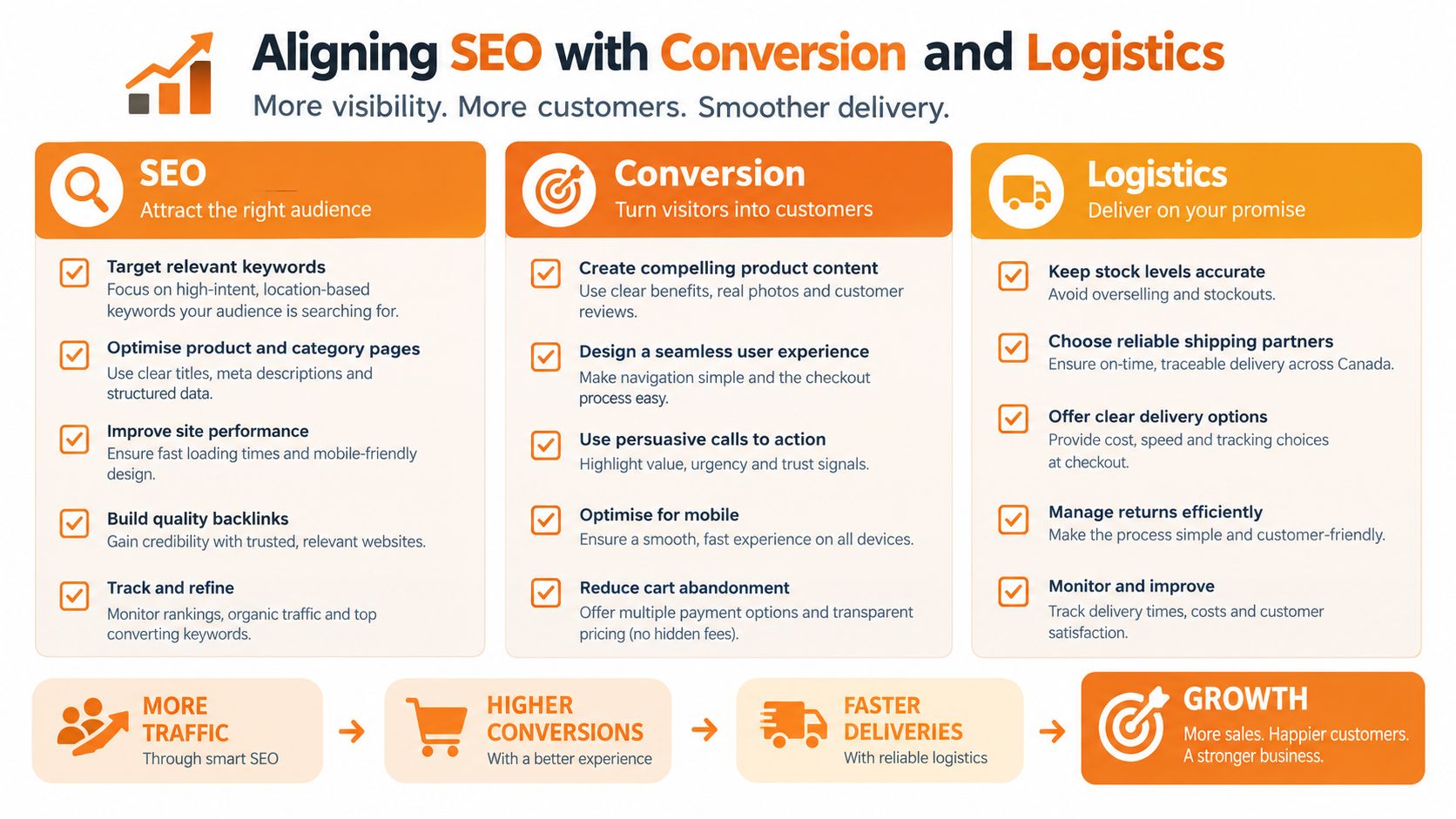
Optimise the full funnel
Start with the query and end with the order. A shopper searching for a product family may need reassurance about fit, ingredients, stock, delivery, returns, and regional eligibility before clicking a product. The category page should answer the questions it can answer and make the remaining path obvious.
Test the page as a commercial system:
- Query alignment: Segment terms by product type, use case, brand, and meaningful attributes.
- Merchandising: Compare bestseller-led, margin-led, new-arrival, and relevance-led product ordering.
- Product cards: Show clear titles, prices, variants, availability, and useful product imagery.
- Logistics: Surface shipping, delivery expectations, returns, and regional restrictions near the product grid.
- Navigation: Give shoppers direct paths to related subcategories and canonical product pages.
- Measurement: Track organic landing-page revenue, add-to-cart rate, checkout rate, and conversion by province and device.
Don't treat a single conversion benchmark as universal. Platform, traffic mix, seasonality, product economics, and customer intent all change the baseline. Your own category-level trend is more useful than an industry comparison that combines unrelated products and audiences.
Omnichannel ecommerce strategy should connect organic landing pages with the fulfilment experience shoppers actually receive. If a page promotes fast delivery but availability changes by province, the interface should make that distinction visible. If returns differ by product type, show the relevant rule before the shopper commits.
Report revenue, not just rankings
A mature dashboard connects search data to business outcomes. Review impressions and clicks, but also examine which category pages produce product views, add-to-cart events, checkout starts, completed orders, and assisted conversions. Segment those results by device and province so a strong national average doesn't conceal a poor mobile or regional experience.
The most valuable SEO test may not involve a title tag. It may involve moving delivery information higher on the page, changing the order of products, improving filter labels, or making returns easier to find. Metadata earns the visit. Relevance, confidence, and logistics determine whether that visit becomes revenue.
Juiced Digital can audit your ecommerce category architecture, faceted navigation, internal links, AI-search readiness, and conversion path, with particular experience in ecommerce and regulated sectors. Visit Juiced Digital to request a focused SEO and CRO assessment for your Canadian or North American store.