

A Vancouver clinic can publish every week and still leave its marketing team asking the same question: which piece is supposed to generate bookings? An e-commerce brand can produce product guides, social posts, and email campaigns, yet have no clear relationship between those assets and revenue. The problem usually isn't effort. It's that the content has been organised as a list of topics instead of a system for moving a specific audience towards a business outcome.
Content pillars work when they connect evidence, editorial decisions, search architecture, compliance, and conversion paths. That means a pillar isn't just “wellness” or “SEO.” It might be compliant education for a regulated health brand, neighbourhood-specific lead generation for a Vancouver service business, or product comparison content that helps a buyer choose the right solution. The subject matters, but the job matters more.
Why Most Content Marketing Fails Before It Starts
A health clinic in Vancouver might publish an article about sleep, a post about supplements, a practitioner video, and a page about massage therapy. Each asset may be useful on its own, but if the pieces target different audiences and lead nowhere, the clinic has created activity rather than an acquisition system.
The same pattern appears in e-commerce. A brand writes about ingredients because the founder cares about them, publishes trend commentary because competitors do, and adds promotional posts before product pages are ready to convert. Search visibility becomes uneven, internal links are improvised, and the marketing team can't explain whether content is attracting prospective customers or merely collecting impressions.

The category problem
Traditional content planning often starts with broad labels:
- Education: General information about the industry.
- Inspiration: Stories and opinions.
- Promotion: Product or service announcements.
- Community: Social posts and audience engagement.
Those labels can help a team organise formats, but they don't tell a writer who the content serves, what decision it supports, which claims are allowed, or where the reader should go next. A regulated CBD company, for example, can't treat an article about potential wellness benefits like a lifestyle blog post. The content needs a defined evidence standard, a careful claims review, and a clear route to compliant product information.
Start with the commercial job
A useful pillar has one primary assignment. That assignment might be generating qualified Vancouver enquiries, supporting compliant education, increasing product revenue, helping existing customers use a product correctly, or building authority in a tightly defined niche.
Practical rule: If a pillar can't be linked to an audience, a decision, and a measurable next step, it's probably a topic bucket rather than a strategy.
Before writing, document the audience's location, search intent, language, objections, regulatory constraints, and conversion path. A clinic serving Vancouver shouldn't assume that national health content will address neighbourhood-level concerns. A brand selling across North America needs to separate Canadian requirements, local language, and broader commercial intent rather than placing everything in one undifferentiated cluster.
The strongest content systems begin with what customers ask, what the business can credibly answer, and what the business needs to achieve. They don't begin with a blank calendar.
The Evidence-to-Brief Workflow for Building Pillars
The practical answer to how to create content pillars is to move from evidence to a brief in seven controlled steps. Each step removes a common source of waste.
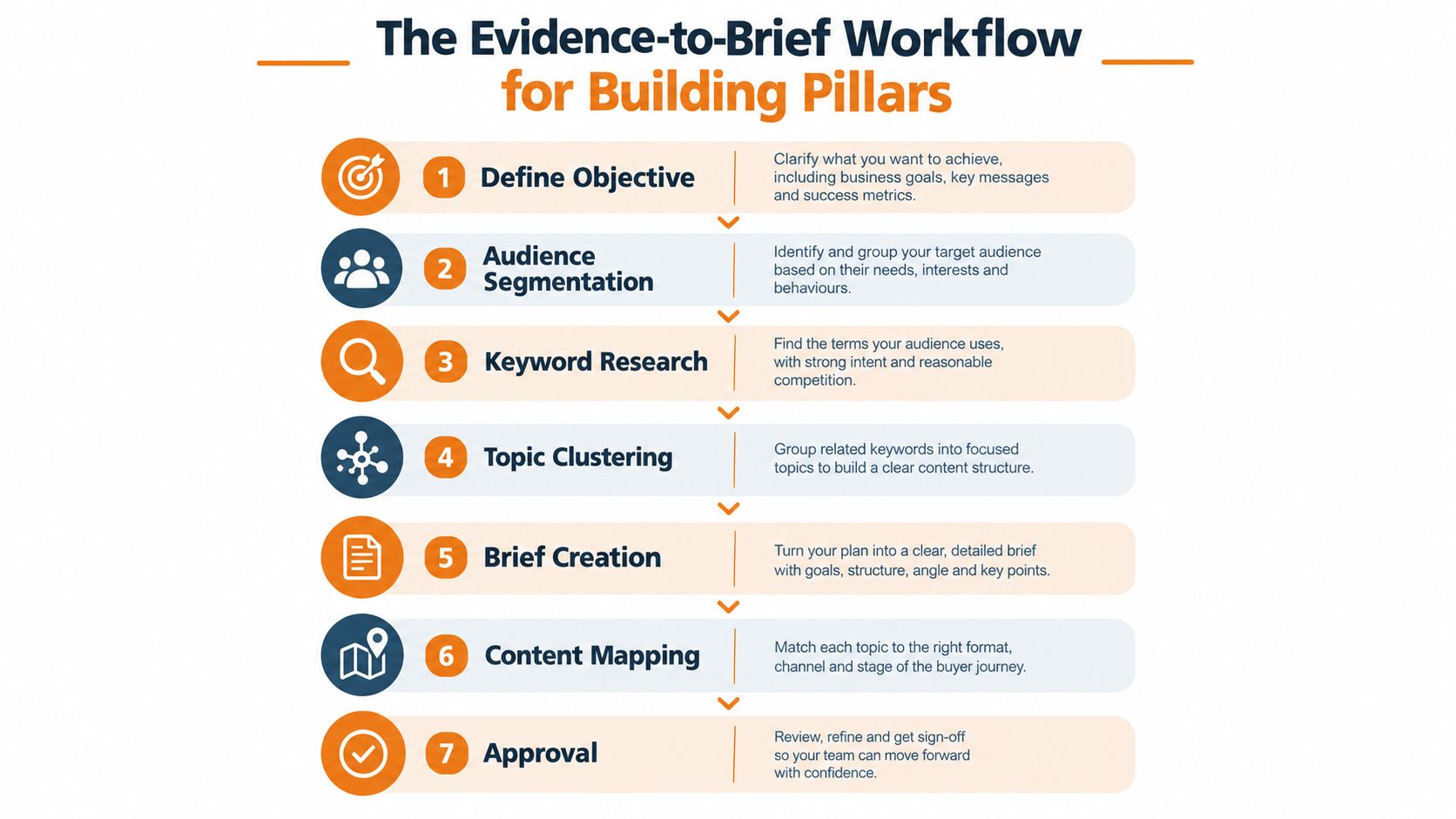
Seven steps from objective to execution
Define one commercial objective. Choose one job for the pillar, such as Vancouver lead generation, qualified e-commerce revenue, booked consultations, or compliant education. Multiple secondary benefits may exist, but one objective keeps prioritisation honest.
Segment the audience. Record location, stage of awareness, problem, intent, and regulatory limitations. “B.C. wellness customer” is too broad. “Vancouver clinic visitor comparing treatment options” gives a writer a usable audience and decision context.
Collect Canadian search and customer-language evidence. Review search results, customer-service questions, sales-call notes, reviews, internal-site searches, and regional terminology. Use keyword research for content planning to identify demand, but don't let volume alone decide what deserves investment.
Group related queries into clusters. Combine queries that represent one underlying problem, then separate those requiring a different answer, audience, location, or funnel stage. A cluster about eligibility shouldn't be mixed with a cluster about product comparisons just because the terms share a word.
Assign a funnel role. Label each cluster as discovery, evaluation, decision, retention, or authority-building. This prevents every page from competing for the same vague awareness audience.
Create one authoritative pillar asset. Build a hub that answers the broad question clearly, then support it with narrower pages. The hub should have a defined audience, evidence standard, author or business expertise, internal-link plan, and conversion destination.
Measure business outcomes. Track organic impressions, non-brand clicks, qualified leads, assisted conversions, lead quality, and revenue. Publication volume is an operational metric, not proof that the pillar is working.
Canadian benchmark evidence places audience understanding at 82% as the most common success factor among high-performing content programmes, followed by high-quality production at 77%, industry expertise at 70%, objective alignment at 62%, and performance measurement at 53% (Canadian content marketing benchmark findings). The order is revealing. Better production can't rescue a team that doesn't understand its audience.
Build the planning record
Use a spreadsheet, Airtable base, or content-management workspace with columns for:
- Persona and location: Who the page serves and whether the intent is Vancouver, Burnaby, Surrey, B.C.-wide, Canadian, or broader.
- Search intent: Informational, comparative, transactional, navigational, or retention-focused.
- Primary and supporting queries: The main problem and related language.
- Funnel stage and target URL: The role of the page and the destination it supports.
- Compliance risk: Claims that need legal, clinical, or regulatory review.
- Internal-link destination, CTA, and KPI: The next action and the outcome that will be assessed.
This workflow takes longer than inventing a list of blog categories, but it reduces rework. It also gives writers better briefs because the assignment includes the audience, evidence, boundaries, and commercial purpose before drafting begins.
Turning Pillars into Searchable Information Architecture
A content pillar works as site structure. The hub page defines the main topic, commercial context, and scope. Supporting pages then handle distinct intents such as problem diagnosis, service-area nuance, comparisons, qualifications, pricing factors, and next-step questions. That structure gives search engines cleaner signals and gives visitors a shorter path to the page that matches what they need.
For a local-services pillar, the hub can explain the service, who it fits, and how to evaluate providers. Supporting pages can cover Vancouver, Burnaby, Surrey, and B.C.-wide situations only where the user need actually changes. If the advice, offer, and constraints are the same, separate location pages usually create thin duplication. If availability, bylaws, travel realities, or local expectations differ, separate pages make sense.
Links have to reflect that logic. The hub should link down to the right supporting pages, and those pages should link back up and across to the most relevant service or conversion page. Descriptive anchors help readers understand what comes next and help crawlers interpret page relationships. Repeating one exact-match anchor across every page weakens that signal and makes the site feel manufactured.
Connect structure to retrieval
AI search and traditional search reward the same thing first. Clear, consistent, crawlable information.
A strong pillar spells out services, locations, expertise, process, eligibility, turnaround expectations, evidence, and next steps in a way that stays consistent across the site. That matters in human review, in search indexing, and in AI-generated answers that pull details from multiple URLs. If those details conflict, the business becomes harder to trust and harder to retrieve accurately.
Google remains the dominant search engine in Canada, so crawlable HTML, indexable canonical URLs, mobile usability, structured internal links, and accurate title and meta elements still carry the load. AI visibility does not replace that work. It raises the cost of getting the basics wrong because fragmented pages and conflicting claims are easier for retrieval systems to misread.
For cannabis, CBD, and functional mushroom brands, architecture also has to reduce compliance risk. Keep education separate from promotion. An educational page can explain terminology, formulation differences, responsible-use considerations, or evidence limits. Commercial pages should handle product or service intent, and any claim that touches health, efficacy, or regulated language should be reviewed before publication. A single all-purpose guide often creates two problems at once. It becomes too broad to rank well for a specific intent, and it increases the chance that educational language drifts into promotional territory.
| Business type | Pillar focus | Key example |
|---|---|---|
| Local service | Location and problem | Vancouver service guide supported by neighbourhood and service-intent pages |
| E-commerce | Education and decision support | Ingredient or product-use hub linked to comparisons and product pages |
| Regulated brand | Evidence and compliance | Carefully sourced education hub separated from promotional claims |
| B2B service | Commercial problem and proof | Industry guide supported by process, comparison, and qualification pages |
A deliberate internal linking strategy maps the hub, supporting pages, conversion destinations, and the links that need review during updates. Every URL should serve a distinct intent. When two pages answer the same question, consolidate them, choose the canonical destination, and redirect the weaker page if needed.
Sector-Specific Examples and Real-World Applications
British Columbia's market makes generic national assumptions especially dangerous. The province has more than 500,000 small businesses, representing 98% of all businesses, and those businesses contributed 34% of B.C.'s GDP in 2023 (Pacific Economic Development Canada operating context). Content for this audience should respect limited budgets, owner-led decisions, local competition, and the need to connect activity with measurable return.

Local services
A Vancouver clinic, contractor, or professional service firm usually needs pillars built around customer problems and service areas, not a long list of industry terms. One pillar might cover choosing the service, another might answer preparation and aftercare questions, and a third might provide proof through practitioner expertise, customer experiences, or process transparency.
The pages should reflect real local intent. Vancouver, Burnaby, and Surrey may require different service-area pages only when availability, travel, neighbourhood needs, or customer questions differ. Thin location pages that change only the city name don't create useful local authority.
E-commerce
An e-commerce brand needs a balance between discovery and decision support. Educational content can explain how to compare products, interpret ingredients, choose a format, or use an item responsibly. Commercial pages should make product differences, availability, shipping context, and the next step clear.
The trade-off is focus. A brand shouldn't create a pillar for every trend it can mention. A subject deserves investment when the business has a credible answer, the audience has a relevant problem, and the page can connect to a product or retention path.
Regulated and niche sectors
Cannabis, CBD, functional mushrooms, and overall health require tighter separation between what can be evidenced and what can be promoted. A narrow evidence-and-compliance hub may be more valuable than a broad trend pillar. Writers should identify unsupported health claims, avoid presenting uncertain outcomes as guarantees, and route readers towards compliant pages.
For all three models, the brief should specify the acceptable evidence, review owner, CTA, and prohibited claims before drafting. That control is more useful than publishing quickly and correcting risky wording after the page is live.
Measuring Performance and Pruning Weak Pillars
A pillar deserves more budget only if it improves a business outcome. Publishing more URLs is not the goal. Review performance at 30, 90, and 180 days with the same baseline, attribution rules, and Canadian location filters each time, or the trend line becomes hard to trust.
The first checkpoint is operational. At 30 days, confirm the pages are crawlable, indexed, internally linked, and earning impressions for the intended queries and locations. By 90 days, shift to click-through rate, ranking movement, engagement with the next step, and whether enquiries match the offer. At 180 days, judge the pillar on assisted conversions, qualified pipeline, repeat purchase behaviour where that matters, and revenue contribution.
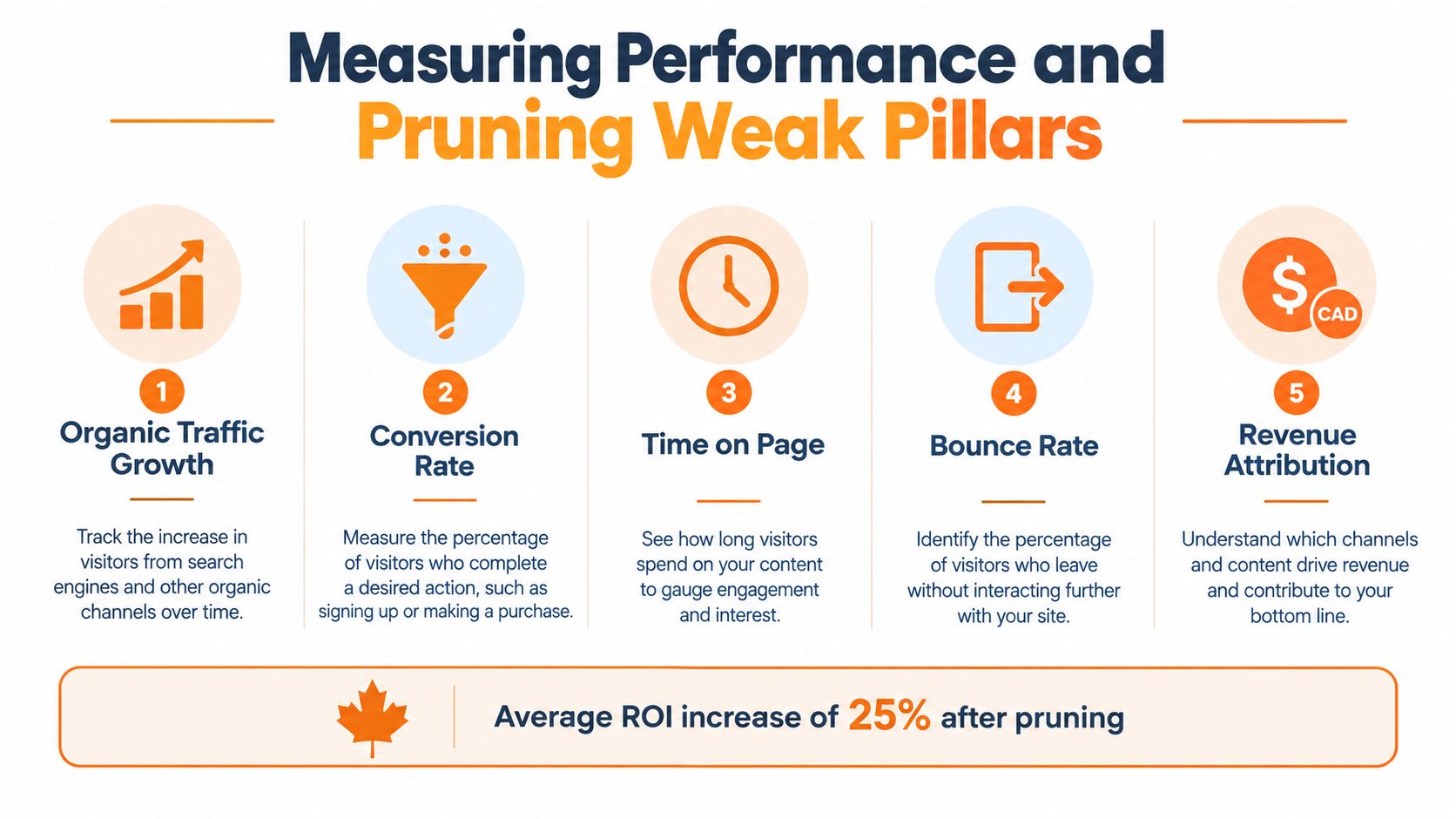
Use a decision-focused dashboard
A useful dashboard helps a team decide whether to expand, repair, merge, or stop a pillar.
Track:
- Organic impressions and non-brand clicks: Whether the pillar reaches the intended search audience.
- Click-through rate: Whether titles and snippets line up with the query well enough to earn visits.
- Canadian location rankings: Whether the content is visible where the business operates.
- Qualified leads and assisted conversions: Whether the pillar influences meaningful actions beyond the first session.
- Lead quality and revenue attribution: Whether the pillar supports commercially valuable demand.
Canadian content teams often say strategy matters, but measurement discipline is usually what separates steady publishing from useful results, as noted earlier. In practice, I see the same issue across B.C. service businesses and regulated brands. A pillar can look healthy in Search Console while contributing very little to pipeline if the traffic is broad, the CTA is weak, or the page attracts researchers instead of buyers.
Prune with evidence
Run a quarterly review and make the trade-offs explicit. Consolidate pages with overlapping intent. Redirect obsolete URLs. Update provincial references when guidance, product rules, or market conditions change. Repair internal links that no longer support the path from education to action. Then check cannibalisation by comparing pages aimed at the same query and seeing which one earns impressions, clicks, and conversions.
In regulated sectors, this review needs an extra filter. Cannabis, CBD, functional mushrooms, and natural health products require tighter separation between what can be evidenced and what can be promoted. If a pillar keeps attracting the wrong audience, creates claim risk, or cannot support a compliant next step, pause it or narrow it.
Do not retire a topic too quickly. A weak CTA is often easier to fix than a weak pillar. If the audience is right but the page fails to move readers forward, improve the offer, proof, and destination first. A clear content marketing ROI framework keeps that review tied to outcomes, not output.
Using AI Tools to Speed Production Without Losing Accuracy
A team can cut production time with AI and still publish weak, risky content if the inputs are loose. The win is not faster drafting on its own. The win is faster execution inside a controlled workflow where evidence, search intent, offer fit, and approval rules are set before anyone generates copy.
That matters in B.C., especially for regulated categories and local service businesses with small teams. AI is useful for clustering related queries, pulling recurring customer questions from reviews or call notes, shaping outlines, drafting metadata, repurposing long-form pieces into email or social versions, and spotting patterns in performance data for an editor to review. It should not decide what you can promise, what a product does, or how far a claim can go.
Recent business use shows why the pressure to automate is growing. In Q2 2025, 12.2% of Canadian businesses used AI to produce goods or deliver services, up from 6.1% in Q2 2024 (Statistics Canada publication on business technology use). Productivity gains are possible, but speed does not protect accuracy.
A safer production sequence
Start with approved inputs. Give the tool source material you would stand behind, a clear audience, the target query, the business offer, and the claim boundaries. If the prompt is broad, the draft will usually blur audience fit and evidence.
Build structure first. Ask for entities, subtopics, missing questions, objections, and format options before you ask for prose. This is the stage where you catch weak angles, overlapping intent, or an outline that cannot support a measurable outcome.
Check every factual statement. Review dates, regulations, ingredient details, clinical wording, and regional references against primary or approved sources. If support is missing, cut the line. Do not polish an unsupported claim until it sounds believable.
Add practitioner judgement. The useful layer is still human. Add process detail, constraints, examples from real delivery, and the wording customers naturally use in sales calls and intake forms.
Run compliance and brand review. For cannabis, CBD, functional mushrooms, and health-adjacent content, review claims line by line and keep a record of the source and approval status for sensitive wording.
Measure the finished asset against the original goal. Check search visibility, engagement, lead quality, and assisted conversions. If AI saves writing time but creates more revision cycles or attracts the wrong audience, the system needs fixing.
AI-assisted discovery is also changing how people find information. Canadian consumer research points to growing use of generative tools for search and answer-finding (Canadian AI adoption research). That raises the standard for consistency across service pages, profiles, FAQs, and third-party mentions. If your business describes the same service three different ways, both buyers and retrieval systems can get the wrong read.
When to Consolidate, Pause, or Retire a Content Pillar
A content pillar should earn its place. I see teams in B.C. run into trouble when they treat every promising topic like a pillar, then realise too late that nobody can review it properly, support it with subject expertise, or connect it to revenue.
Use four tests before you keep investing: available expertise, compliance risk, production effort, and attributable revenue. These force a practical decision. A pillar can have visible search demand and still be the wrong call if nobody on staff can stand behind the content. A pillar with real commercial value may still need a tighter scope if legal review is slow or claims rules are strict. If a topic has weak demand, no clear next action, and no realistic path to qualified business, it should not stay on the calendar.
The capacity decision matrix
| Decision | Use it when | Practical action |
|---|---|---|
| Keep and expand | The pillar attracts the right audience and supports qualified actions | Add supporting pages, proof, and format adaptations |
| Consolidate | Several pages overlap or compete for the same intent | Choose a primary URL, merge useful material, and redirect weaker pages |
| Pause | The topic may matter, but expertise, evidence, or production capacity is missing | Stop new briefs and reassess after resolving the constraint |
| Retire | The pillar creates risk, attracts the wrong audience, or cannot support a meaningful business outcome | Remove or redirect relevant pages and document the decision |
AI changes the capacity calculation, but it does not remove it. Faster drafting helps a team maintain a focused system. It also makes it easier to publish across too many pillars before the business has enough review capacity, proof, or demand to support them. That problem shows up quickly in regulated sectors, where one weak claim or inconsistent page can create approval delays across the whole workflow.
For cannabis, CBD, functional mushrooms, and other health-adjacent categories, smaller often works better. A narrow pillar built around evidence, approved wording, and real customer questions usually performs better than a trend-driven category filled with articles nobody is comfortable promoting. It also gives sales, compliance, and content teams a shared standard for what gets published and what stays in draft.
Strategic test: If you can't name the audience, the business job, the reviewer, and the next measurable action, don't promote the pillar to production.
Good pillar management is subtraction as much as expansion. Consolidate when topics overlap and split authority. Pause when the business lacks proof, approvals, or internal ownership. Retire pages and clusters that keep pulling in the wrong audience or fail to support a meaningful outcome after a fair test period.
Strategic focus usually beats volume, especially for Vancouver companies balancing local search visibility, limited production time, and tighter compliance review.