
A digital PR company creates earned media and search-relevant brand assets that drive qualified traffic, links, and conversions, not just press mentions. In California, roughly 2.54 million small and medium-sized businesses sell physical products online, while 94% of California small businesses use at least one technology platform, making measurable digital visibility a commercial necessity.
You may be searching for an agency because organic visibility has stalled, press coverage arrives inconsistently, or a previous campaign generated impressive-looking reach without producing enquiries. That frustration is justified. A list of media logos doesn't tell you whether the right customers discovered your company, searched for your brand, visited a useful landing page, or converted.
The strongest digital PR programmes connect earned media, SEO, conversion optimisation, local visibility, and revenue reporting. They also recognise that AI-generated search answers are changing how people discover businesses, although AI visibility remains harder to attribute than a conventional referral click. The right partner won't promise that every placement produces a sale. It will show how campaign activity contributes to a chain of commercial outcomes and where the evidence remains incomplete.
What Happens When You Hire a Digital PR Company
A typical engagement starts after a business owner notices the same pattern for several months. Competitors appear in industry publications, search results remain dominated by familiar brands, and internal content earns little attention. The company hires a digital PR company expecting coverage, but the useful work starts before anyone sends a pitch.
The agency first scopes the commercial problem. It reviews priority products or services, target locations, customer questions, competitors, existing search visibility, previous coverage, analytics access, and legal or regulatory restrictions. It then maps audiences and publications, separating a journalist who reaches procurement leaders from one who attracts general awareness. This distinction matters because a large audience can still be commercially irrelevant.
The next stage turns business knowledge into a story people can publish. Depending on the company, that might mean a data-led article, expert commentary, a founder perspective, a useful market resource, a local trend, or a response to a timely news event. The agency creates the supporting content, develops targeted outreach, coordinates experts or partners, and adapts the pitch for each publication rather than distributing identical copy.
A useful overview of how public relations supports reputation and visibility is available in Juiced Digital's explanation of public relations. Digital PR adds a stronger performance layer by connecting that visibility to search demand and user behaviour.
The engagement is collaborative
Your team still supplies subject expertise, approvals, customer language, product evidence, and access to decision-makers. A PR team can identify an angle, but it can't responsibly invent proof, approve a health claim, or answer a technical journalist's questions without your input.
Expect an operating rhythm that includes strategy sessions, editorial calendars, pitch approvals, placement tracking, content revisions, and reporting. Coverage may create a short-lived spike, but durable value usually comes from combining media activity with optimised pages, internal links, paid amplification, email follow-up, and conversion tracking.
Practical rule: Treat a placement as the beginning of a measurement path, not the final deliverable.
Core Services and How Digital PR Fits With SEO and Paid Media
A capable digital PR company normally organises its work into four connected functions: strategy, creation, distribution, and optimisation. The exact mix depends on whether you're promoting a local clinic, an e-commerce catalogue, a professional service, or a regulated product.
Strategy starts with commercial intent
The agency should identify the business pages and actions that matter before developing a campaign. For a Vancouver service business, that could be a booking page, service-area page, or Google Business Profile. For an e-commerce brand, it could be a product category, comparison guide, or educational resource that supports non-branded discovery.
Audience mapping then determines the media opportunity. A local campaign may target neighbourhood publications, regional business journals, community organisations, and relevant creators. A national campaign may focus on trade publications, specialist editors, podcasts, newsletters, and expert-led commentary.
Creation gives journalists a reason to respond
Digital PR content works best when it offers something more useful than a company announcement. Common formats include:
- Data stories: Original analysis, surveys, public datasets, or customer insights presented with a clear editorial angle.
- Expert commentary: A named subject-matter expert who can explain an issue accurately and quickly.
- Practical resources: Calculators, visual explainers, research summaries, checklists, and original guides.
- Newsjacking: A timely, evidence-based response that helps an editor complete a story.
- Partner campaigns: Joint content with associations, creators, complementary businesses, or community groups.
The asset shouldn't exist only to attract links. It needs a credible reason to be cited, a useful destination for visitors, and a logical relationship to the product or service you sell.
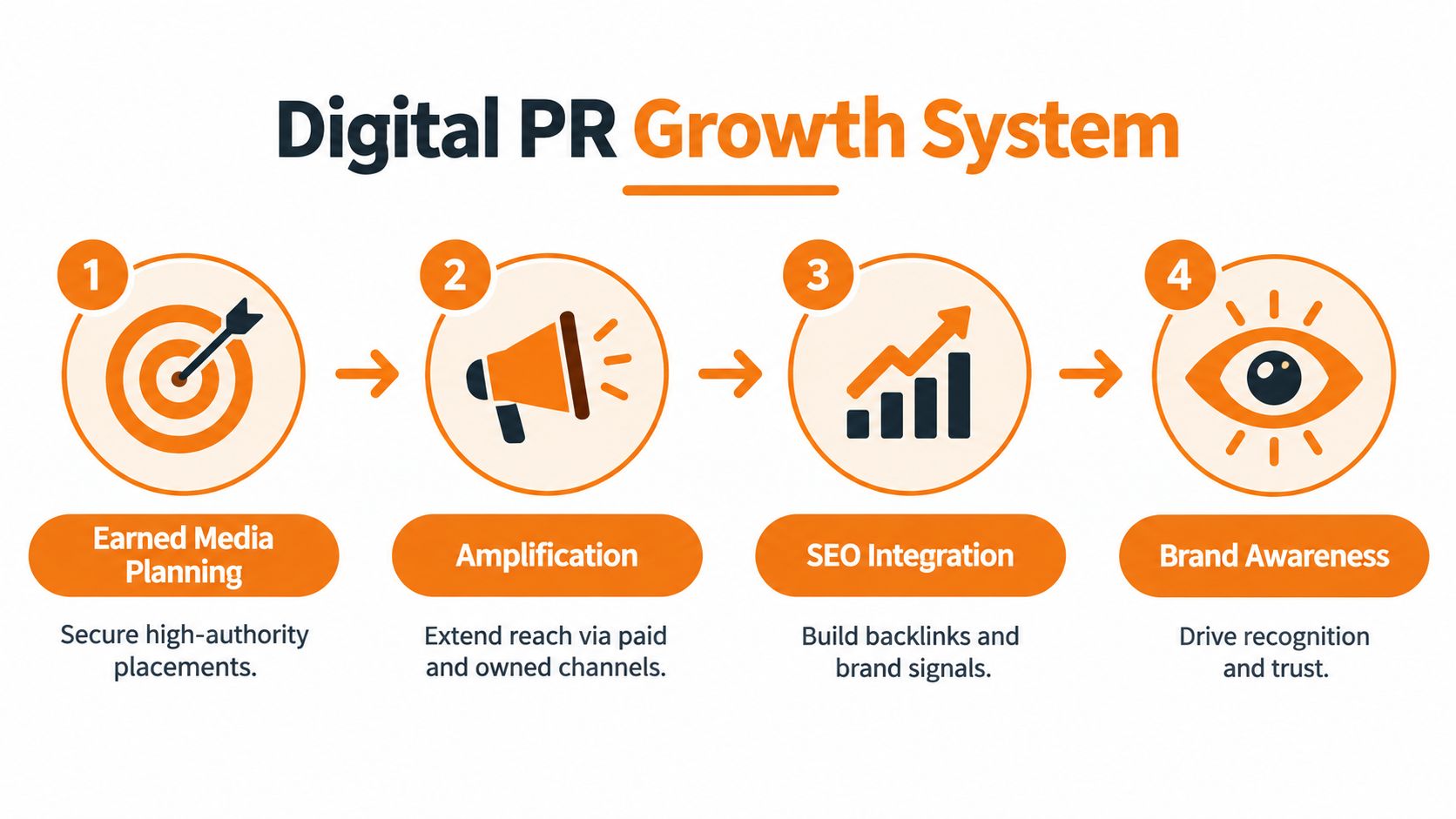
Distribution connects earned, paid, and owned channels
Outreach should be selective. The team researches publication focus, journalist interests, audience relevance, editorial requirements, and timing. It may also coordinate founder posts, partner newsletters, social content, creator amplification, or a small paid test that helps validate which message attracts the right audience.
Paid media and PR have different jobs. Paid ads provide controlled distribution and fast message testing. Earned media provides third-party credibility and can create discovery that doesn't depend on continuing ad spend. Owned channels let you capture and nurture the attention generated elsewhere.
SEO turns attention into compounding visibility
A placement can support SEO through a relevant link, branded search demand, contextual recognition, and a stronger association between your organisation and its subject area. It won't fix poor technical SEO, weak page intent, confusing navigation, or a slow conversion path. The agency needs to coordinate with the team responsible for on-page improvements, structured business information, internal linking, and content quality.
The relationship between earned coverage and search performance is explored in Juiced Digital's guide to digital PR for SEO. California's technology environment reinforces the need for this integration. The U.S. Chamber of Commerce reports that 94% of California small businesses use at least one technology platform and 32% currently use an AI platform in its small-business technology report.
KPIs and Measurement That Actually Matter for Digital PR
A campaign can earn coverage and still fail commercially. The failure often appears when an agency reports impressions, outlet counts, and screenshots but can't explain what happened after a prospect encountered the story.
Measurement works better in three layers. The first captures earned-media credibility, including relevant publications, brand mentions, expert citations, link context, and the quality of the audience reached. The second tracks search visibility, such as branded queries, impressions for priority topics, relevant backlinks, local visibility, and the appearance of consistent business information across trusted sources. The third records business actions, including qualified referral visits, calls, form submissions, bookings, assisted conversions, opportunities, and revenue.
A BDC-backed Canadian consumer study found that 47% of consumers search online before buying and 70% are influenced by consumer opinions posted online, as reported in CBC's coverage of Canadian consumer trends. That supports a measurement model in which media coverage and public sentiment are connected to the pages and actions that influence a purchase.
A practical reporting model
| Layer | Example KPIs | Review Cadence |
|---|---|---|
| Earned credibility | Relevant placements, editorial mentions, link relevance, expert citations | After each campaign and monthly |
| Search visibility | Branded-query impressions, priority-topic visibility, relevant backlinks, local pack visibility | Monthly and quarterly |
| Commercial impact | Qualified referral traffic, assisted conversions, calls, bookings, sales-qualified leads, revenue by source | Weekly for actions, monthly for trends |
Use tagged publisher links wherever possible. Review analytics referral data alongside Search Console query changes, CRM source fields, call tracking, Google Business Profile actions, and landing-page conversion rates. For local campaigns, segment results by municipality or service area rather than combining every location into one total.
Why vanity metrics mislead
Impressions estimate potential exposure, not attention or intent. A placement in a high-profile publication may reach the wrong audience, contain no useful path to your site, or appear beside a claim that doesn't fit your brand. A smaller specialist publication can produce fewer visible impressions while sending more relevant visitors and generating stronger commercial conversations.
Backlinks deserve the same scrutiny. Count relevance, destination page, surrounding context, referral quality, and whether the link supports a broader topic cluster. Don't accept a report that treats every link as equal or presents authority scores without showing the actual publication and page.
The best report answers one question: what changed for the business after the campaign, and what evidence connects that change to the work?
How to Evaluate and Choose a Digital PR Company
Agency selection becomes easier when you stop asking which team can promise the most coverage and start asking which team can explain the entire path from idea to qualified action.
Begin with the portfolio. Look for work in your market, audience, geography, and risk environment. A consumer campaign for an unregulated product doesn't prove that an agency can handle health, cannabis, CBD, finance, or professional services. Ask to see the original objective, the content or angle, the media strategy, the reporting method, and the business outcome. Be cautious if the agency only shows logos or screenshots without context.
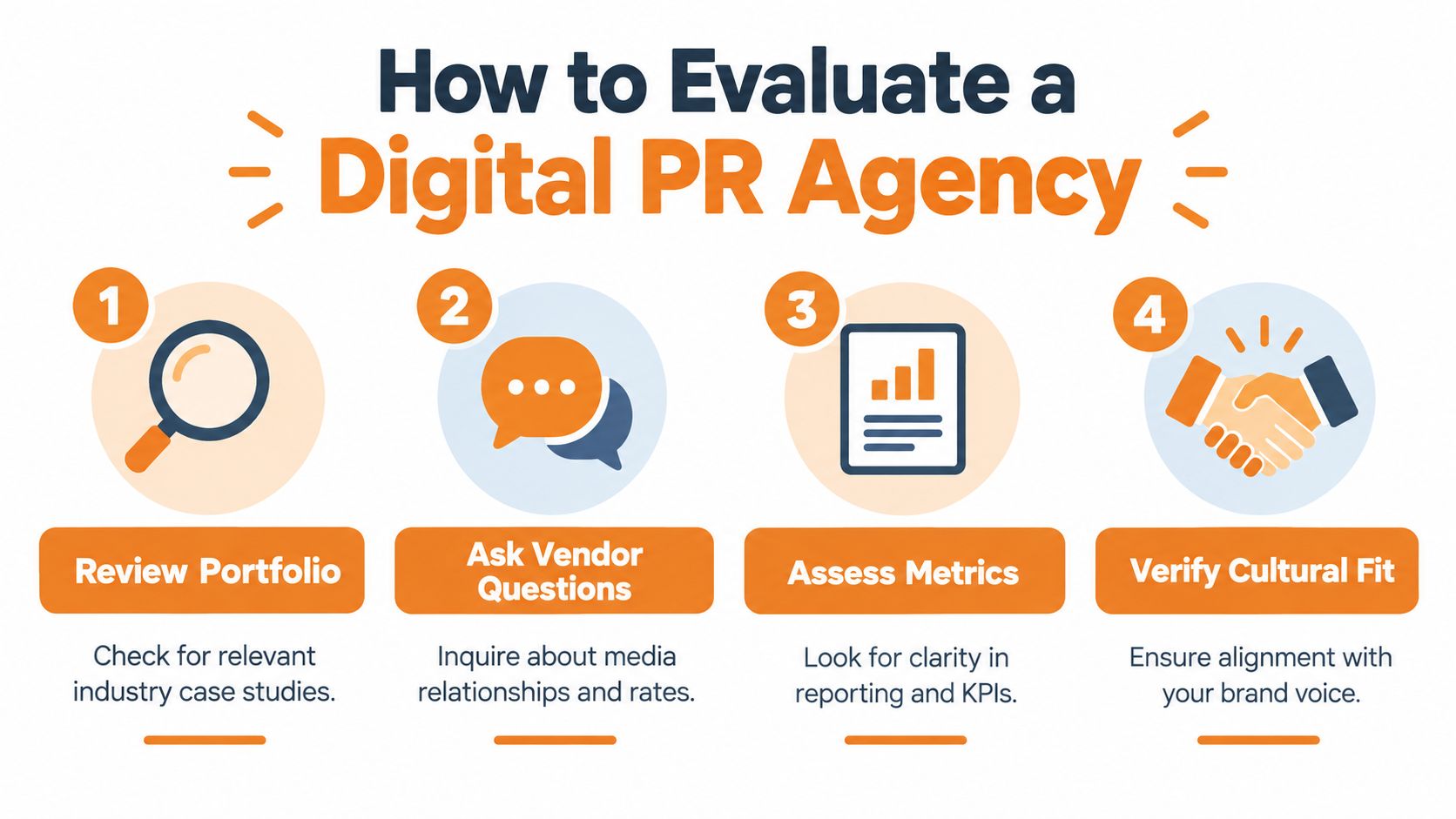
Questions worth asking in the vendor interview
- What do you count as success? Look for a mix of coverage quality, search visibility, qualified actions, and commercial outcomes.
- How do you choose publications? The answer should address audience fit, editorial relevance, geography, topical authority, and link context.
- What will you need from our team? A serious partner will identify approval, expert, data, product, and compliance requirements.
- How do you attribute results? Ask about UTM tags, referral reporting, branded-query analysis, CRM integration, assisted conversions, and attribution limits.
- What happens if a pitch fails? Strong agencies describe testing, angle refinement, journalist feedback, and content iteration, not a guaranteed media result.
- Who writes and approves claims? This matters particularly in regulated or evidence-sensitive sectors.
Pricing needs a clear scope
Common commercial structures include a monthly retainer, a fixed campaign fee, a performance component, or a hybrid arrangement. Retainers can support ongoing relationships and experimentation. Project fees suit a defined research asset or product launch. Performance components may align incentives, but they can also encourage low-value placements if the contract rewards volume rather than relevance.
Ask what the fee includes. Creative production, research, design, media-list development, outreach, follow-up, reporting, paid amplification, expert coordination, and revisions may be priced separately. A useful discussion of digital marketing agency pricing can help you identify scope differences before comparing proposals.
Red flags that should stop the process
A guarantee of a fixed number of editorial links is risky because publications control their own decisions. So is a promise to make every campaign appear in AI answers. AI-search inclusion can vary by prompt, location, personalisation, source availability, and system behaviour, and users may not click even when a brand is mentioned.
Be wary of agencies that:
- Sell domain metrics alone: Authority scores don't demonstrate audience relevance or revenue impact.
- Hide the publication list: You should know where coverage appeared and whether the outlet fits your market.
- Use mass outreach: Generic pitches can damage relationships and produce weak editorial alignment.
- Avoid analytics access: If the agency can't inspect the relevant data, it can't credibly report commercial impact.
- Ignore compliance: Regulated campaigns need documented evidence, controlled wording, review workflows, and appropriate publishers.
B.C. readiness also affects your priorities. Only 15% of B.C. businesses reported using generative AI or planning to use it soon, while 68% had not considered adopting it, according to the B.C. Chamber of Commerce AI adoption report. That gap argues for a staged plan. Build accurate business information, reviews, strong pages, and reliable measurement before paying for an elaborate AI-search promise.
Real Campaign Examples and Regulated-Industry Notes
A Vancouver plumbing company and a North American e-commerce brand shouldn't receive the same PR brief.
For the local service company, the first useful move may be fixing inconsistent business information, improving service-area pages, strengthening review generation, and clarifying the booking path. Earned media can then highlight a local data point, seasonal advice, or an expert response to a community concern. The result to watch isn't a coverage count. It's whether people in the target service area discover the business, search its name, call, request a quote, or book.
An e-commerce brand has a wider content surface. A digital PR company might build a category resource, develop original analysis, provide product expertise to trade editors, and direct coverage to a comparison or buying guide. California provides a substantial environment for this work. A technology report identifies about 4.24 million small and medium-sized businesses in the state, with roughly 2.54 million, about 60%, selling physical products online and generating estimated total revenue of $457 billion in the measured year, as detailed in the California online small-business report.

Regulated campaigns need a different operating model
Cannabis, CBD, functional mushrooms, and health brands face tighter scrutiny around evidence, wording, platform policies, and publisher fit. A credible campaign separates educational information from product claims, records the source for every material assertion, and sends copy through a documented review process.
The agency should also explain what it won't say. Claims about treating, preventing, curing, or guaranteeing a health outcome can create legal and reputational exposure when the evidence doesn't support them. A publisher that accepts sensational language may deliver short-term attention while creating a long-term trust problem.
In regulated marketing, restraint is part of performance. A compliant, credible mention is more valuable than a dramatic placement that your legal or platform partners later require you to remove.
Next Steps and How to Move From Planning to Campaign Launch
Start with a one-page brief. State the commercial priority, audience, geographic scope, products or services, target pages, known restrictions, existing analytics, previous PR activity, and the action you want a qualified visitor to take. This gives agencies something concrete to price and prevents the proposal from becoming a menu of vague deliverables.
Shortlist teams that can show relevant work and explain their measurement process. During the final conversation, ask who owns strategy, writing, outreach, approvals, reporting, and compliance. Confirm whether you'll receive the actual placement list, campaign assets, referral data, search observations, and recommendations for the next cycle.
Before launch, agree on a baseline and tracking plan. Set up publisher link tagging, conversion events, call or form attribution, CRM source fields, and a reporting schedule. For local businesses, separate target municipalities and service areas. For e-commerce brands, connect coverage to category pages, product discovery, assisted conversions, and revenue reporting.
Give the agency enough access to learn your business, but keep approval rights for sensitive claims and brand representation. Agree on response times, escalation procedures, content ownership, publication monitoring, and how the team will handle an unsuccessful angle. A campaign becomes more useful when both sides can test, learn, and revise instead of defending an initial idea.
The decision is straightforward. Hire a digital PR company when you need credible visibility that supports search and acquisition, not when you only want a press-release distribution service. Choose the partner that can connect a story to a relevant audience, a useful page, a measurable action, and an honest account of what the data can't prove.
Juiced Digital combines digital PR with AI-powered SEO, paid advertising, conversion rate optimisation, and local or e-commerce growth strategies for businesses that need measurable visibility. Visit Juiced Digital to review its services and request a consultation about turning earned coverage into qualified traffic, leads, and sales.