
A Canadian B2B advertiser can pay about US$43 for a single click on a lead-generation keyword, according to Canada-focused paid search data. That figure changes the question. Lead generation marketing isn't about buying more traffic. It's about turning expensive attention into qualified conversations, then proving which channels create revenue.
Canadian teams also work inside a more cautious buying environment. Longer decision processes, regional differences, consent requirements, and fragmented buyer journeys mean a form submission isn't automatically a valuable lead. The businesses that perform well connect search intent, conversion architecture, CRM routing, follow-up, and compliance into one operating system.
What Lead Generation Marketing Really Means in 2026
A single click can cost about US$43 for the keyword “B2B lead generation” in Canada-focused paid search data. The same source lists about US$31 for “B2B marketing agency” and US$27 for “account based marketing”. These are historical reference points, not universal current prices, but they show why Canadian lead generation requires more than traffic acquisition. The Canadian keyword cost context supports a practical standard: measure the path from click to qualified lead, sales opportunity, and revenue.
Lead generation marketing is the operating system behind that path. It attracts a potential buyer, captures relevant contact details, records intent signals, sends the information to a CRM, and assigns the next action to a salesperson or nurture program.
A page view, social reaction, impression, or low-intent download can show attention. None proves that sales received an opportunity worth pursuing. Qualification depends on fit, interest, timing, and permission to continue the conversation, with the weighting changing by market. A local service inquiry may need location and service urgency. A B2B form may need company size, buying role, and project context.
The difference between attention and pipeline
A working lead engine answers five questions:
- Who is the prospect? Record the source, offer, geography, company or household context, and relevant behaviour.
- Why did they convert? A pricing request signals different intent from a general newsletter subscription.
- What happens next? Set a defined sales, nurture, or disqualification path before the form goes live.
- Who owns the response? An unassigned form creates a contact record, not a reliable pipeline process.
- Can revenue be traced back? Marketing and sales need shared definitions for MQL, SQL, opportunity, and closed customer.
Channel selection should follow the buying task. Local SEO captures existing local demand. Paid advertising captures active searches but can become expensive when competition rises. Content and organic search build consideration over time. Conversion rate optimisation improves the share of visitors who become leads. Email and lifecycle nurture support consented contacts through longer decisions. Digital PR strengthens discovery and authority, while AI search visibility helps brands appear in emerging answer-led journeys.
Canadian execution adds constraints that generic US playbooks often miss. Regional demand, smaller addressable markets, and higher acquisition costs can make broad targeting wasteful. CASL requires disciplined consent, sender identification, and unsubscribe handling for commercial electronic messages, including email and relevant SMS programs.
AI can speed research, segmentation, copy drafting, lead scoring, and CRM triage. It still needs human review for positioning, proof, qualification logic, and lawful communication. In regulated sectors, that review also protects against unsupported claims, sensitive-data misuse, and automated outreach that lacks clear consent.
The Core Channels That Drive Qualified Leads
No single channel reliably carries a Canadian buyer from first contact to signed agreement. Local services may win the first interaction through a map listing, B2B software may need search, a comparison guide, and a sales conversation, while e-commerce brands often depend on several visits before a purchase.
| Channel | Funnel stage | Typical Canadian CPL |
|---|---|---|
| Local SEO and Google Business Profile | High intent and decision | Varies by service, market, and conversion path |
| Google Search and paid media | Active demand capture | Varies with competition and lead quality |
| Content and SEO | Awareness and consideration | Compounds through ongoing publishing and optimisation |
| CRO | Capture and decision | Usually measured as conversion efficiency rather than a standalone CPL |
| Email and lifecycle nurture | Consideration and reactivation | Depends on consented database quality and engagement |
| Digital PR | Authority and discovery | Depends on campaign scope and placement quality |
| AI search optimisation | Emerging discovery | Developing, with outcomes tied to entity and content visibility |
Use local intent before buying broader reach
Canadian local search deserves operational priority. A Canadian local SEO source reports that roughly 46% of Google searches have local intent, and that the Google Map Pack appears for about 93% of those searches. The same source reports that about 76% of smartphone local searches lead to a business visit within one day.
Those figures make Google Business Profile optimisation more than a branding exercise. A Vancouver electrician, dentist, or HVAC operator should maintain accurate service areas, categories, hours, photographs, review responses, call handling, and booking paths. The landing page must match the searcher's need, whether that's an emergency call, an estimate, or a scheduled appointment.
Sequence channels instead of spreading budget thin
Paid search can capture demand quickly, but it stops producing when spend stops. Content and SEO take longer to build, but they can create durable entry points for informational and comparison searches. CRO often provides the quickest practical improvement because it works on traffic the business already owns.
Email can nurture captured contacts, but it can't repair poor targeting or missing consent. Digital PR can strengthen authority and referral discovery, while AI search optimisation requires clear entities, structured information, and content that directly answers questions. A business should normally connect at least one capture channel, one nurture mechanism, and one authority layer, then measure how those pieces work together.
For paid search execution, teams can review PPC advertising management as one possible operating model. The important decision isn't which agency or platform sounds most polished. It's whether campaigns pass qualified context into the CRM and whether sales can act on it.
A Practical Lead Generation Strategy Framework
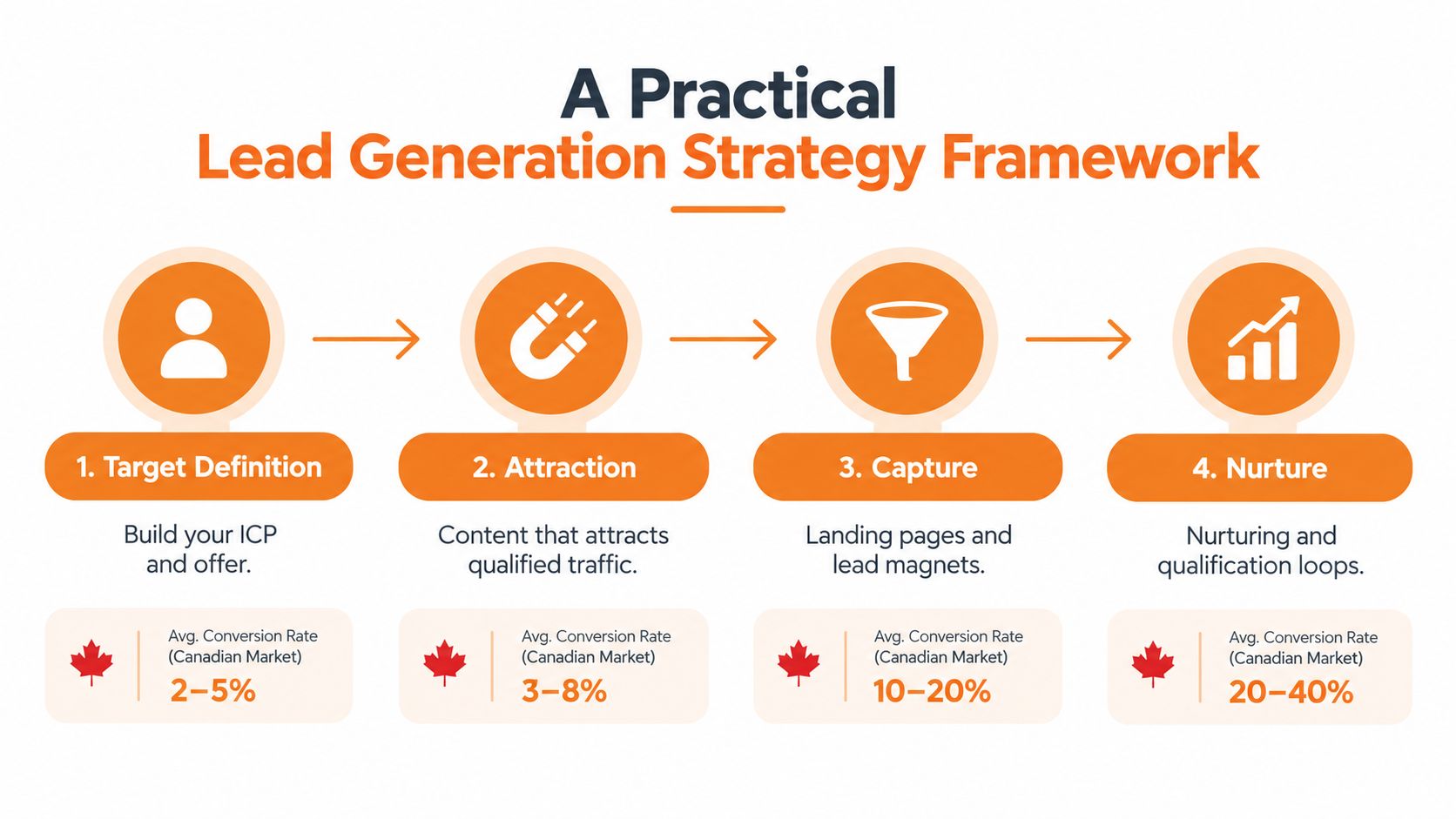
A reliable strategy starts with commercial decisions, not a list of channels. Canadian funnel data shows why. One 2026 benchmark reported that only 18% to 30% of Canadian MQLs advanced to SQL, compared with 25% to 40% in the United States, while technology sales to mid-market Canadian firms commonly took 90 to 150 days from first contact to signature. The benchmark also reported a Canadian lead-to-customer conversion rate of about 0.94% and MQL-to-SQL conversion falling from 13% in 2024 to 9.8% in 2026. These figures are provided by a Canada-focused B2B lead-generation benchmark, and they point to qualification and handoff as major constraints.
Start with the buyer and the offer
Document the ideal customer profile before launching campaigns. Include geography, industry, company characteristics, pain triggers, buying authority, urgency, and disqualifiers. Then define the offer that earns attention, such as an assessment, estimate, consultation, technical guide, or product trial.
A generic “contact us” form rarely gives a cautious Canadian buyer enough reason to act. The offer should reduce a specific risk or help the prospect make a decision.
Sequence the engine
Pair one capture channel with one nurture channel and one authority layer. A Vancouver service company might combine Google Business Profile, a call-focused landing page, and review management. A B2B technology firm might combine paid search, a comparison asset, and a consented email sequence.
An account-based programme can add personalisation for valuable targets. The account-based marketing approach is useful when a small group of organisations matters more than broad lead volume.
Build the conversion and routing path
Give each landing page one primary offer, one clear call to action, relevant proof, and transparent consent language. Ask only for information needed at that stage. Cold traffic usually needs a low-friction form, while a warm prospect requesting a proposal can reasonably provide more context.
Finally, sync submissions to the CRM, score fit and behaviour, and agree on MQL and SQL definitions with sales. Assign ownership, establish response expectations, and record rejection reasons. Without that loop, marketing learns only how many forms arrived, not why revenue did or didn't follow.
Measurement and KPIs That Matter
A low CPL can conceal a failing programme. A channel may generate inexpensive contacts that don't match the ICP, don't have authority, or never respond to sales. Another channel may appear costly because it attracts fewer but more valuable opportunities.
Five measures give a more useful operating view:
- Cost per lead shows the acquisition expense for each captured contact. Calculate it from attributable campaign spend divided by new leads, then segment by source and lead quality.
- MQL-to-SQL conversion tests whether marketing's definition of interest matches sales' definition of readiness.
- Lead-to-customer rate connects contact volume to closed revenue. It should be reviewed by channel, offer, geography, and business model.
- Pipeline velocity reveals where opportunities stall, including slow response, weak discovery, legal review, procurement, or insufficient nurturing.
- Marketing-influenced ROAS considers revenue from opportunities that marketing sourced or materially influenced, rather than assigning all value to the last click.
Use this cost-per-lead calculation resource to standardise the basic calculation, but don't stop there. The useful question is what happens after the lead enters the CRM.
| KPI | Local services, Vancouver HVAC | E-commerce, Toronto DTC | Regulated cannabis producer |
|---|---|---|---|
| Cost per lead | Useful for comparing calls, forms, and service areas | Useful for list growth and product interest | Must be read alongside consent and permitted acquisition paths |
| MQL-to-SQL | Less central than booked jobs and qualified calls | Usually less central than purchase and repeat purchase behaviour | Important when wholesale or partnership leads need review |
| Lead-to-customer | Strong indicator of booking and close quality | Connects capture to first purchase and later value | Must account for product, provincial, and communication restrictions |
| Pipeline velocity | Critical because missed calls can lose urgent demand | Less relevant to immediate checkout journeys | Important for wholesale, retail, and partnership cycles |
| Marketing-influenced ROAS | Useful when service revenue is tracked accurately | Important for paid media and lifecycle campaigns | Useful only when attribution respects channel restrictions |
A local operator should prioritise call quality and booked work. An e-commerce brand should connect first-party data to purchase behaviour. A regulated producer should give greater weight to lawful acquisition, qualification, and approved communication workflows.
Practical rule: Review CPL beside qualification and revenue outcomes. Never celebrate cheaper leads until sales confirms that lead quality has held.
How AI Is Reshaping Lead Generation Marketing
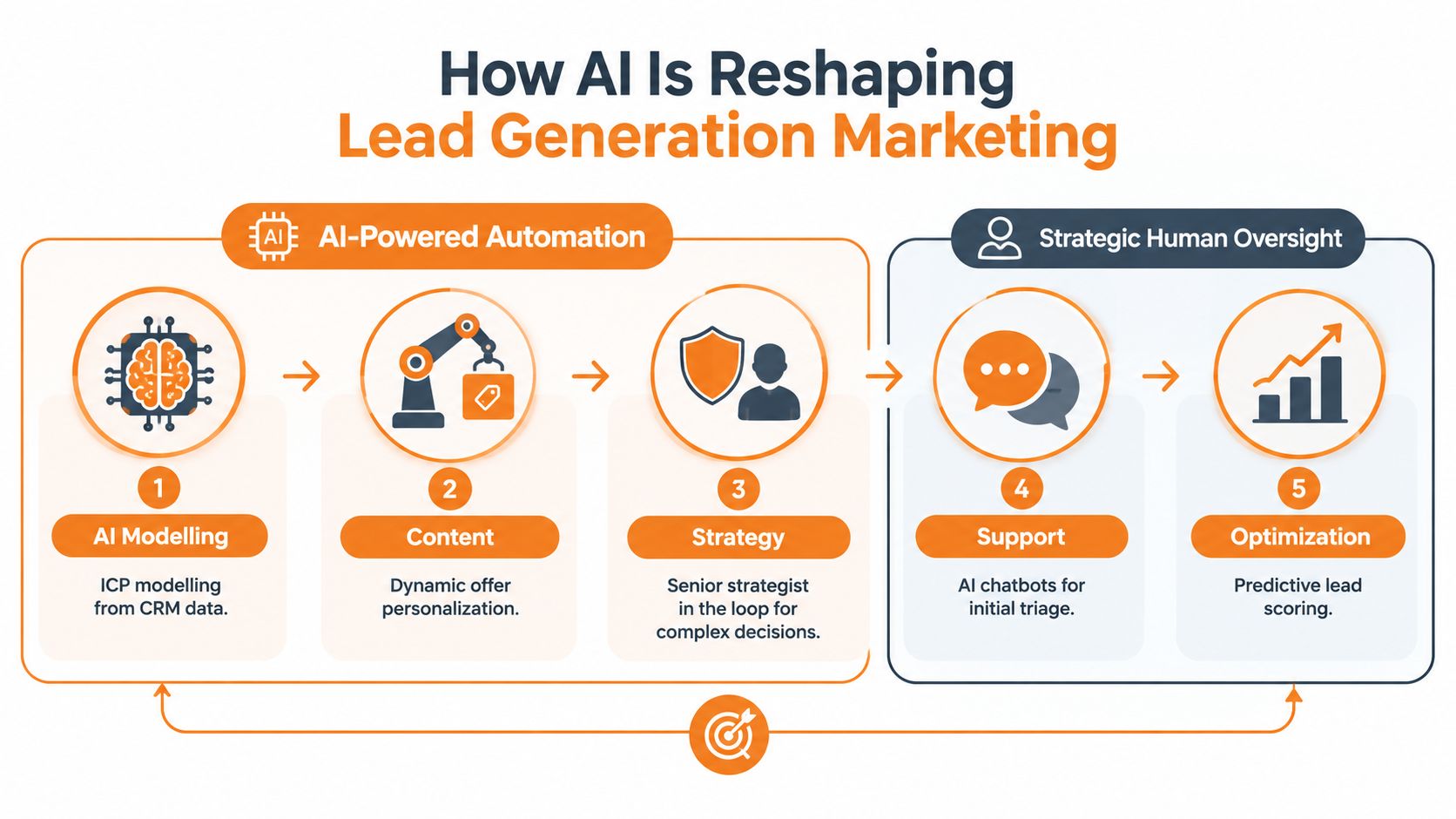
AI is most useful when it compresses repetitive analysis without making unsupervised commercial decisions. It can inspect a CRM export, group customers by fit and behaviour, draft alternatives, identify anomalies, and prepare a prioritised work queue. A senior marketer still needs to decide which segment matters, what promise the brand can substantiate, and what the law permits.
Five useful applications
ICP modelling can identify patterns in closed-won CRM records, such as industry, location, product mix, or sales objections. A Mississauga SaaS company might use those patterns to create audience segments for testing, then validate them against real sales feedback rather than accepting the model's output as truth.
Offer development becomes faster when AI reviews competitor messaging, search results, and ad libraries. It can propose hooks for Google responsive search ads, but a person must check claims, brand safety, trademark concerns, and platform policy before anything reaches spend.
Creative production can generate multiple headline, image, and landing-page variants. The system may help score them against historical click and conversion data, while the strategist chooses the final creative direction and protects consistency across the customer journey.
Lead scoring can rank new form fills against patterns in past closed deals. This works best when the CRM contains clean outcomes. If sales records are incomplete, AI amplifies unreliable assumptions.
Nurture sequencing can trigger relevant follow-up from intent signals such as a pricing visit, a content download, or a return to a service page. In a regulated cannabis context, scoring rules can flag prohibited or risky copy before a message is sent, but compliance review remains essential.
A workflow can be efficient and still be wrong. AI may invent an unsupported case study, misread a policy, or turn a tentative internal idea into a confident claim. Verify every output before publication, launch, or sales use.
Human judgement remains essential for positioning, pricing, consent language, regulated claims, exclusions, and final creative approval. AI should shorten the path from evidence to execution, not remove accountability.
Sector-Specific Approaches for Canadian Businesses
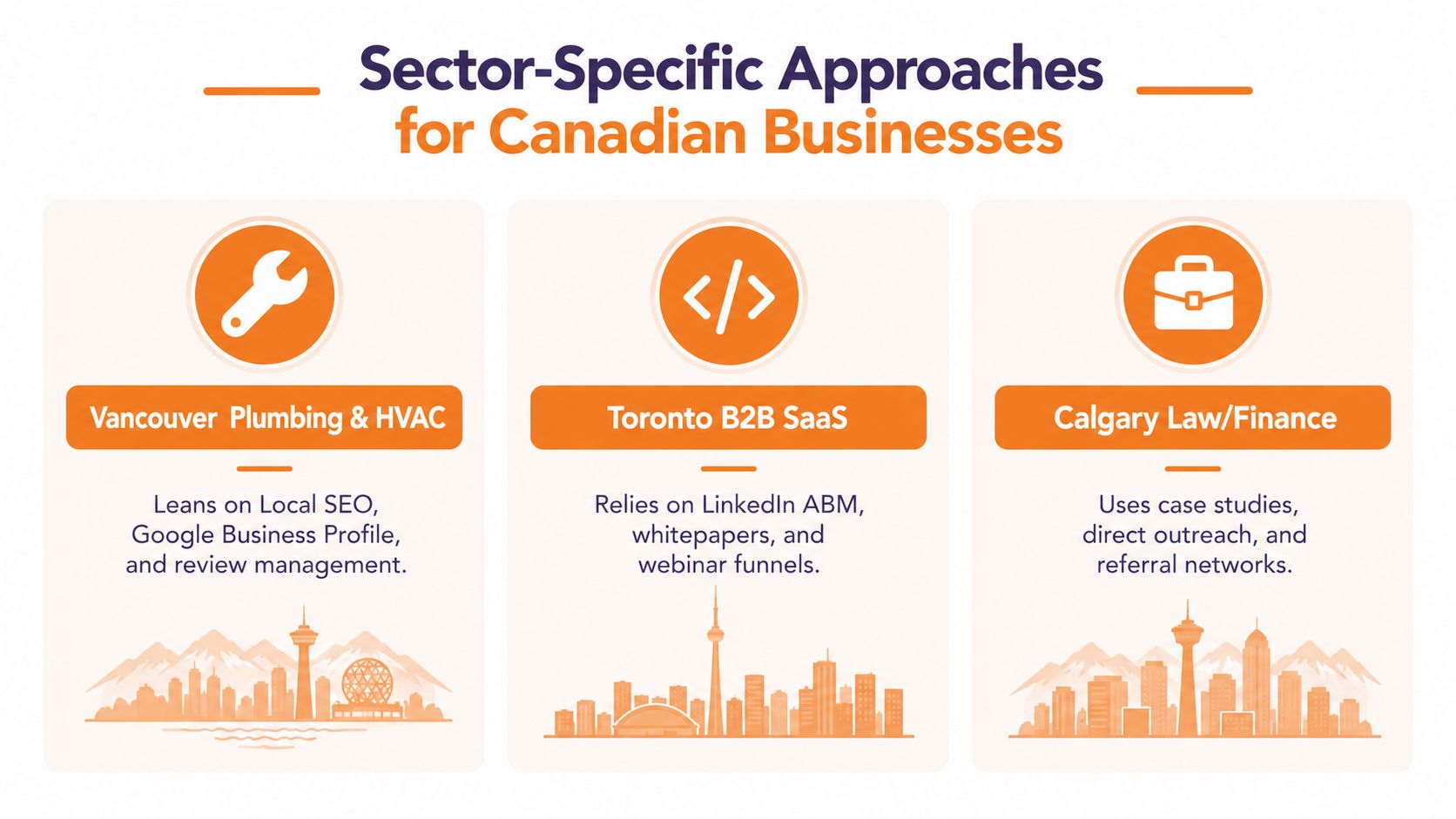
The same funnel architecture behaves differently depending on urgency, buying group, transaction value, and regulation. A local trades company doesn't need the same lead definition as a DTC brand, and neither can use the same acquisition assumptions as a regulated producer.
Vancouver plumbing and HVAC
The dominant channel is local intent. A plumbing or HVAC operator should connect Google Business Profile management, service-area pages, review responses, and emergency-call landing pages. The page needs an obvious phone action, accurate availability, service location, and a promise that matches the search.
The qualifying journey may be brief when the customer has an urgent problem. The meaningful KPI isn't form volume. It's qualified calls, booked jobs, arrival areas, and revenue by service type. Missed calls and vague location targeting can waste strong visibility.
Toronto Shopify commerce
A Toronto DTC brand needs a different definition of a lead. An email or SMS opt-in is valuable because it creates a permissioned first-party relationship, but the business still needs to connect that contact to product views, cart activity, first purchase, and repeat behaviour.
Meta prospecting can introduce the product, while Klaviyo flows can respond to consented browsing, cart, and post-purchase signals. The trade-off is complexity. More automation creates more opportunities for irrelevant timing, excessive frequency, or a message that fails to match the customer's actual status.
Canadian cannabis and CBD
A licensed cannabis producer or CBD brand operates within tighter advertising and claims constraints. Educational content, verified opt-ins, compliant publisher relationships, and digital PR can create demand without relying on unrestricted product promotion.
The qualifying journey often involves education before commercial intent. Useful indicators include consent quality, relevant content engagement, wholesale enquiries, compliant retailer relationships, and progression through approved communications. A templated lead-generation playbook fails here because the strongest channel may be the channel that creates trust while saying less.
Compliance, Trust, and the CASL Reality
Canadian lead generation can't treat consent as a footer added after campaign planning. CASL requires sender identification, a physical mailing address, and a working unsubscribe mechanism, while implied consent operates within specific conditions and time limits. Canadian compliance guidance also describes consent logs, verified contact data, and LinkedIn as a warm-up layer rather than a closing channel.
That makes imported lists, purchased databases, and unconsented email blasts poor strategic choices even before legal risk enters the discussion. A list can look large in a spreadsheet while producing weak engagement, complaints, and unusable attribution.
Design consent into the conversion path
Landing pages should explain what the person is agreeing to receive, identify the sender, and separate necessary transaction communication from optional marketing where appropriate. Keep records of the form version, timestamp, source, wording, and relevant permission status. Make unsubscribe actions clear and functional.
Sales teams also need rules for outreach. A prospect who downloaded a public guide isn't automatically equivalent to a person who expressly requested a consultation. Route those contacts differently and preserve the evidence behind the decision.
Treat regulation as a trust signal
Financial services, healthcare, cannabis, and other regulated sectors may face additional CRTC, provincial, privacy, or industry requirements. The exact review path depends on the offer and jurisdiction, so marketers should involve qualified legal or compliance professionals rather than relying on a generic template.
Consent-first acquisition often improves operational quality because the team knows why a person entered the database and what communication they expect. Trust isn't a constraint added to growth. It's part of the offer.
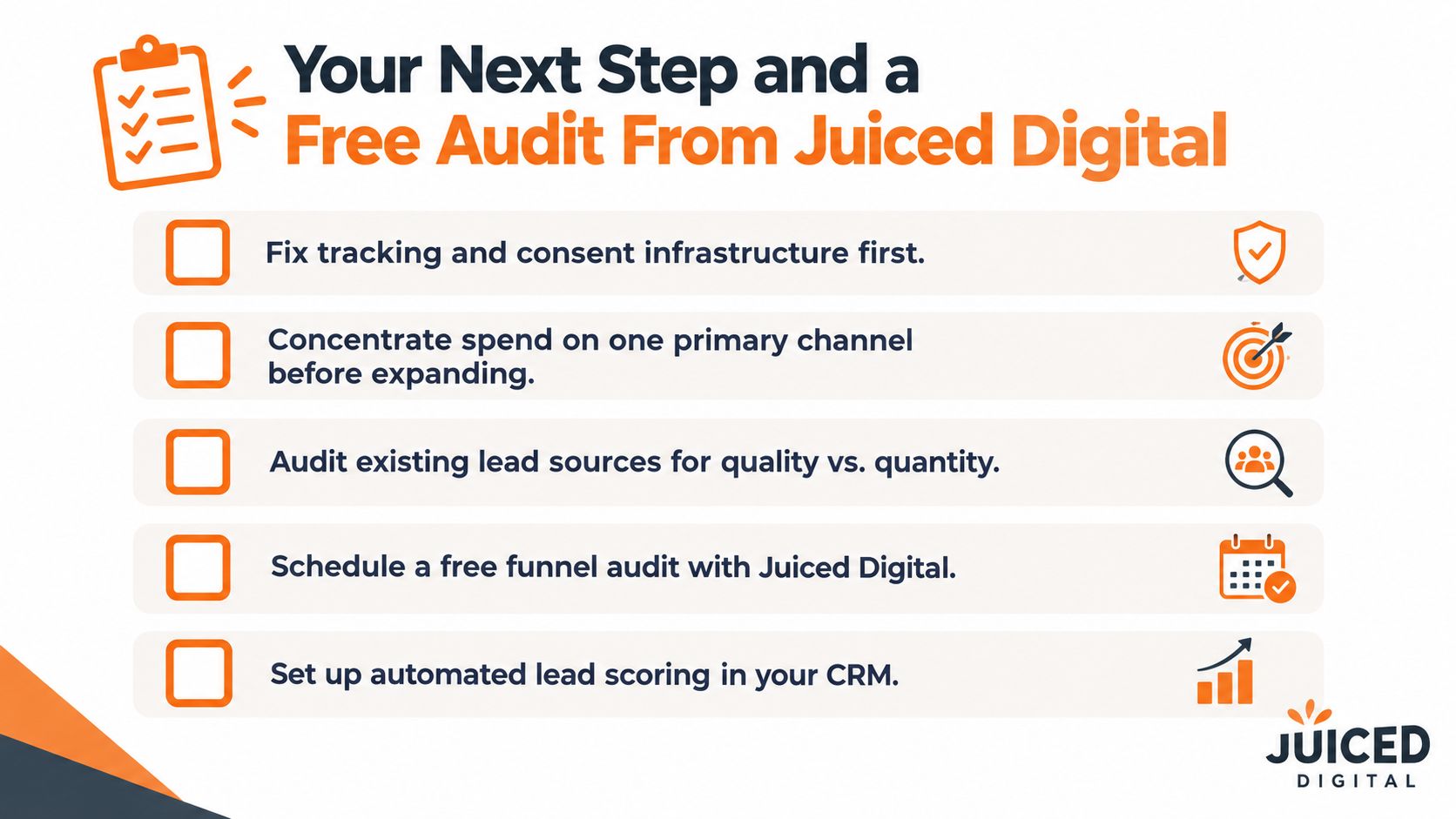
Your Next Step and a Free Audit From Juiced Digital
Most lead engines don't need more channels first. They need cleaner foundations and sharper decisions.
Start with the following order:
- Fix measurement and consent: Confirm source tracking, CRM fields, conversion events, permission records, unsubscribe handling, and sales ownership.
- Choose one primary capture channel: Concentrate on the channel closest to existing demand before adding a second source.
- Audit quality, not just volume: Compare leads by fit, intent, response, qualification, and revenue.
- Instrument the five core KPIs: Make marketing and sales review the same definitions and outcomes.
- Pilot one AI workflow: Start with a contained use case such as CRM segmentation, creative variation, or lead triage, with human approval before deployment.
The IAB Canada digital advertising market report reported that the Canadian digital advertising market grew 16% year over year to $21.1 billion in 2025. As competition for paid attention increases, conversion quality and follow-up discipline matter more than just expanding media spend.
A free Lead Engine Audit can expose whether the primary gap sits in channel selection, offer-market fit, landing-page conversion, qualification, compliance, or attribution. It should leave you with a prioritised view of what to repair first, what to test next, and which metrics sales should validate.
Juiced Digital helps Canadian businesses connect local SEO, paid media, AI-enabled search, conversion optimisation, digital PR, and compliant lead-generation systems to measurable commercial outcomes. Visit Juiced Digital to request the free audit and identify the clearest next improvement in your funnel.