
A mid-sized B2B SaaS team can do everything its SEO dashboard tells it to do and still feel the pipeline weakening. Organic sessions remain stable, priority pages hold their rankings, and the weekly report shows a healthy spread of top positions. Yet fewer prospects arrive with the right questions already answered, and qualified demos start to decline.
The reason is often hidden outside the ranking report. Buyers now ask conversational systems to compare vendors, explain technical categories, and recommend next steps. Your page may rank well without becoming one of the sources an assistant cites. AI SEO optimization addresses that gap, shifting attention from being visible as a link to being trusted as evidence inside an answer.
The Moment Your Old SEO Playbook Stops Working
The warning usually arrives in a meeting, not in an analytics platform. A marketing lead reviews organic performance and sees no obvious collapse. The content team has published consistently, technical issues are under control, and several commercial pages still rank strongly. But sales says the leads feel less informed, and the best prospects appear to have formed a shortlist before visiting the site.
The team then checks how buyers search. Instead of opening several results, prospects ask an assistant which platforms suit a particular industry, what implementation risks to expect, or which Canadian providers understand local requirements. The assistant returns a composed answer with citations. The company's page might be relevant, but it isn't referenced.
That creates two different forms of visibility:
- SERP visibility means a search engine displays your page among ranked results.
- Citation visibility means an answer engine uses your content as supporting evidence.
- Pipeline visibility means the buyer can connect your brand with a solution before a click or form submission occurs.
A position-one ranking supports the second and third outcomes, but it doesn't guarantee them. AI systems retrieve passages, entities, documents, and external references, then assemble an answer around the user's intent. A brand that appears frequently in those answers can influence demand even when the user never lands on the original page.
Practical rule: Treat rankings as distribution, not proof that your brand is part of the buyer's decision.
The Canadian market makes that distinction difficult to ignore. A 2026 Canadian AI search report estimates that the addressable AI search market grew 14% to 18% year over year through 2025, while roughly 62% of Canadian SMBs now rank AI search among their top three marketing priorities for 2026, compared with 47% in 2024. The same report associates investment lasting 12 months or more with 2.4 times the qualified-lead volume of investment lasting under six months.
The practical question is no longer, “Which page ranks?” It's, “Which sources does the system trust when a qualified Canadian buyer asks for a recommendation?”
What AI SEO Optimization Actually Means in 2026
AI SEO optimization is the practice of making a brand, its entities, and its content easy for answer engines to retrieve, interpret, verify, and cite. It includes traditional SEO, but it adds a stronger focus on how individual passages and brand references contribute to a generated response.
Traditional SEO is like filing a book in a well-organised library. You need a clear title, a catalogue record, a useful subject classification, and a shelf where people can find it. AI SEO is also making sure a research assistant can open the book, identify the relevant chapter, understand who wrote it, and quote the right passage by name.
The distinction matters because a system may not use an entire page. It may select a definition, comparison, product detail, author statement, local service description, or independent reference that helps it answer a specific question. A page can therefore be technically accessible and relevant while still being difficult to cite.
Retrieval determines whether you enter the candidate set
Answer systems often use search or retrieval processes to find potentially relevant material. Crawlability, indexation, internal linking, clear titles, and useful metadata still determine whether your content can be discovered. A blocked page, weak information architecture, or vague topic focus remains a problem regardless of the interface.
Entity grounding adds another layer. The system needs to connect your organisation with its services, locations, people, products, industries, and proof. Consistent names, author information, About pages, business profiles, structured data, and reputable mentions help establish those relationships.
Reasoning determines whether your content supports the answer
The retrieved material must match the question and provide enough context to be useful. A sentence that says a service is “innovative” offers little evidence. A sentence that identifies the service, audience, geography, and practical outcome gives the system more usable meaning.
This is why citation worthiness matters. Strong pages make clear claims, define terms, distinguish facts from opinions, and answer related questions without forcing the reader or system to infer the basics.
Generation determines how your brand appears
The final answer may summarise several sources, choose one example, or cite a page that supports only part of the response. Your objective isn't to manipulate a particular prompt. It's to publish clear, self-contained information that can survive extraction and still represent your brand accurately.
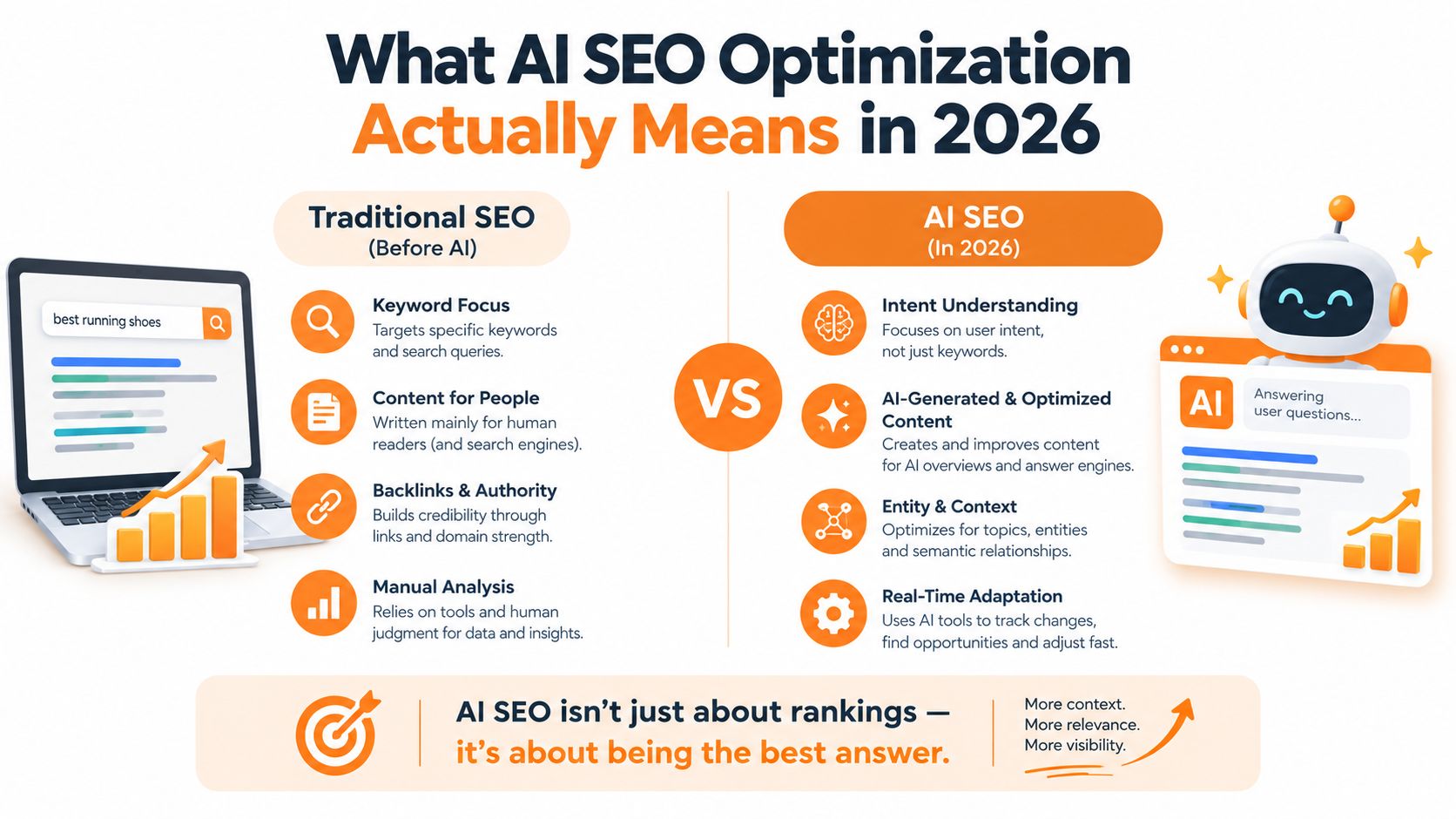
Google's AI Overviews were reported to appear on roughly 47% of sampled Canadian commercial-intent queries in Q1 2026, up from about 24% in Q1 2025, according to the Canadian SEO industry report for 2026. That doesn't make classic SEO obsolete. It makes the technical goal broader: earn discovery, earn understanding, and earn inclusion.
The Four Areas Where AI Quietly Reshapes SEO
AI changes SEO most usefully when it removes repetitive analysis, not when it replaces judgement. The weekly work still includes understanding demand, planning pages, improving technical access, and reporting outcomes. The difference is that teams can process more evidence before deciding what deserves human attention.
Keyword and intent research
The old task is exporting keyword lists, sorting variations, and manually deciding whether related queries belong on one page. An AI-assisted workflow groups terms by entity, intent, audience, geography, and buying stage. It can surface that several apparently different searches are really asking about the same product category, while a similar phrase may require a separate comparison or location page.
The strategist still validates the clusters against search results, customer language, sales calls, and product knowledge. The output isn't “more keywords.” It's a clearer map of which entities the site must explain and which questions need a citable answer.
Content production
A conventional brief often starts with a keyword, a word-count target, and competitor headings. A stronger AI-assisted brief adds the entities that must be defined, claims that require evidence, Canadian context, internal links, author requirements, and answer formats that make sense for the query.
Generative tools can create outlines, extract unanswered questions, suggest title and heading options, and identify missing relationships between pages. They're less reliable at original insight, nuanced compliance language, and first-hand expertise. Editors should use them to accelerate preparation and revision, not to approve unverified drafts.
Technical SEO
Technical teams spend too much time repeating the same checks across templates and content groups. AI can help classify crawl issues, identify patterns in internal links, compare schema against visible page content, and prioritise fixes by business importance.
The developer still needs to confirm the diagnosis. Automated recommendations can misunderstand JavaScript behaviour, canonical intent, multilingual relationships, or a deliberate template choice. The useful output is a shorter, better-prioritised ticket queue, not a promise that every recommendation should ship.
Rank and citation tracking
Rank tracking answers a narrow question: where does a page appear for a selected query? AI search monitoring asks a broader set of questions:
- Brand presence: Does the assistant mention the company?
- Citation presence: Which page or external source supports the mention?
- Entity accuracy: Does the answer describe the business correctly?
- Competitor displacement: Which brands appear when yours doesn't?
- Commercial relevance: Does visibility occur for questions connected to qualified demand?
Teams should sample important prompts across ChatGPT, Perplexity, and Google AI Overviews, then record the answer, cited sources, location context, and next action. The goal is not to chase unstable wording. It's to identify missing evidence and weak entity associations.
| Workflow Area | Traditional SEO Output | AI-Augmented Output |
|---|---|---|
| Keyword and intent research | Keyword list and manual map | Entity and intent clusters with page recommendations |
| Content production | Brief, draft, and optimisation notes | Evidence-led brief, answer blocks, entity coverage, and editorial review queue |
| Technical SEO | Issue export and prioritised fixes | Pattern classification, schema checks, link opportunities, and developer-ready tickets |
| Rank and citation tracking | Position and traffic report | Rankings, mentions, citations, source quality, and pipeline context |
A simple rule keeps the workflow grounded: automate collection and pattern recognition first, then reserve human time for strategy, evidence, positioning, and decisions.
A Practical Workflow for Adopting AI SEO in Your Team
Don't begin by replacing your entire stack. Start with the part of the process that consumes the most skilled hours while producing the least strategic value.
Start with a workflow audit
Review how the team currently researches queries, creates briefs, checks internal links, reviews schema, and prepares reports. Mark each activity as strategic, repetitive, or dependent on specialist judgement. Repetitive work is the safest starting point for automation.
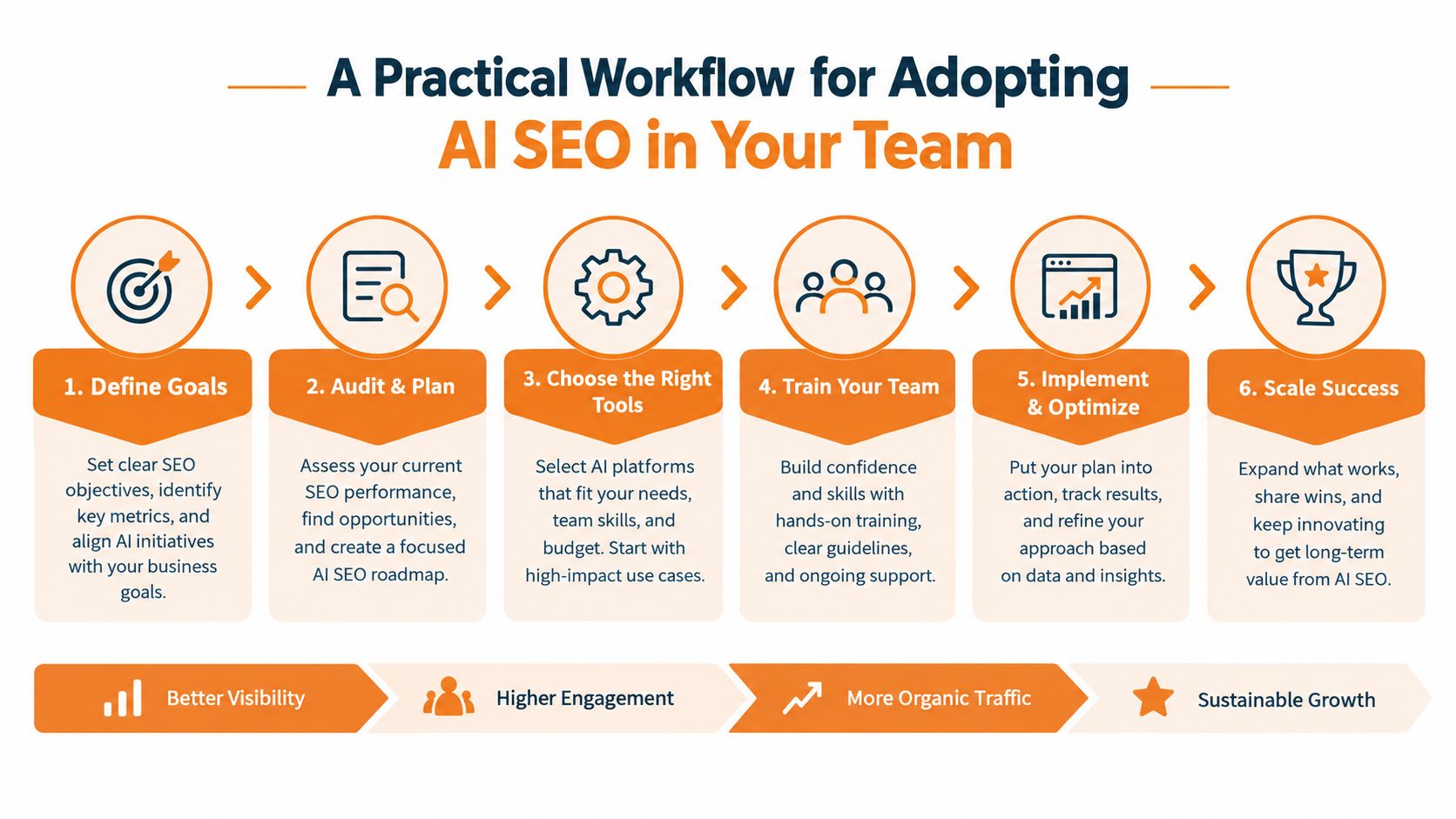
A sensible order of operations looks like this:
- Establish the entity foundation: Align organisation, author, product, service, location, and industry information across the site and important external profiles.
- Fix structural weaknesses: Improve crawlability, internal linking, page hierarchy, visible answers, and relevant structured data.
- Cluster demand: Use AI to group queries by meaning and intent, then have a strategist approve the resulting page map.
- Generate evidence-led briefs: Include the audience, query context, claims, sources, entities, local signals, and conversion path.
- Optimise drafts and existing pages: Ask AI to identify omissions, ambiguity, unsupported statements, and weak internal-link destinations.
- Monitor answers and pipeline: Track citation presence alongside organic conversions, referral paths, qualified form fills, and demo requests.
Teams wanting a practical overview of implementation can also review how to use AI for SEO, then adapt the process to their CMS and approval model.
Keep the human checkpoint explicit
The strategist owns the intent model and commercial priorities. The editor owns accuracy, voice, originality, and reader usefulness. The developer owns implementation, rendering, schema, indexation, and measurement integrity. If those responsibilities blur, AI output tends to move from draft to publication without anyone owning the risk.
Run a 30-day pilot on one content vertical or one client. Choose a contained set of pages, document the baseline, automate one repetitive stage, and record every human correction. Those corrections reveal where the model lacks context and where your process needs better inputs.
The best first automation is rarely content generation. It's usually classification, extraction, or quality control around work the team already understands.
At the end of the pilot, keep the workflow only if it improves decision quality or frees meaningful specialist time without increasing corrections, rework, or factual risk. Speed alone isn't a sufficient success criterion.
The AI SEO Tool Landscape by Capability
Tool selection works better when you assess the job rather than the brand name. Mature products can reduce manual analysis, but no platform can reliably decide what your organisation should claim, which evidence is strong enough, or how a regulated Canadian business should describe its services.
Research and clustering tools
This is one of the strongest categories. AI can group large query sets, identify recurring entities, classify intent, and expose gaps between informational and commercial demand. The output is valuable when a strategist reviews clusters against live results and customer language.
The weak version produces elegant labels that don't correspond to separate pages or meaningful business decisions. A cluster is only useful if it changes the content map, internal-link plan, or prioritisation.
Content generation and optimisation tools
These tools are effective for outlines, rewrites, metadata variations, question extraction, and comparisons between an existing page and a defined brief. They can also help editors find unsupported superlatives or unclear passages.
They're unreliable when asked to create original experience, expert opinions, legal interpretations, or market claims without source material. Many drafts sound polished while repeating familiar category language. That can make a site more readable without making it more authoritative.
Technical auditing tools
AI-assisted crawlers and site auditors can classify errors, connect issues to templates, and turn raw findings into explanations that non-technical stakeholders can act on. They're particularly helpful for triage across large sites.
They shouldn't replace rendered testing, log analysis, developer review, or manual inspection of important templates. A tool may correctly detect a pattern and still recommend the wrong fix.
Performance prediction tools
Forecasting and recommendation features are the most overhyped category. Models can identify correlations and help teams compare scenarios, but they can't isolate every algorithmic, competitive, seasonal, or commercial variable. Treat predictions as planning inputs, not commitments.
| Capability Cluster | Maturity Level | Time Savings | Output Reliability |
|---|---|---|---|
| Research and clustering | Mature for classification | High for large datasets | Strong after strategist review |
| Content generation and optimisation | Useful but uneven | Moderate for preparation and editing | Variable, especially for factual claims |
| Technical auditing | Mature for pattern detection | Moderate to high for triage | Good for findings, dependent on implementation context |
| Performance prediction | Developing | Limited for dependable forecasting | Directional rather than definitive |
An all-in-one suite offers convenience, shared data, and simpler procurement. Point solutions often provide deeper control for a specific workflow. A small team may favour integration simplicity, while an agency with varied clients may need modular tools and stronger export options.
For a broader comparison of practical platforms, see AI tools for SEO. The build-versus-buy decision should follow the same principle. Buy commodity capabilities such as crawling, clustering, and monitoring. Build proprietary prompts, taxonomies, QA rules, and reporting logic only where your team's expertise creates a genuine advantage.
Risks, Misconceptions, and Guardrails You Cannot Skip
The most expensive AI SEO failures don't look automated. They look like confident, well-formatted pages containing claims nobody verified.
A model can invent statistics, citations, product capabilities, regulatory details, or customer outcomes. It can also merge two similar entities, flatten a brand's tone, and produce a page that resembles thousands of other generated articles. Canadian businesses face additional exposure when content discusses provincial rules, bilingual audiences, health claims, or regulated categories.
Quality is the issue, not the production method
AI-assisted content isn't automatically harmful. The meaningful distinction is whether the published page helps users, reflects real expertise, and supports its claims. A human-written page can be thin and misleading. An AI-assisted page can be carefully researched and edited. The review standard should focus on usefulness, accuracy, originality, and transparency.
That doesn't mean teams should publish at scale without controls. Search platforms and users have little reason to trust content that repeats generic advice, hides its sources, or makes precise claims without evidence.
Build guardrails into the workflow
Use a written process rather than asking individual writers to “be careful”:
- Source verification: Require every factual claim to be checked against an approved primary or authoritative source.
- Citation review: Confirm that each link supports the exact statement it accompanies, not merely the general topic.
- Human sign-off: Assign an editor or subject specialist to approve claims involving regulations, health, finance, products, or performance.
- Voice controls: Maintain examples of approved language, prohibited wording, brand terminology, and escalation rules.
- Originality checks: Compare drafts with existing site content and competing pages, then add first-hand detail or remove unnecessary duplication.
- Disclosure policy: Decide when the organisation discloses AI assistance to clients, readers, partners, or internal stakeholders.
Never let a fluent sentence lower your verification standard. Fluency is a formatting quality, not evidence.
Training-data provenance also deserves attention. Teams should understand which material enters prompts, which tools retain inputs, and whether confidential client information is being exposed. For a structured external review, AI SEO agency services can be considered alongside internal governance, provided ownership of final claims remains clear.
The safest operating model treats AI as an analyst, drafting assistant, and quality-control layer. People remain responsible for facts, positioning, compliance, and the decision to publish.
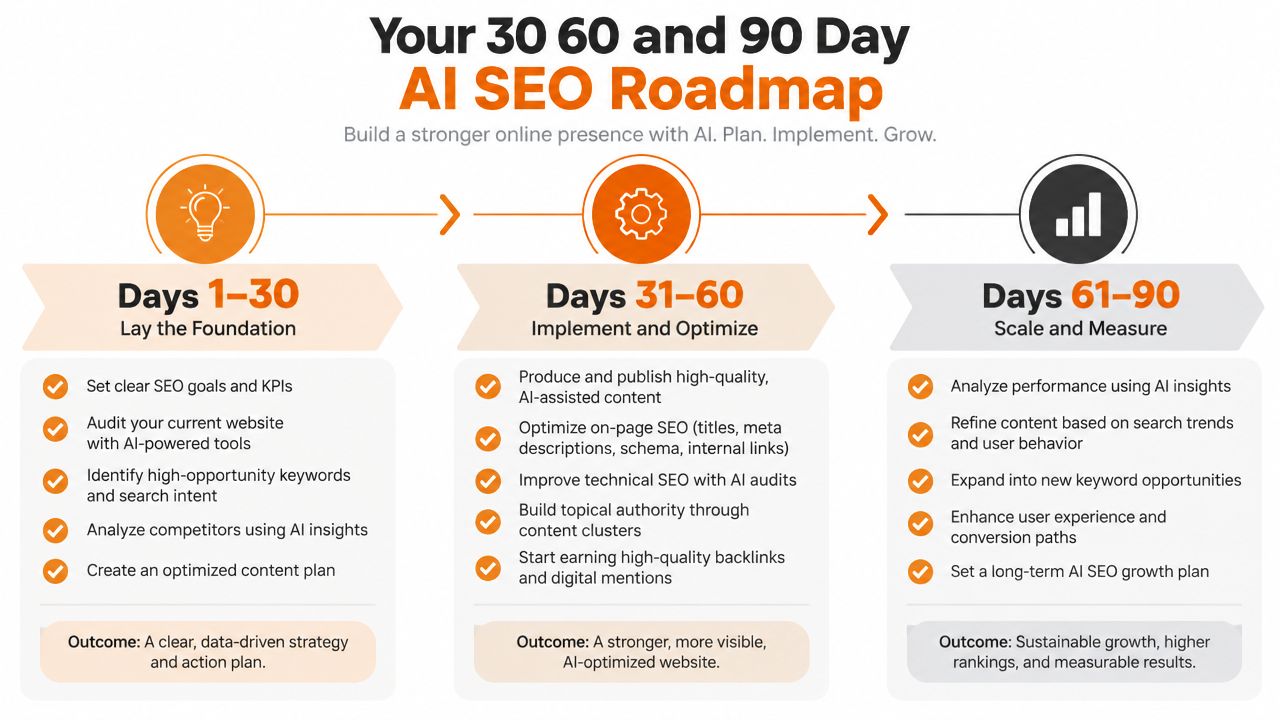
Your 30 60 and 90 Day AI SEO Roadmap
A useful roadmap connects technical preparation with commercial measurement. Canadian businesses should also account for regional and language differences rather than treating the country as one English market. A Canada-focused citation study found Canadian-domain sites received 6.8% of citation slots for Canadian-intent commercial queries, compared with 47.9% for U.S.-domain sites, 23.1% for Wikipedia and Reddit-style sources, and 11.4% for Canadian government and educational sites.
Days 1 to 30
Create the baseline. Record organic conversions, qualified leads, demo requests, priority entities, and citation presence across representative Canadian prompts. Choose one repetitive workflow, such as clustering or internal-link auditing, and run the pilot.
Deliverable: baseline dashboard and approved pilot process.
Proof: fewer manual hours or better prioritisation without increased correction work.
Decision: expand the workflow, revise it, or stop it.
Days 31 to 60
Strengthen the entity footprint. Review organisation and author pages, visible service descriptions, structured data, internal relationships, local profiles, and English and French page targeting where appropriate. Publish concise answer blocks, comparison content, FAQs, and location-specific evidence for priority commercial topics.
Deliverable: updated entity and structured-content system.
Proof: improved coverage of target questions and more accurate brand representation in sampled answers.
Decision: identify which topics and regional sources deserve further authority work.
Days 61 to 90
Formalise QA and connect visibility to pipeline. Review citations, referral paths, qualified form fills, sales feedback, and assisted conversions. Keep a record of unsupported claims, missed citations, and pages that assistants repeatedly use or ignore.
Deliverable: operating cadence with owners, review gates, and reporting definitions.
Proof: commercially relevant visibility and lead quality, not traffic alone.
Decision: scale to another vertical, client, province, or language market.
The central shift is simple but demanding. AI SEO optimization isn't a prompt library. It's an authority and measurement system that helps the right sources become retrievable, understandable, and citable for commercially important questions.
Juiced Digital builds AI Search SEO, local SEO, paid media, digital PR, and conversion strategies around measurable growth for Canadian and North American brands. If you need to connect citation visibility with qualified leads, visit Juiced Digital to request a consultation or audit.