
You search Google for a product on your phone, compare prices while commuting, check whether a nearby store has it, and place an order during lunch. The confirmation says pickup is available. When you arrive, the store can't find the order, the website still shows stock, and customer service asks you to explain the situation from the beginning. The purchase didn't fail because the shopper lacked intent. It failed because the channels disagreed.

That journey is increasingly normal in Canada. Statistics Canada data reported by Trade.gov's Canada ecommerce guide shows that retail spending reached $865.2 billion in 2024, while ecommerce revenue accounted for $73.7 billion, up 9.0% year over year. Online shopping is no longer a specialist channel that sits apart from retail. It works alongside search, mobile browsing, physical stores, pickup, delivery, and returns.
A useful omnichannel ecommerce strategy connects those moments so the customer can move between them without losing information, choice, or confidence. It isn't just a larger channel list. It's a commercial and operational system that keeps product information, customer context, pricing, inventory, fulfilment, and service aligned.
This guide is for founders and marketers building direct-to-consumer brands, retailers adding ecommerce, and regulated businesses such as cannabis and CBD companies that need compliant growth. You'll learn what omnichannel means, which capabilities matter first, how to build a roadmap without replatforming everything at once, and which metrics can prove whether the investment is working.
By the end, you should be able to design a customer journey that starts with digital discovery, respects Canada's store-first shopping habits, and ends with a reliable purchase, pickup, delivery, or return.
Introduction Why Omnichannel Matters Now
The customer in the opening example didn't think in channels. They thought, “I need this product, and I want the easiest reliable way to get it.” Your website, Google listing, email, social profile, point-of-sale system, and store team are separate parts of the business, but the shopper experiences one brand.
That distinction matters because disconnected channels create very specific problems. A paid search ad can promote a product that a store has already sold. An email can offer a discount that staff can't honour at the till. A product page can promise pickup while the order management system routes the item from a distant warehouse. Each issue looks small in isolation, but together they make the brand feel unreliable.
Canadian shoppers already move across online and physical retail as part of ordinary buying behaviour. NIQ's analysis of Canada's omni marketplace reported that 73% of Canadians shop both online and in store, and 61% of Canadian CPG shoppers had made at least one online purchase. The implication is practical: your ecommerce site shouldn't compete with your stores for ownership of the customer. It should help the customer choose the right path.
The operating principle: Let the shopper change channels without having to restart the journey.
An effective strategy coordinates four things. First, the customer can discover products wherever research happens. Second, the brand shows accurate information and availability. Third, the buyer can choose a convenient fulfilment method. Fourth, service and returns continue with the same context after purchase.
For cannabis, CBD, and other regulated categories, the system also needs compliance built into the journey. Age gating, provincial rules, product claims, advertising restrictions, payment requirements, and delivery limitations can affect which channels are available and what a brand can say. Compliance isn't a final approval step. It shapes the experience from search result to checkout and post-purchase communication.
The goal isn't to launch everywhere. It's to make the important handoffs dependable, then expand when the data and operations can support another channel.
What an Omnichannel Ecommerce Strategy Really Means
A multichannel business sells through several routes. Its website may have one promotion, its marketplace account another, and its stores may use a separate inventory file. Each channel can perform well on its own, yet the customer still encounters inconsistent prices, product details, account information, and service policies.
An omnichannel business treats those routes like an orchestra. The website, mobile experience, social commerce, marketplace, email programme, and physical store are different instruments, but they play from the same score. The score is the shared customer, product, inventory, order, and service context.
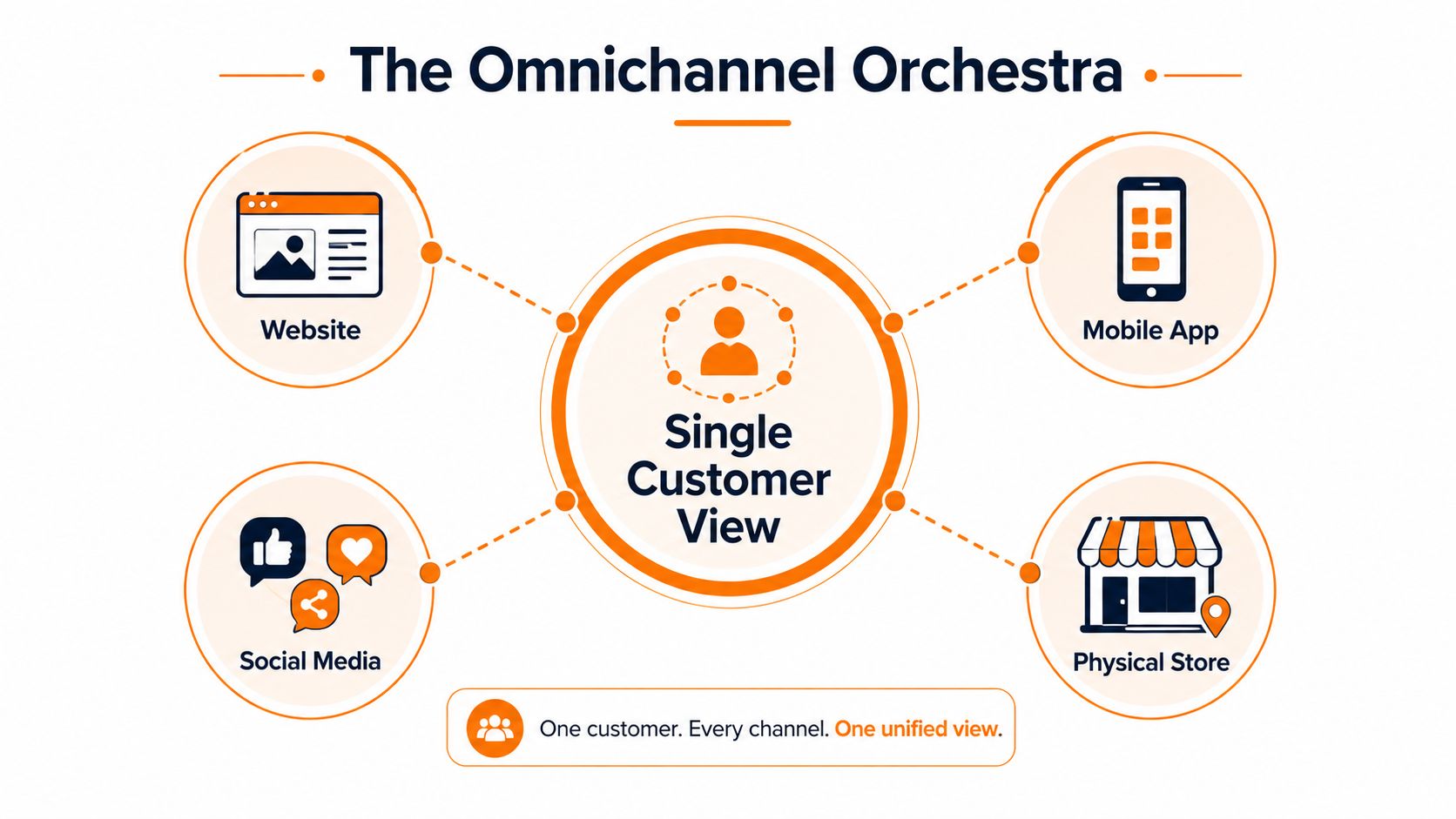
Omnichannel means continuity, not just presence.
A customer might discover a product through search, save it on a phone, inspect it in a store, and complete the purchase online. Another customer might see an item online, reserve it, collect it in person, and return it through a store. The channel sequence can vary. The brand should still recognise the product, the order, the offer, the fulfilment promise, and the customer's next likely need.
A single customer view doesn't necessarily mean one giant database or a perfect profile of every visitor. It means the systems that matter share enough identity and event data to avoid obvious contradictions. A known customer should not receive a cart reminder for an order they already collected. A store associate should be able to access the information needed to resolve a pickup or return. A marketer should know whether a promotion applies online, in store, or both.
The same principle applies to inventory. If a product page says an item is available for pickup, the promise needs a defined stock source, a reservation rule, a preparation process, and an expiry policy. Otherwise, “available” is only a marketing statement.
Watch the short explainer below for a visual introduction to the connected-channel model.
This is why omnichannel isn't only a marketing project. It involves ecommerce, retail operations, customer service, merchandising, finance, and technology. A customer journey perspective helps teams identify the moments where those functions need to work together, rather than optimising each channel in isolation.
Four Systems That Keep Every Channel Aligned
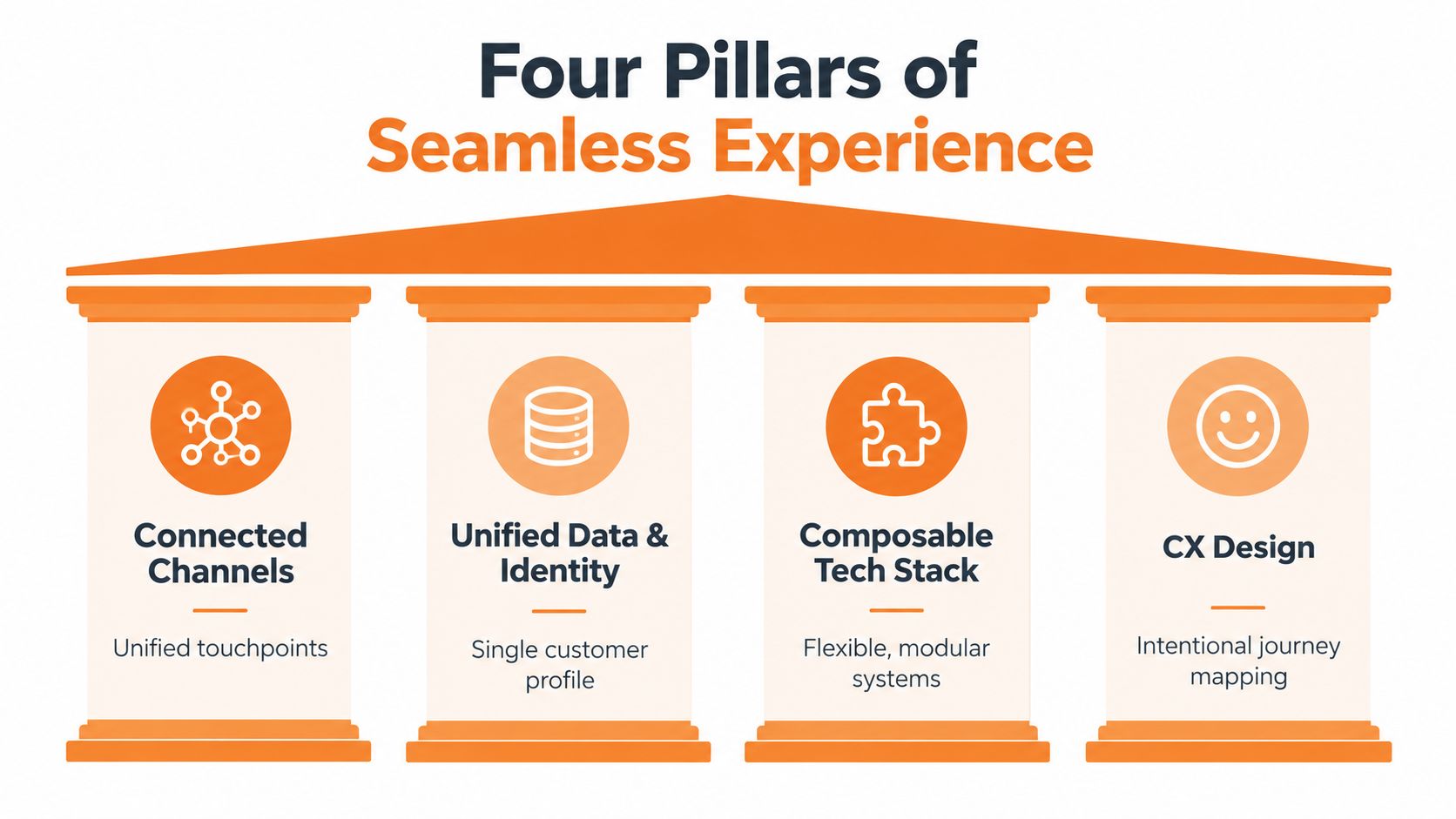
A connected shopping experience depends on several systems working together. Weak stock accuracy can undermine a polished website, while an advanced CRM cannot repair a return process that stores cannot support. For Canadian retailers, fulfilment rules often shape the customer's experience more than another campaign or channel.
Connected channels
Begin with the channels customers already use. For many Canadian brands, these include a DTC website, Google search, email, social media, marketplaces, and physical stores. Each channel needs a defined job, so shoppers can continue their research or purchase without losing useful context.
Search captures research intent. The website explains the offer and converts demand. Social platforms support discovery and consideration. Marketplaces provide reach and familiar buying environments. Stores build trust, answer questions, and handle pickup, exchanges, or returns.
Channel alignment becomes visible at the handoffs. A store locator should provide useful local details. A product page should show pickup availability when that option exists. A paid campaign should lead to a landing page that matches its message and the shopper's location. For cannabis and CBD products, channel design must also reflect applicable age, product, advertising, and provincial compliance requirements.
Unified data and identity
Customer data covers more than names and email addresses. It may include browsing signals, consent status, purchases, returns, loyalty activity, service conversations, and store interactions. Product records require the same care, including descriptions, variants, regulated claims, pricing, images, and eligibility restrictions.
Unification means defining the source of truth for each object and agreeing how systems exchange updates. The ecommerce platform may own product content, the point-of-sale system may own store transactions, and the order management system may own fulfilment status. Clear ownership prevents a marketing message, product page, and store associate from presenting conflicting information.
Retention teams can also place email marketing automation for ecommerce within the wider customer journey. An abandoned-cart message should account for completed purchases, channel preferences, consent, and inventory conditions.
Composable technology
A composable stack connects modules instead of forcing every capability into one platform. Depending on the retailer, those modules may include ecommerce, point of sale, inventory management, order management, customer data, search, email, analytics, and customer service.
Modularity lets a brand improve one area without replacing everything. It also creates operating work. Teams need owners for APIs, event definitions, identity matching, permissions, and error handling. A flexible stack without these rules relocates silos into a more complicated architecture.
Customer experience design
Design around customer jobs such as “find a nearby item,” “compare options,” “collect quickly,” and “return without hassle.” These jobs reveal the systems and policies each moment requires more clearly than a generic channel plan.
Canadian retailers still have room to improve their fulfilment experience. In a 281-chain Canadian retail sample, OrderDynamics research reported that 31.0% offered Click and Collect, 34.5% provided basic active inventory visibility, and 74.7% of omnichannel retailers supported Buy Online Return In-Store. The practical lesson is clear: fulfilment deserves the same design attention as campaigns and content.
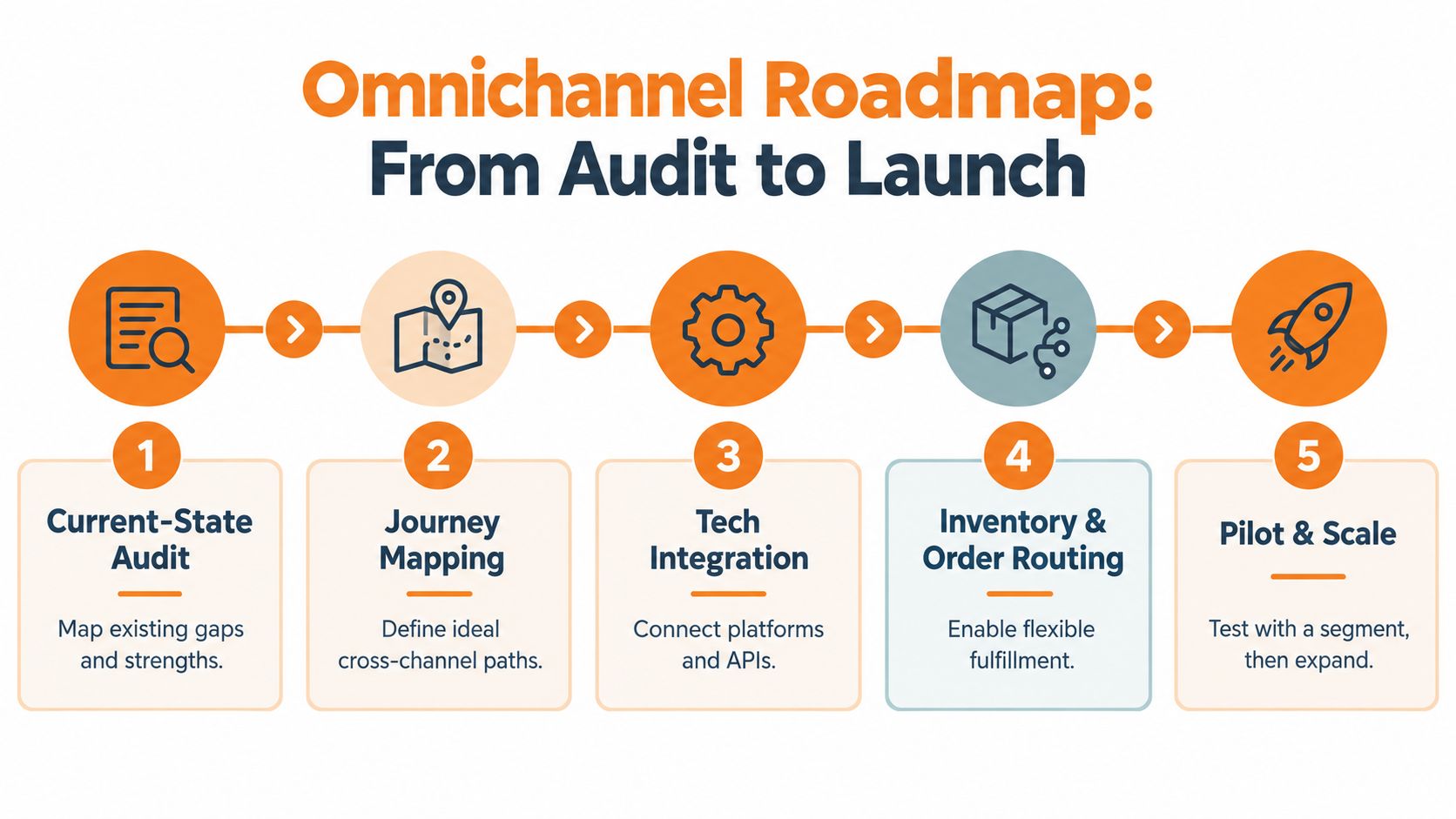
Building Your Omnichannel Roadmap From Audit to Launch
Begin with an audit, not a platform purchase. Gather the current customer journeys, channel responsibilities, systems, policies, and failure points. Include store staff and customer service in the interviews because they see problems that analytics may only reveal as abandonment or complaints.
Map the present state
Document how a customer discovers, evaluates, buys, receives, returns, and seeks help for a product. Mark every handoff between search, website, store, checkout, warehouse, courier, point of sale, and service desk.
For each handoff, record:
- Owner: Identify the team responsible for the customer-facing promise.
- System: Note where product, customer, order, and inventory data lives.
- Decision: Document the rule that controls availability, routing, pricing, or eligibility.
- Failure mode: Capture what happens when data is late, incomplete, or wrong.
This audit gives you a prioritised problem list. It also prevents a common mistake, treating a visible frontend issue as the root cause when the underlying problem sits in inventory or order management.
Choose a focused first journey
Don't launch every omnichannel feature at once. Select a journey that combines clear customer value with manageable operational effort. Buy Online Pickup In Store can be a sensible pilot for a retailer with reliable store stock and staff capacity. Buy Online Return In Store may be more appropriate when returns create friction but store teams can process them consistently.
Use a simple scoring model. Rate each use case for customer impact, revenue relevance, operational complexity, compliance risk, and measurement quality. A smaller pilot with clear ownership will teach you more than a broad rollout with unclear accountability.
Connect the technology and stock rules
Map the data between ecommerce, point of sale, inventory, order management, payment, email, and analytics systems. Define when stock becomes available online, when a pickup unit is reserved, who can substitute or cancel an item, and how the customer receives status updates.
Search deserves a place in this phase. KPMG's Canadian retail research reports that 63% of shoppers use search and other online touchpoints as their first source for category and product research, while Canada ranked fourth among eight major retailing countries on omnichannel solutions. Your product information and local availability therefore need to work before the customer reaches the store.
Add compliance before launch
For cannabis and CBD, define age verification, provincial availability, shipping boundaries, product claims, promotional language, consent, and record-keeping with qualified legal and compliance advisers. Don't assume that a tactic permitted for a general retailer is suitable for a regulated product.
Build compliance into templates and workflows. A product feed should exclude restricted claims. A paid campaign should use approved creative and targeting rules. A pickup workflow should verify the required conditions at the appropriate point. The exact requirements vary by product and jurisdiction, so treat this as a governance workstream rather than a copywriting preference.
Pilot, test, and expand
Run the first journey with a defined customer segment, selected locations, and a controlled product range. Test stock accuracy, payment, confirmations, staff alerts, pickup timing, cancellations, refunds, returns, accessibility, and customer support.
After launch, review exceptions rather than only averages. A customer who receives the right product through the wrong process may still be dissatisfied. Fix the operational causes, document the new workflow, train teams, and expand only when the pilot performs reliably.
Measuring Success With Omnichannel KPIs That Matter
A channel can look healthy while the customer journey remains difficult. Website conversion, store revenue, email clicks, and marketplace sales each measure one part of the path. Omnichannel measurement connects those pieces: can customers research, purchase, receive, use, and return products with reasonable effort and cost?
Set a baseline before changing the experience. Keep KPI definitions stable, distinguish online-only orders from cross-channel journeys, and record the operational cost behind each result. Canada's store-first buying pattern belongs in that baseline. KPMG's 2025 retail findings report that six in 10 Canadians mostly shop at brick-and-mortar stores, 66% prefer the in-store experience, 57% are frustrated with online shopping, and 85% cite price as the top purchase factor. More online traffic is not progress if it creates store confusion or makes pricing less clear.
Omnichannel KPI Decision Matrix
| Business Goal | Primary KPI | Diagnostic KPI | Why It Matters |
|---|---|---|---|
| Increase cross-channel sales | Blended conversion rate across journeys | Assisted visits, store-linked orders, checkout completion | Shows whether customers moving between channels are progressing |
| Improve pickup reliability | Successful pickup completion | Inventory accuracy, cancellation rate, preparation time | Separates demand from the quality of the pickup promise |
| Reduce fulfilment waste | Fulfilment cost per order | Split shipments, distance to customer, return handling cost | Connects customer choice with margin and operational effort |
| Make returns easier | Return resolution time | BORIS usage, refund exceptions, service contacts | Reveals whether the post-purchase experience is connected across channels |
| Grow customer value | Customer lifetime value by journey type | Repeat purchase, channel migration, discount dependency | Shows whether convenience creates durable relationships |
| Improve merchandising | Revenue and margin by fulfilment option | Stockouts, substitutions, product availability accuracy | Helps teams decide where inventory and promotions should go |
Attribution requires restraint. A store purchase may follow several digital interactions that the final transaction does not capture. Use customer-level or journey-level reporting where consent and identification permit. Compare those findings with store, ecommerce, and service data so one channel does not receive credit for the entire outcome.
Teams can use ecommerce reporting and analytics support to connect acquisition, conversion, fulfilment, and retention. The aim is one operating view, not a collection of separate scoreboards. That view helps marketers see whether a promise made online is being delivered profitably in stores and through fulfilment.
Real World Examples and Regulated Industry Playbooks
Consider a DTC brand that ships nationally but has a small retail presence. Its first useful move isn't to add another social storefront. It connects product availability to a store pickup option, creates a reservation rule, trains staff on pickup exceptions, and updates search and paid landing pages to explain local fulfilment. The customer researches online, chooses a nearby store, and receives a clear confirmation. The brand earns a sale while the store becomes part of the service experience.
A local retailer may need a different sequence. Suppose its website and store teams maintain separate stock records. The retailer can first unify product and inventory data, then align paid media with location-level availability. Instead of promoting a product broadly, the campaign can direct shoppers to a page that reflects the relevant store's assortment and fulfilment options. The improvement comes from matching demand generation to operational reality, not from increasing media volume.
These are illustrative operating patterns, not reported case-study results. The transferable lesson is to define the promise first, then make the systems and people capable of delivering it.
Smaller brands also need to think carefully about scale. Retail Insider's coverage of Canadian ecommerce growth reports that ecommerce order volumes rose 20% in 2025, but the top 10% of brands generated half of total order growth. The same source reports that 97% of shoppers buy from marketplaces and 78% are discouraged when preferred return options aren't available. Marketplaces, store pickup, and practical local returns can therefore be strategic infrastructure for brands that can't build a national fulfilment network immediately.
Regulated category considerations
Cannabis, CBD, and functional mushroom brands need channel discipline. Product education, search content, email, paid media, influencer activity, and marketplaces may all face different restrictions. Build an approved message library, label claims carefully, control audience targeting, and keep age and consent requirements visible in the journey.
A compliant experience can still be useful. Explain ingredients without unsupported health promises, provide transparent product information, describe fulfilment accurately, and route questions to trained support. Juiced Digital offers SEO, paid advertising, conversion optimisation, digital PR, and compliant marketing support for ecommerce and regulated health categories, with the work shaped around the rules that apply to each business.
Your Next Steps to Launch and Scale With Confidence
Treat the next 90 days as an operating sprint, not a reason to rebuild the entire business.
Days 1 to 30 should create a current-state map. Trace priority customer journeys, assign ownership for product and inventory data, document channel policies, and log the failures behind service contacts, cancellations, or abandoned orders.
Days 31 to 60 should prepare one controlled pilot. Connect only the required systems, set pickup and return rules, improve product and local availability information, write approved messages for regulated products, and train store and service teams to handle exceptions.
Days 61 to 90 should test the promise in practice. Launch with one focused segment or location group. Monitor order accuracy, fulfilment cost, cancellations, service contacts, returns, and blended conversion. Fix the operational causes before adding locations or channels.
The KPMG survey discussed in the measurement section shows that stores remain central to Canadian shopping, so your first 90 days should strengthen store-linked fulfilment before adding new channels. Expand when inventory data is dependable, staff can deliver the stated promise, compliance checks are repeatable, and reporting includes operational costs.
Juiced Digital helps ecommerce and regulated brands audit customer journeys, improve SEO and paid visibility, connect marketing with conversion optimisation, and plan measurable omnichannel growth. Visit Juiced Digital to request a focused consultation or audit.