

You're probably in one of two spots right now. Your phone isn't ringing enough from Google, or it is ringing, but paid ads are eating margin and you don't trust the numbers. Either way, you've realised the same thing most Vancouver and BC service businesses eventually realise. Local visibility isn't a side task anymore. It's an operating system.
That's why choosing a local SEO agency has become harder, not easier. Too many agencies still sell a stale checklist: citations, a few title tags, maybe some blog posts, then a ranking report that says very little about booked work. Meanwhile, local discovery has shifted. Google Business Profile drives action inside Search and Maps, AI-generated answers are compressing clicks, and sloppy entity data can sabotage everything before content even has a chance.
A real local SEO agency should help you win where customers make decisions. That means profile actions, review trust, map visibility, local landing pages, and increasingly, AI-surfaced answers. If an agency can't explain how it handles those pieces in a BC context, keep looking.
The Real Reason Local Businesses Hire a Local SEO Agency
A North Vancouver plumbing company usually doesn't start looking for SEO because the owner suddenly loves organic traffic. They start looking because something broke in the acquisition model. Ads got expensive. Lead quality got worse. The map pack stayed dominated by competitors. The website existed, but nobody had built the local layer underneath it.
That's the buying trigger.
Most local businesses hire a local SEO agency when they realise they're invisible in the moments that matter most. A customer searches for an urgent service, compares map results, reads reviews, checks hours, taps to call, and moves on. If your Google Business Profile is thin, your service pages are generic, and your entity data is inconsistent, you lose before your homepage even enters the conversation.
The problem isn't rankings alone
People still talk about “ranking on Google” like it's one thing. It isn't. Local discovery now happens across the map pack, Google Business Profile panels, service-area pages, review snippets, and increasingly AI-generated search answers. If you're only evaluating blue-link rankings, you're measuring the wrong battlefield.
Google's own Business Profile guidance matters here because it confirms what owners already feel in practice. Businesses can track profile performance in Search and Maps, including views, clicks, calls, and directions through Google Business Profile performance guidance. Those are the actions a serious local SEO agency should care about.
Practical rule: If the agency reports impressions and rankings but not calls, clicks, direction requests, or booked leads, it's doing SEO theatre.
Why the opportunity is getting bigger in competitive markets
California is a useful signal for what local competition looks like when business formation keeps rising. The state recorded 553,931 business applications in 2025, up 7.1% from 2024 and 51.7% above the 2019 baseline, according to California small business application data. More businesses entering the market means more profiles, more reviews, more local pages, and more pressure on every service category.
That same pressure shows up in major Canadian metros. Vancouver businesses aren't competing in a sleepy local web anymore. They're competing in a dense, review-driven, profile-first environment where every category has more noise.
What the operational gap usually looks like
When I audit local businesses, the pattern is boringly consistent:
- Half-built profiles: Categories are weak, services are missing, hours are outdated, and photos stopped months ago.
- Thin local pages: City pages are cloned from each other, with neighbourhood names swapped in.
- No entity control: Legal business names, abbreviations, and address formats don't match across platforms.
- No review process: Staff ask inconsistently, responses are delayed, and nobody watches sentiment trends.
- No schema ownership: The site has basic metadata but no disciplined local structured data strategy.
Generic SEO firms miss this because they treat local search like smaller national SEO. It isn't. Local SEO is operational. It sits between your website, your profile, your reviews, your business records, and your sales process. That's why a specialist exists in the first place.
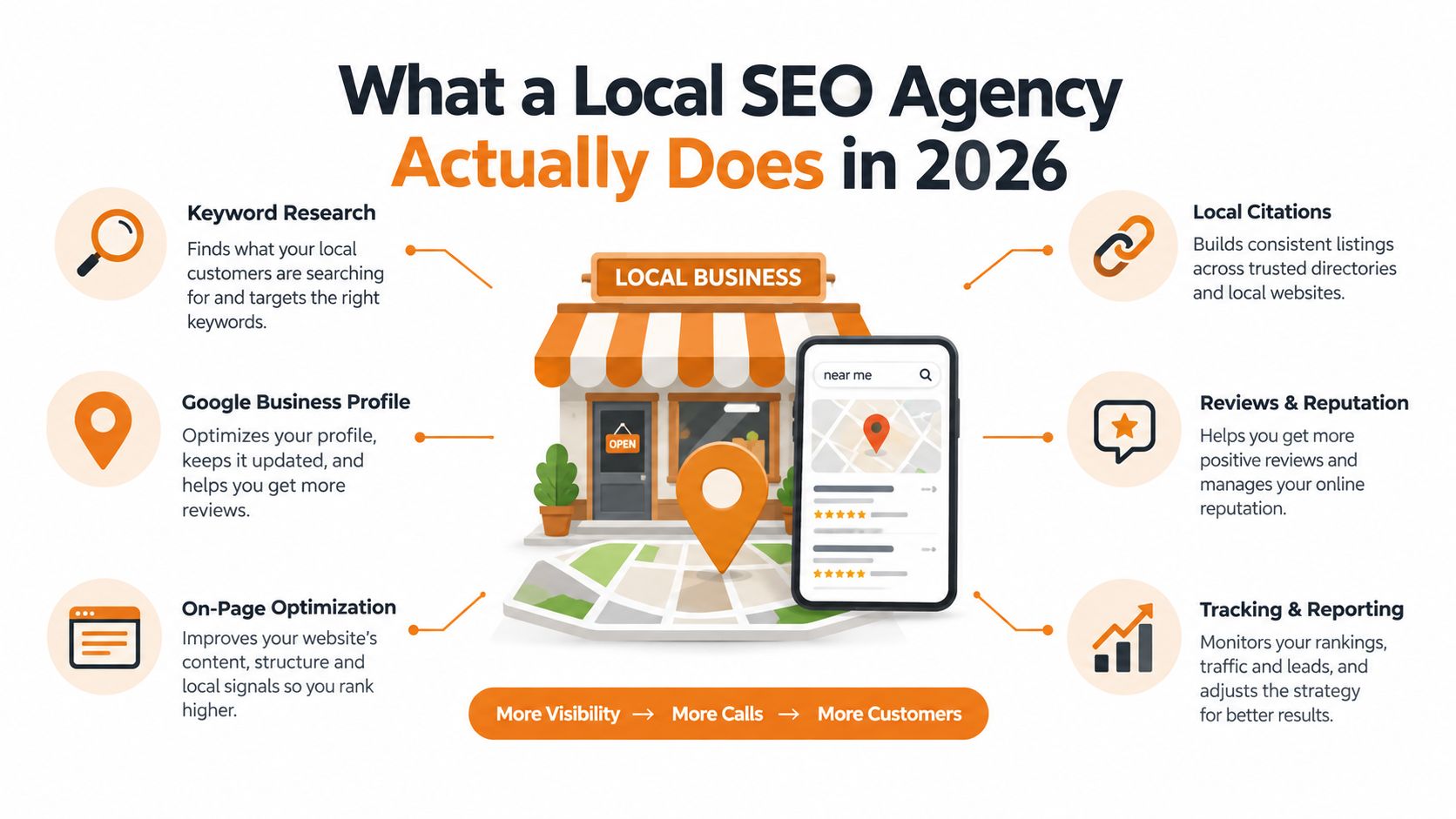
What a Local SEO Agency Actually Does in 2026
The outdated version of local SEO was simple. Submit the business to a pile of directories, tweak a homepage title tag, and wait. That playbook is old. It won't carry a serious service business in Vancouver, Burnaby, or Surrey.
A modern local SEO agency owns four jobs at once: profile management, entity trust, local content architecture, and review operations.
A visual summary helps:
It treats your Google Business Profile like a product
Your profile isn't a listing. It's a conversion asset. A proper agency manages categories, service lists, business descriptions, photos, posts, Q&A, and issue resolution. It also watches for edits, duplicates, and suspension risks before they become a crisis.
Profile completeness changes buyer behaviour. Google Business Profile guidance says customers are 70% more likely to visit, 50% more likely to consider purchasing, and complete profiles are 2.7 times more likely to be considered reputable, as cited in BrightLocal's local SEO statistics roundup. The same source also notes that an average SMB profile can generate around 1,009 searches per month, including 228 direct views and 781 discovery views. If an agency underplays profile work, it doesn't understand local acquisition.
It builds for AI-overwritten discovery
Clicks don't flow the same way they did a few years ago. In Canada, AI-generated local discovery is becoming impossible to ignore. One recent Canadian analysis estimated AI Overviews appear on roughly 47% of commercial-intent queries and have nearly doubled year over year, according to Canadian AI search adoption analysis.
That changes what an agency should build:
- Answer-first service pages that cover real pre-purchase questions
- Structured entity signals that help Google connect brand, service, and location
- Proof-rich content that AI systems can extract without guessing
- Review language and Q&A coverage that reinforces expertise and relevance
A local SEO agency that still talks only about citations and rank trackers is behind.
Here's a useful explainer for the AI side of the work:
It verifies the business before it promotes the business
BC-specific competence matters. In British Columbia, the government registry supports searches by business name, incorporation or registration number, CRA business number, owner name, and active versus historical status, according to the BC business search quick guide. A good agency checks those identifiers before it pushes citations, location pages, or profile edits.
Agencies that skip entity verification create duplicate listings, wrong legal names, and trust problems that take months to unwind.
It knows where specialists beat generalists
Generalist SEO firms can handle broad website work. They usually struggle with dense local competition, multi-location service brands, and regulated categories. Law, dental, healthcare, wellness, and other compliance-sensitive sectors need more than keyword placement. They need controlled reviews, careful claims, and location accuracy.
That's where a specialist local SEO practice earns its keep.
The Six Core Services That Drive Local Rankings
Most agencies sell local SEO as one bundled thing. That's lazy. Local growth comes from a stack of separate systems, and some matter more than others.
For a typical Vancouver service business, I'd prioritise the six pillars below in this order.
The ranking pillars that usually move the needle first
Google Business Profile management
This is usually the fastest lever. Category selection, services, photos, Q&A, posts, hours, and duplicate control directly affect visibility and conversion behaviour.On-page local SEO
Your site needs unique service pages, location relevance, strong internal linking, and local schema. If every page says the same thing with a different city name, don't expect traction.Reviews and reputation operations
Reviews shape trust before the click and after it. The acquisition process matters as much as the star rating.Citation and entity management
Useful, but often oversold. Cleanup matters more than volume.Local content
Case-led pages, neighbourhood proof, FAQs, and problem-solving content support both organic and AI visibility.Technical local SEO
Critical when broken, less visible when healthy. Indexation, mobile performance, and crawl hygiene keep the rest of the system working.
Local SEO Service Pillars Ranked by Impact
| Service Pillar | Impact (1-5) | Effort | Time-to-Result |
|---|---|---|---|
| Google Business Profile optimization and management | 5 | Medium | Short to medium |
| On-page local SEO | 5 | High | Medium |
| Reviews and reputation management | 4 | Medium | Medium |
| Citation and entity management | 3 | Medium | Medium |
| Local content production | 3 | High | Medium to long |
| Technical local SEO | 3 | Medium to high | Varies by issue severity |
What separates competent delivery from checkbox work
A weak agency says “we'll do citations.” A strong one says it will reconcile naming, address formatting, service-area references, and profile data against authoritative business records, then audit duplicates and mismatches before expanding citations.
A weak agency says “we'll make city pages.” A strong one builds pages with local proof. That means actual service context, neighbourhood references, FAQs, reviewer language, and schema that identifies the right business and service relationship.
Here's how I'd pressure-test each pillar:
- Profile management: Ask who owns category changes, Q&A seeding, post cadence, and suspension response.
- On-page local SEO: Ask whether pages are written uniquely by service and geography, not generated from one template.
- Reviews: Ask how requests are triggered after service completion and how responses are approved in regulated sectors.
- Citations: Ask which directories matter and why. “More listings” is not an answer.
- Content: Ask whether they can produce proof-led pages using job stories, before-and-after context, and local examples.
- Technical: Ask how they confirm pages are indexed and how they catch mobile UX issues that block conversion.
The most expensive local SEO mistake isn't underinvesting in one channel. It's paying for six services when only two are executed well.
How to Evaluate and Choose the Right Local SEO Agency
You don't need twenty sales calls. You need a hard filter. Most agencies disqualify themselves if you ask the right questions early.
Use a five-part shortlist
Judge every local SEO agency against these criteria:
| Criterion | What to Look For | Red Flag |
|---|---|---|
| City-specific map pack experience | Evidence they understand Vancouver-area competition and service-area behaviour | Generic SEO portfolio with no local examples |
| Regulated-sector fluency | Comfort with reviews, claims, licensing, and content constraints in your vertical | “We work with everyone” but no compliance process |
| Reporting tied to actions | Calls, clicks, forms, direction requests, and page-level conversion reporting | Ranking-only dashboards |
| AI workflow disclosure | Clear explanation of how they use AI for research, drafting, clustering, or SERP analysis | Black-box “AI SEO” with no human QA details |
| BC entity verification | Process for validating legal name, status, and registration data before citation work | They've never checked registry records |
Ask for a real plan, not a pitch deck
A good agency should be able to show you a practical first-quarter roadmap. Not every task, but enough to prove it knows what it's doing.
Ask for these three things:
- A 90-day sample plan: It should include profile work, site changes, content priorities, and reporting milestones.
- Two comparable references: Same service model, similar geography, similar complexity.
- Ownership clarity: Who writes content, who controls citations, who keeps access to the Google Business Profile, and what happens if you leave.
If the agency also claims AI capability, ask how it approaches answer-engine visibility and local intent modelling. If you want a benchmark for that line of questioning, review what an AI SEO agency should be able to explain around AI search workflows and measurable search visibility.
Know the red flags before you sign
Some warning signs are obvious. Others are disguised as convenience.
- Guaranteed map-pack rankings: No credible agency can guarantee placement.
- No direct GBP access: If they insist on controlling everything through their own account, walk away.
- Citation blasting as the core offer: That's maintenance work, not strategy.
- No mention of reviews: Local SEO without reputation management is incomplete.
- Very low pricing in a market like Vancouver: If the fee barely covers labour, the work is probably templated, outsourced, or both.
One more point. Match the agency to your business model. A one-location trades company, a clinic with multiple practitioners, and a strata lawyer all need local visibility. They do not need the same operating process.
Pricing Models, Contracts, and Realistic ROI
Local SEO pricing gets messy because agencies bundle very different scopes under the same label. Some are selling light maintenance. Others are rebuilding the whole local presence.
The useful way to compare pricing is by model, not by headline fee.
Local SEO Pricing Models and Expected ROI
| Pricing Model | Typical Range | Best For | Time to ROI |
|---|---|---|---|
| Monthly retainer | $900 to $2,500 | Businesses needing ongoing profile work, content, reviews, and reporting | Medium-term |
| One-time project | $1,500 to $4,000 | Single-location businesses with obvious setup gaps and clean operations | Short to medium |
| Performance or hybrid | Varies by structure | Businesses with strong tracking and clear lead attribution | Depends on baseline and terms |
When each model makes sense
A monthly retainer fits most service businesses because local SEO isn't static. Profiles need management, reviews need process, competitors change categories, and location pages need refining. If your market is competitive, a one-time setup won't hold for long.
A project-based engagement makes sense when the fundamentals are broken but the business doesn't need deep ongoing support yet. Think profile rebuild, citation cleanup, schema implementation, and location-page refresh.
A performance or hybrid deal sounds attractive, but read the fine print. These models only work when tracking is solid and both sides agree on what counts as a lead. Otherwise, they create arguments instead of accountability.
Tie ROI to actions you can verify
Smaller businesses often get misled. Rankings can improve while sales stay flat. Local SEO only earns its budget if it increases commercial actions you can track.
For Canadian local intent, distance and purchase timing matter more than most agencies admit. Recent Canadian local SEO research cites that 76% of smartphone local searchers visit a business within a day, 28% of local searches lead to a purchase within 24 hours, and successful local conversions in major Canadian metros average about 8.2 km, according to Canadian SEO statistics on local search behaviour. That supports a neighbourhood-level strategy, not generic citywide targeting.
So measure ROI against things like:
- GBP calls and direction requests
- Form submissions from service-area pages
- Tracked phone leads by location
- Booked jobs inside the target radius
- Revenue by source in your CRM or accounting workflow
Contract terms that protect you
Don't lock into a long contract before the agency proves execution quality. A local SEO campaign needs time, but that doesn't mean you should accept vague deliverables.
Look for:
- Clear monthly outputs
- Shared access to data
- A cancellation path
- Defined ownership of content and listings
- Reporting that matches how you run the business
If the contract is full of rankings and light on operational deliverables, the agency is selling hope.
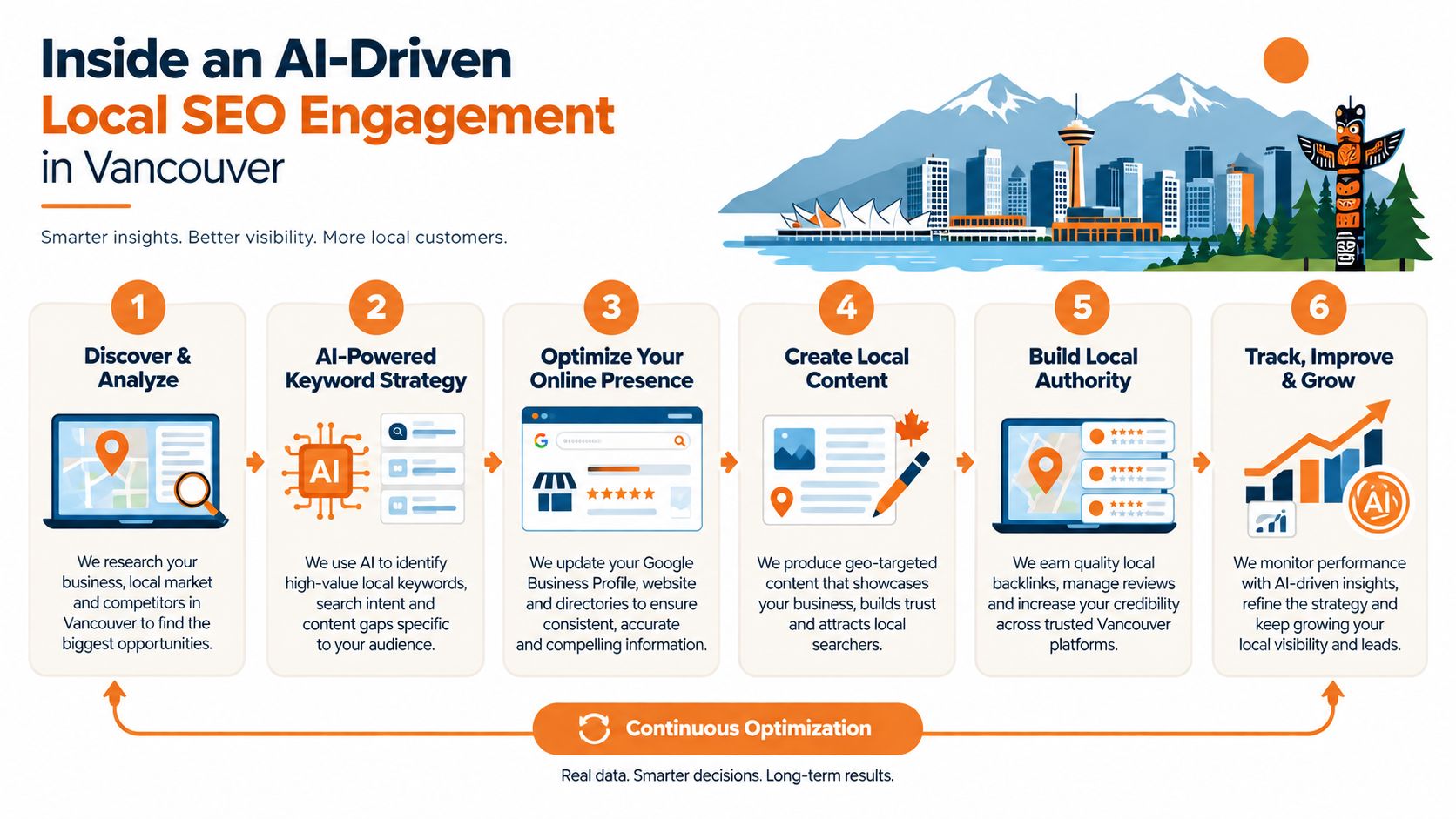
Inside an AI-Driven Local SEO Engagement in Vancouver
A regulated Vancouver service firm comes in with the usual mess. The Google Business Profile is claimed but neglected. Citations don't match. Reviews come in sporadically. The website has service pages, but they read like templates.
The first move isn't content. It's verification.
The work starts with entity control
Before anything gets expanded, the agency checks the business against official records. In Canada, the federal portal aggregates provincial registries, including British Columbia, with a source update shown on September 18, 2026 on the Canada business registry search portal. That gives the team a benchmark for location validation and entity consistency, especially if the client has more than one office or service area.
Once the legal name, registration status, and location details are reconciled, the site's schema and citation footprint can be corrected without introducing more confusion.
AI helps with speed, not accountability
Next comes search-intent modelling. AI can cluster local service modifiers, question variants, and area-specific topics much faster than a manual spreadsheet process. That's useful. It's not a substitute for judgement.
Human editors still need to make the call on compliance-sensitive copy, especially in regulated sectors where testimonials, claims, or before-and-after framing can create risk.
A solid Vancouver workflow usually looks like this:
- Entity audit first: Registry checks, legal name matching, and schema cleanup
- Profile rebuild next: Categories, services, photos, business description, and Q&A
- Intent clustering: AI-assisted grouping of commercial and informational local queries
- Proof-based page creation: Service and area pages built from actual customer scenarios
- Review engine setup: Compliant request process and response governance
- Shared measurement: Weekly profile actions and landing-page performance in one dashboard
For a business comparing agency options, that's the kind of process detail you should ask to see. If you want to compare it with a local service implementation, review a Vancouver local search optimization workflow and see whether the agency you're considering can explain its own process at that level.
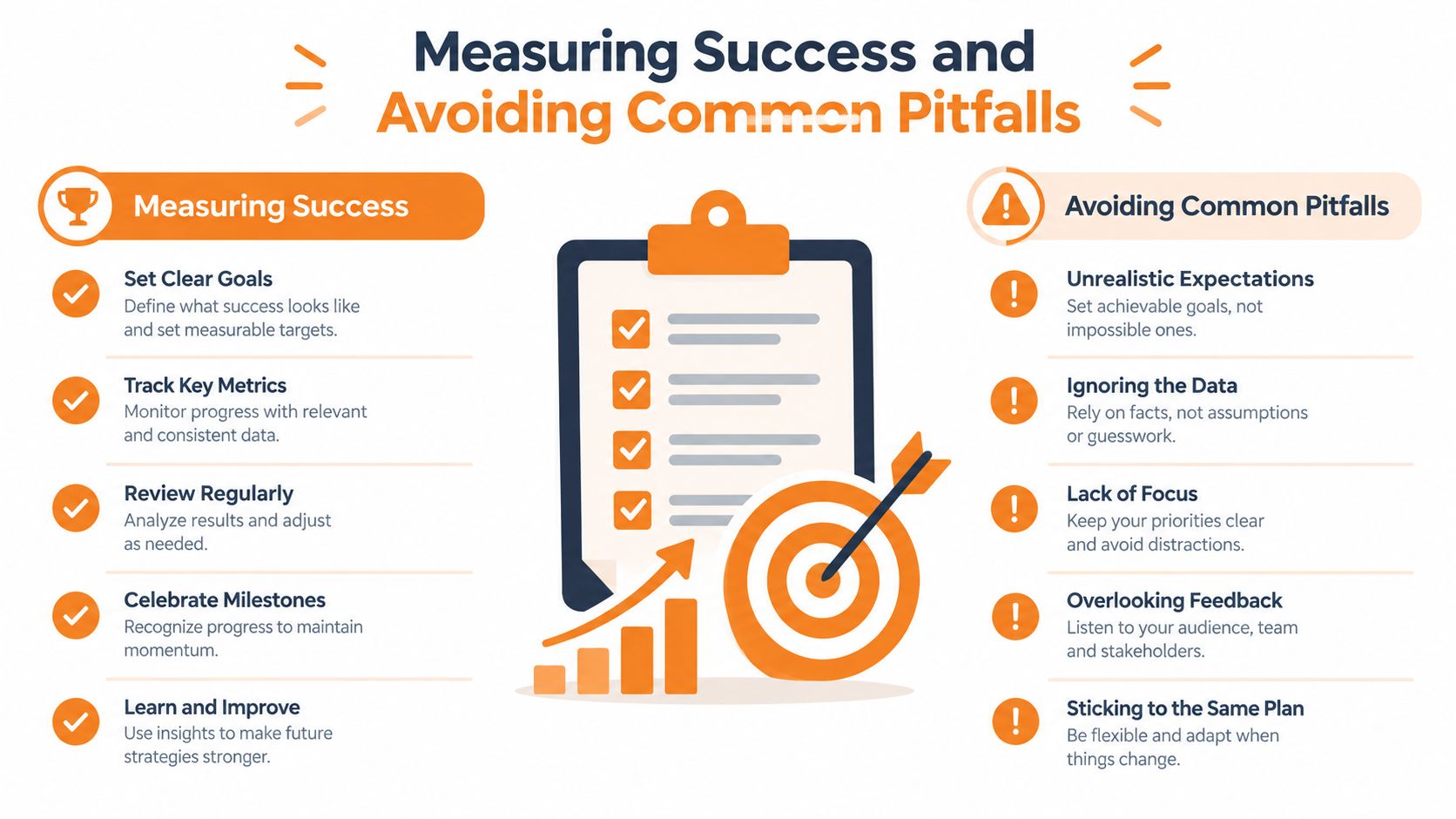
Measuring Success and Avoiding Common Pitfalls
Most local SEO reporting is still too shallow. You don't need another screenshot showing that a keyword moved from one position to another. You need to know whether visibility turned into calls, visits, forms, and booked work.
What success should look like
Start with a baseline before any work begins. Pull profile actions, review volume and recency, service-page clicks, form submissions, and tracked calls. Then review changes against actual work completed.
The metrics that matter most are usually:
- Google Business Profile actions: Calls, website clicks, messages, bookings, direction requests
- Local landing page engagement: Clicks and conversions from service and area pages
- Review velocity and sentiment: Are new reviews arriving consistently, and are themes improving?
- Map visibility by priority service areas: Not vanity citywide checks
- Lead attribution: Can the business tie enquiries back to local search?
If you need a framework for that baseline, a proper local SEO audit should surface profile gaps, entity inconsistencies, page issues, and conversion blind spots before the campaign starts.
The mistakes that keep repeating
The same errors show up across weak local SEO engagements:
Stop rewarding agencies for rankings they can screenshot and start rewarding them for actions they can explain.
- Chasing rankings instead of actions: Position gains are useful only if they increase commercial activity.
- Building low-quality citations: More listings don't fix wrong data.
- Using templated review responses: In regulated sectors, generic replies can create compliance issues and brand damage.
- Ignoring category hygiene in GBP: Wrong or stale categories distort relevance signals.
- No CRM or call tracking tie-in: Without attribution, “SEO is working” becomes a guess.
The final checklist before you hire
Use this as your last filter:
- Reporting cadence: Monthly at minimum, with action-level visibility
- Dashboard access: You should see the same data they see
- GBP ownership: Your business retains access and control
- Citation audit rhythm: Not one-and-done if the business changes
- Content accountability: You know who writes it, edits it, and approves it
- Entity verification process: Especially important in BC and for multi-location brands
A real local SEO agency should make your local presence more measurable, more resilient, and easier to trust. If it makes things feel murkier, it's the wrong fit.
Juiced Digital helps Vancouver and BC businesses with local SEO that goes beyond citation checklists. The team works on Google Business Profile optimisation, AI-aware local content, regulated-sector compliance, and measurement tied to real actions, not vanity reports. If that's the kind of local SEO agency support you need, visit Juiced Digital.