
Think of programmatic advertising less like traditional ad buying and more like a lightning-fast, automated stock market for digital ads. It’s a system that throws out the old rulebook of manual negotiations, phone calls, and drawn-out deals between advertisers and publishers. In its place, it uses smart technology to buy and sell ad space in the blink of an eye—literally, in the milliseconds it takes for a webpage to load.
What Is Programmatic Advertising, Really?
At its core, programmatic advertising is the automation of buying and selling digital ad inventory. The old-school method involved a ton of back-and-forth: endless emails, haggling over prices, and manually signing insertion orders. Programmatic tech sweeps all that away, creating a sophisticated ecosystem where machines handle the entire transaction.
This automation is what allows advertisers to connect with very specific audiences at an incredible scale. Instead of just buying a banner spot on theglobeandmail.com and hoping the right people see it, you’re buying the chance to show your ad to a particular person. Imagine you want to reach a 30-year-old in Vancouver who loves hiking and recently googled “new trail running shoes.” Programmatic lets you show your ad to that exact person, regardless of what website they’re browsing at that moment.
The real magic of programmatic isn’t just the automation; it’s the precision. It’s a fundamental shift from buying ad space to buying access to your target audience. This makes every ad dollar you spend smarter and much more accountable.
The whole process happens almost instantly. When someone matching your target profile lands on a site with available ad space, an auction kicks off behind the scenes. Different advertisers, through their platforms, place bids for that single ad impression. The highest bidder wins, and their ad appears on the page—all before the user has even finished scrolling.
The Core Components Explained
To really get what programmatic advertising is, you need to know the key players that make these super-fast transactions happen. We’ll dive deeper into each one later, but for now, here’s a quick rundown of who’s involved:
- Advertisers (The Buyers): These are the brands and agencies trying to get their message in front of the right people.
- Publishers (The Sellers): Think website owners, app developers, and online content creators. They have the ad space (or inventory) to sell.
- The Technology (The Marketplace): This is the engine room, made up of platforms like Demand-Side Platforms (DSPs), Supply-Side Platforms (SSPs), and Ad Exchanges that connect the buyers and sellers and run the automated bidding process.
This automated system isn’t just a niche trend; it’s become the default way to buy digital ads. The numbers speak for themselves. In 2023, programmatic ad spending in Canada hit a staggering $40.7 billion USD. And it’s not slowing down, with forecasts predicting the market could balloon to $174.8 billion USD by 2030. You can dig into more data on North American programmatic ad trends to see just how massive this shift has become.
To make things even clearer, here’s a quick summary table breaking down the main parts of the programmatic ecosystem.
Programmatic Advertising At A Glance
| Component | Description |
|---|---|
| Advertiser | The company or brand looking to purchase ad space to reach potential customers. |
| Publisher | The website or app owner with available ad inventory to sell. |
| Demand-Side Platform (DSP) | Software used by advertisers to manage and buy ad inventory from multiple sources. |
| Supply-Side Platform (SSP) | Software used by publishers to manage and sell their ad inventory to advertisers. |
| Ad Exchange | A digital marketplace that connects DSPs and SSPs, facilitating the real-time auction. |
These components work together seamlessly to create an efficient marketplace where advertisers find their ideal audience and publishers maximize their revenue.
How The Programmatic Ecosystem Actually Works
To really get what programmatic advertising is all about, you have to pull back the curtain and see the split-second transaction that happens every time you load a webpage. It’s a complex, high-speed dance between different technologies, all working in sync to get the right ad in front of the right person at just the right moment.
Imagine an incredibly fast, automated auction house. But instead of people shouting bids, powerful software platforms do all the work in milliseconds. The whole point is to connect advertisers who are looking for an audience with publishers who have ad space to sell.
This entire process hinges on three key pieces of technology: the Demand-Side Platform (DSP), the Supply-Side Platform (SSP), and the Ad Exchange. Each one has a very specific job to do to keep the wheels turning.
The Key Players In The Programmatic Auction
The ecosystem is really just a classic supply-and-demand model, with specialized software representing each side of the deal.
-
Demand-Side Platform (DSP): This is the advertiser’s command centre. Brands and their agencies use a DSP to manage their ad campaigns across countless websites and apps, all from one dashboard. It’s where they set their targeting criteria (things like demographics, interests, and online behaviour), upload their ads, and decide how much they’re willing to pay for each impression.
-
Supply-Side Platform (SSP): This is the publisher’s storefront. Website owners and app developers use an SSP to manage and sell their available ad space, which we call inventory. The SSP connects their inventory to a ton of ad exchanges and DSPs, helping them squeeze every last drop of revenue out of their ad slots by getting the highest possible price.
These two platforms then meet in the middle to do business.
The Ad Exchange: Think of this as the central marketplace—like the TSX, but for digital ads. It’s a massive, neutral pool of ad inventory from publishers that advertisers can bid on. The ad exchange connects the DSPs (the buyers) with the SSPs (the sellers), creating the digital floor where the auction takes place.
This whole setup makes the most common type of programmatic buying possible: Real-Time Bidding.
Real-Time Bidding: The Lightning-Fast Auction
Real-Time Bidding (RTB) is the engine that drives most of the programmatic world. It’s an auction-based system where ad impressions are bought and sold one at a time, as they happen.
Here’s a play-by-play of how it unfolds:
- A User Visits a Site: You click a link and land on a publisher’s webpage.
- The Auction Kicks Off: As the page loads, the publisher’s SSP sends out a bid request to an ad exchange. This request contains anonymous data about you (like your general location, browsing habits, and demographics) and details about the ad space up for grabs.
- DSPs Evaluate and Bid: The ad exchange blasts this request out to dozens, sometimes hundreds, of DSPs. Each DSP instantly analyzes the user data to see if you fit their advertiser’s target profile. If it’s a match, the DSP submits a bid on the advertiser’s behalf.
- A Winner Is Chosen: The ad exchange collects all the incoming bids and, in an instant, declares the highest bidder the winner.
- The Ad Is Served: The winning advertiser’s ad is immediately sent back to the publisher’s website and pops up on your screen. This entire chain of events is over in less than 100 milliseconds—literally faster than you can blink.
While RTB is the most common way to do things, it’s not the only game in town.
Beyond RTB: Private Marketplaces And Programmatic Direct
Sometimes, advertisers need a bit more control and transparency than an open auction can give them. For those situations, other buying methods have popped up, which we cover in our complete guide to programmatic display advertising.
- Private Marketplace (PMP): This is an invitation-only auction. Here, a select group of advertisers gets exclusive access to bid on a publisher’s premium ad inventory. It offers a much higher degree of brand safety and exclusivity compared to the wide-open market.
- Programmatic Direct: This approach simply automates the old-school way of buying ads directly. An advertiser agrees to buy a specific number of ad impressions from a publisher for a pre-negotiated, fixed price (often called a fixed CPM). The transaction is handled programmatically, but there’s no auction involved.
In the Canadian market, RTB is still the dominant force, accounting for 43% of total market revenue in 2023. But things are changing. Private Marketplaces are now the fastest-growing segment, which tells us that while Canadian brands love the efficiency of RTB, they’re increasingly looking for the control and premium ad placements that PMPs provide. If you want to dive deeper into these market dynamics, you can explore more detailed research on Canada’s programmatic landscape.
Exploring Different Programmatic Ad Formats
Knowing how programmatic advertising works is one thing, but the real magic happens when you see the creative possibilities it opens up. Programmatic isn’t just about boring banner ads; it’s a powerful engine that can deliver all sorts of engaging ad formats across pretty much any digital channel you can think of.
This flexibility means you can pick the perfect format to hit your campaign goals and actually connect with your audience. A one-size-fits-all approach just doesn’t cut it anymore. A local physiotherapy clinic in Vancouver, for example, could run geo-targeted display ads to find potential patients who live or work nearby. In contrast, a national e-commerce brand selling activewear can use powerful video ads to tell its story and show its products to a much wider audience across the country.
The Most Common Programmatic Ad Types
Different formats are suited for different jobs, whether you’re trying to build brand awareness or drive immediate sales. Let’s break down the most common options you’ll come across.
- Display Ads: These are the visual ads you see everywhere—the banners, squares, and sidebars on websites. They might be the most traditional format, but programmatic targeting gives them a huge boost, making sure they’re seen by people who are actually interested. There’s a whole range of standard Google Display Ad sizes to choose from.
- Video Ads: Think of the pre-roll ads before a YouTube video or the in-stream ads that pop up on social media. Video is an incredible tool for storytelling. In fact, programmatic video ad spending is expected to hit over $207 billion by 2025, which shows just how popular and effective it is.
- Native Ads: These are the chameleons of the ad world. They’re designed to blend in with the content around them, looking like “sponsored articles” or “recommended for you” posts. Because they match the look and feel of the website, they feel less like an interruption and tend to get much better engagement.
The diagram below shows the simple, three-step journey a programmatic ad takes from the user’s visit to the ad appearing on their screen.
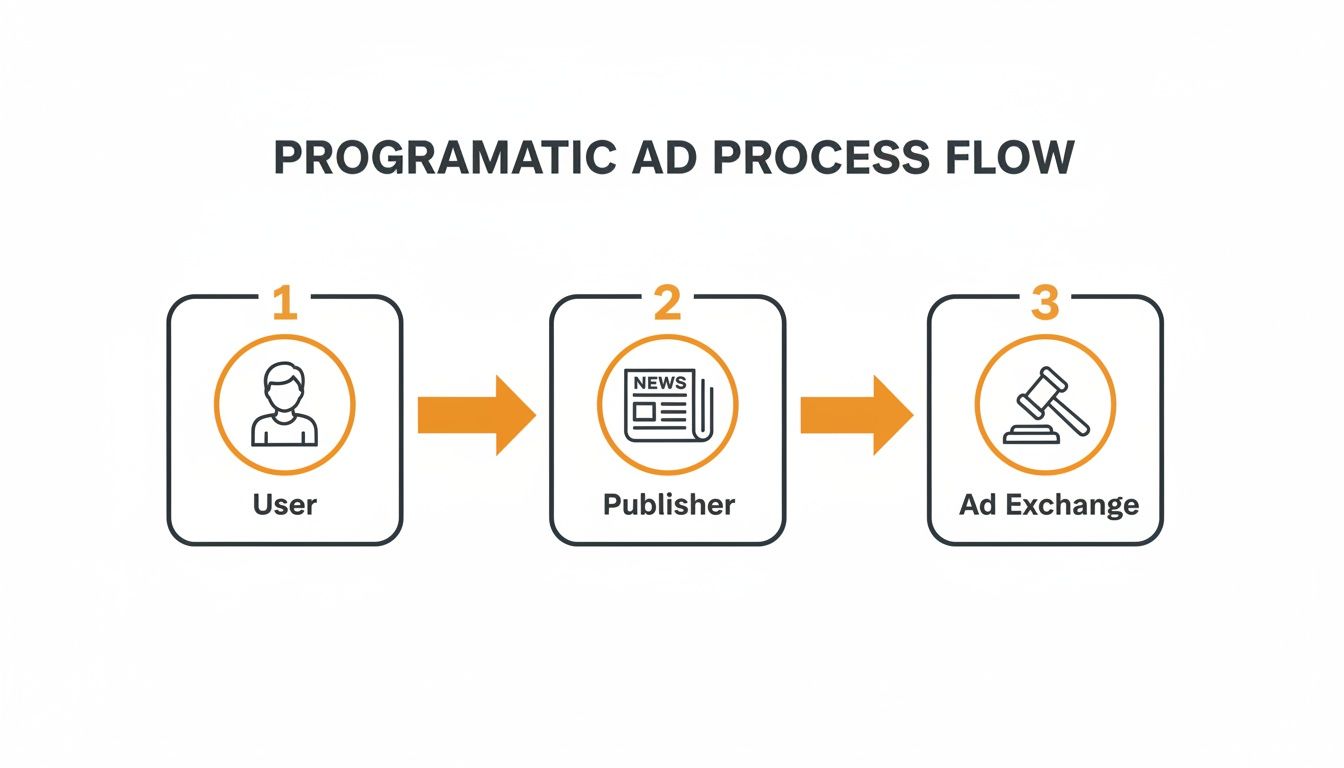
This entire lightning-fast process is what allows all these different ad formats to be delivered in the blink of an eye, matching the right creative to the right person.
Emerging and Specialized Formats
Beyond the big three, programmatic technology is always finding its way into new spaces, giving us exciting new ways to grab people’s attention.
Programmatic isn’t just a technology; it’s a bridge to your audience, wherever they are. Whether they’re streaming a show, listening to a podcast, or browsing their favourite blog, there’s a programmatic format designed to reach them effectively.
This constant evolution has given rise to some really interesting specialized formats:
- Audio Ads: With podcasts and music streaming bigger than ever, programmatic audio lets you place ads directly into listeners’ ears. It’s the perfect way to reach people when they’re screen-free, like during their commute or at the gym.
- Connected TV (CTV): This is all about ads delivered through smart TVs and streaming devices like Apple TV or Roku. CTV gives you the best of both worlds: the big-screen impact of a traditional TV commercial combined with the sharp targeting of digital marketing.
- Digital Out-of-Home (DOOH): Yes, even billboards have gone programmatic. DOOH lets you buy ad space on digital screens in public places—think bus shelters and shopping centres—and use data to show different ads based on the time of day or even the weather.
The Good, The Bad, and The Programmatic: A Realistic Look
Programmatic advertising can be a game-changer for businesses, but it’s not a magic wand. Like any powerful tool, it has its strengths and its weaknesses. To really make it work, you need to understand both sides of the coin. On one hand, you get incredible efficiency and laser-focused targeting. On the other, you’re stepping into a complex world that needs to be handled with care.
The biggest win for most marketers is the sheer efficiency. Think about all the time that used to be spent on phone calls, emails, and negotiating ad placements one by one. Programmatic automates that entire process. This frees up your team from the grunt work and lets them focus on what actually drives results—strategy, creative, and digging into the data to see what’s working.
This automation naturally leads to massive scalability. A single person or a small team can suddenly manage campaigns reaching millions of people across a mind-boggling number of websites and apps. That kind of reach was unthinkable with traditional ad buying. You can launch, tweak, or stop campaigns on the fly, giving you the agility you need to keep up with the market.
The Upside: Why Marketers Love Programmatic
Beyond just saving time, the real power of programmatic is its targeting capability. You can get incredibly granular. We’re talking about targeting people based on their age, what they’re interested in, their recent online activity, what they’ve bought before, and even their physical location.
This precision means your ads are shown to people who are genuinely likely to be interested, which slashes wasted ad spend. For any business keeping a close eye on the bottom line, this leads directly to a much healthier Return on Ad Spend (ROAS). If you’re new to that term, our guide to understanding ROAS is a great place to start.
Here’s a quick rundown of the core benefits:
- Supercharged Efficiency: Automates the tedious manual work, saving you a ton of time and resources.
- Pinpoint Audience Targeting: Uses data to find your ideal customer, making ads far more relevant and effective.
- Real-Time Campaign Tuning: Lets you make instant changes based on performance, so your budget is always working its hardest.
- Massive Reach: Gives you access to a global inventory of ad space across countless digital properties.
The Downside: Navigating the Potential Pitfalls
Now for the reality check. The programmatic world isn’t all smooth sailing. Its automated, complex nature can open the door to some serious issues if you’re not paying attention.
Ad fraud is a big one. This is where bots and other non-human traffic generate fake impressions and clicks, literally stealing your ad budget. It’s a persistent problem in the industry, and if left unchecked, it can eat up a significant chunk of your spend without you even realising it.
Then there’s brand safety. You work hard to build your brand’s reputation, and the last thing you want is your ad showing up next to offensive or inappropriate content. Because the buying is automated, you don’t always have direct control over placement—unless you take specific steps to manage it.
Finally, the sheer complexity of the whole system can be a major hurdle. With a sea of acronyms like DSPs, SSPs, and ad exchanges, it’s easy for newcomers to feel lost. This complexity can also hide a lack of transparency, making it tough to see exactly where your money is going and how much is being skimmed off in fees along the way.
But don’t worry, there are proven ways to tackle these issues:
- Use Ad Verification Tools: Work with third-party companies that specialize in sniffing out fraud and ensuring your ads are actually seen by real people.
- Manage Whitelists and Blacklists: Take control by creating lists of sites you approve of (whitelists) and sites you want to avoid at all costs (blacklists).
- Explore Private Marketplaces (PMPs): These are invite-only auctions where you can buy high-quality ad space from a curated group of trusted publishers, giving you much more control and transparency.
Programmatic Advertising Pros vs Cons
To sum it all up, here is a clear comparison of what you stand to gain and what you need to watch out for.
| Benefits (Pros) | Challenges (Cons) |
|---|---|
| Automation saves time and reduces manual negotiation and paperwork. | Ad fraud is a real risk, with bots potentially wasting your budget. |
| Incredibly precise targeting lets you reach your ideal audience. | Brand safety concerns mean ads could appear next to inappropriate content. |
| Real-time data and optimization allow for agile campaign adjustments. | The ecosystem is complex and can be overwhelming for beginners. |
| Access to a massive scale of inventory across the web. | Lack of transparency can make it hard to track fees and ad placement. |
| Improved ROI by reducing wasted ad spend and increasing conversion rates. | A steep learning curve is required to master the platforms and strategies. |
By being proactive and smart about these challenges, you can minimize the risks and unlock the incredible potential that programmatic advertising has to offer. It’s about going in with your eyes open.
How To Launch Your First Programmatic Campaign
Alright, let’s move from theory to practice. Getting your first programmatic campaign off the ground can feel a bit intimidating, but it really just boils down to a clear, step-by-step process. Once you break it down into manageable phases, you can confidently put this powerful ad tech to work for your business.
The journey doesn’t start with tech or platforms—it starts with strategy. Before you even think about placing a bid, you have to know exactly what you’re trying to achieve. A campaign without clear goals is like a ship without a rudder; you’ll just drift aimlessly and burn through your budget.
This initial planning stage is non-negotiable. It lays the groundwork for every single decision you’ll make later, from who you target to how you measure success. Putting in the time here will dramatically boost your chances of seeing a great return on your ad spend.

Step 1: Define Your Objectives and KPIs
First things first, you need to answer the most critical question: what does a “win” look like for this campaign? Are you gunning for immediate sales, trying to get your brand name out there, or hoping to drive traffic to a new landing page? Your main goal will shape your entire strategy.
Once you’ve got a goal, you need a way to track it. That’s where Key Performance Indicators (KPIs) come in. Think of them as the specific signposts that tell you whether you’re heading in the right direction.
Here’s how goals and KPIs typically line up:
- Goal: Increase Brand Awareness. Your mission is to get your brand in front of as many relevant eyeballs as possible.
- KPIs: Impressions (how many times your ad was shown), Reach (how many unique people saw it), and Cost Per Mille (CPM), which is simply the cost per thousand impressions.
- Goal: Drive Website Traffic. You want to pull new visitors to your website or a specific page.
- KPIs: Clicks, Click-Through Rate (CTR), and Cost Per Click (CPC).
- Goal: Generate Leads or Sales. This is all about driving direct action and getting those conversions.
- KPIs: Conversions (like a form fill or a purchase), Conversion Rate, and Cost Per Acquisition (CPA).
Setting clear, measurable goals from the outset is the single most important step. It transforms your campaign from a hopeful experiment into a strategic business initiative with accountable results.
Step 2: Pinpoint Your Target Audience
With your goals locked in, it’s time to figure out exactly who you’re talking to. This is where the real magic of programmatic advertising happens. You can go way beyond broad demographics and build a highly detailed profile of your ideal customer using a mix of powerful data.
Think about the different layers of targeting you can use:
- Demographic Targeting: This is your foundation. Start with the basics like age, gender, income level, and education to sketch out a general profile of your audience.
- Geographic Targeting: Get specific with location by targeting users by country, province, city, or even down to a postal code. For local businesses, geo-fencing is a game-changer—it lets you target users within a tight radius of a physical spot, like a coffee shop targeting people within a few blocks.
- Contextual Targeting: Place your ads where they make sense. You can put them on websites and apps whose content is directly related to your product. For instance, a company selling hiking gear could target articles and blogs all about outdoor adventures.
- Behavioural and Interest Targeting: This is incredibly powerful. It targets users based on their past online actions—what sites they’ve visited, what they’ve searched for, or products they’ve looked at. An e-commerce store can use retargeting to show ads for a specific pair of shoes to someone who added them to their cart but never checked out.
Step 3: Execute and Optimize Your Campaign
Now you’re ready to get your hands dirty with the technical setup. This phase is all about choosing your platform, setting your budget, and designing ads that get noticed.
First, you’ll need to pick a Demand-Side Platform (DSP). This is your command centre for buying ad space. Many modern DSPs, like Google’s Display & Video 360 or The Trade Desk, are built to be user-friendly, giving you a central dashboard to manage everything from audience targeting to bidding.
Next, set a budget you’re comfortable with. Programmatic platforms are flexible, so you can start small and ramp up as you see what works. You can set daily or lifetime spending caps to make sure you never go over budget.
Finally, it’s time to work on your creative. Whether it’s a display banner, a short video, or a native ad, make sure it’s eye-catching, has a clear message, and includes a strong call to action (CTA) that tells people exactly what to do next. Once you launch, keep a close eye on your campaign’s performance against your KPIs and be ready to optimize—that could mean tweaking bids, refining your audience, or testing new ad creative to get better results.
The Future Of Programmatic Buying
The world of programmatic advertising never stands still. Just when you think you’ve got it figured out, new technology and changing expectations around consumer privacy come along and rewrite the rules. The automated engine that runs so much of modern digital marketing is constantly getting smarter, faster, and more predictive. If you want to build a strategy that lasts, you need to understand where it’s all heading.
Two massive forces are currently shaping programmatic’s next chapter: the rapid advancement of Artificial Intelligence (AI) and the industry-wide pivot to a cookieless internet. These aren’t just minor tweaks; they’re fundamentally changing how we target ads, measure results, and even create campaigns.
AI-Powered Targeting and Optimization
AI isn’t just a buzzword in programmatic anymore—it’s quickly becoming the brains of the whole operation. We’re moving past simple automation, with AI algorithms now taking on incredibly complex tasks that were once impossible for a human to manage at scale.
This technology is weaving its way into every part of a campaign:
- Predictive Targeting: Instead of just reacting to past behaviour, AI models can now analyze huge datasets to predict which users are most likely to convert. This allows you to focus your ad spend with laser-like precision.
- Automated Bid Optimization: Forget setting static bids and hoping for the best. AI can adjust bids for every single ad impression in real-time, factoring in hundreds of signals to make sure you pay the perfect price.
- Dynamic Creative Optimization (DCO): AI is even getting into the creative side of things. It can automatically mix and match headlines, images, and calls-to-action to build the most effective ad for each individual seeing it.
The next chapter of programmatic isn’t just about automating the buy; it’s about using AI to make every decision smarter. From predicting audience behaviour to crafting personalized ad creative, AI is turning programmatic into a truly intelligent marketing channel.
This evolution is cementing programmatic’s place as the default way to buy digital ads. In North America, programmatic is on a clear path to account for 74% of total open-internet revenues by 2026. For digital platforms and publishers, that dominance is even more pronounced, with nearly 90% of revenues already flowing through programmatic channels. You can explore detailed forecasts on Canada’s ad market to see just how big this shift is.
Navigating A Cookieless World
The other seismic shift on the horizon is the end of the third-party cookie. For years, these little trackers have been the backbone of user-level targeting. While losing them definitely presents a challenge, it’s also a huge opportunity to build a more transparent and privacy-friendly advertising ecosystem.
In this new reality, first-party data becomes gold. This is the information you collect directly from your own customers with their consent—think website analytics, CRM contacts, or email lists. This data is now your most valuable asset.
Advertisers with a solid first-party data strategy are going to have a massive competitive edge. They’ll be able to build their own rich audience profiles and deliver relevant, personal ad experiences without relying on old, invasive tracking methods. This ensures their programmatic efforts will stay effective and respectful of user privacy for years to come.
Common Questions About Programmatic Advertising
Diving into programmatic advertising can feel a bit daunting at first. It’s a complex space, and it’s only natural to have a few questions before you jump in. Let’s tackle some of the most common ones we hear from marketers and business owners.
How Much Do I Really Need to Spend to Get Started?
There’s a persistent myth that programmatic is strictly a big-brand game, requiring an astronomical budget. The good news is that’s just not true. While more budget means more data for the algorithms to learn from, you can definitely get your feet wet with a more modest amount.
Most modern Demand-Side Platforms (DSPs) are built for flexibility. You can set daily or lifetime spending caps that you’re comfortable with, so there are no scary surprises. It’s entirely possible to run a small test campaign for a few hundred dollars just to see what happens and gather some early performance metrics. The goal isn’t a massive initial splash; it’s about spending enough to get meaningful feedback you can act on.
Can Programmatic Actually Work for a Small Business?
Yes, one hundred percent. In fact, it can be a game-changer. While the technology sounds complicated, its real strength for smaller and local businesses is surgical precision.
Think about it this way: a local dental clinic in Vancouver doesn’t need to advertise to people in Toronto. They can use geo-fencing to serve ads only to people within a 5-kilometre radius of their front door. Every single dollar is spent reaching potential patients, not wasted on impressions halfway across the country. That kind of efficiency is exactly what small businesses need to compete.
For small businesses, it all comes down to efficiency. You stop paying for broad, hopeful advertising and instead put your budget directly in front of people in your service area who are showing signs they need what you offer. It makes every dollar count.
How Long Until I See Results?
Programmatic isn’t a magic button for instant results; it’s more like a smart system that needs time to learn. You’ll see initial activity like impressions and clicks almost immediately—within the first day or two of launching a campaign.
But the real magic happens after the system has had a chance to gather data. You should plan for a “learning phase” that typically lasts 2-4 weeks. During this initial period, the platform is busy testing different audiences, creatives, and bidding strategies to figure out what works. You’ll start to see stable, meaningful results and a clearer Cost Per Acquisition (CPA) once this phase is complete.
Ready to see what programmatic advertising can do for your business? The AI-powered paid media team at Juiced Digital designs and manages high-performance campaigns that turn ad spend into measurable revenue. Book your free consultation today!