

89% of Canadian businesses had at least one web presence in 2021, whether a website, a social media account or paid online advertising, and 33% had at least some e-commerce sales, up from 25% in 2019, according to Statistics Canada's survey of digital technology and internet use. Digital presence stopped being a differentiator years ago. It's the entry fee.
That reframes the whole job. A Vancouver clinic or a British Columbia e-commerce brand doesn't win because it has a website and runs some ads. It wins when channels, offers and data pull toward one measurable result, and when consent and AI-search accuracy are designed in from the start instead of patched on later. This guide is about building that system, component by component, and knowing when it's ready to spend money.
Why a Campaign Strategy Beats Scattered Tactics
Think of a campaign as a relay team, not a group of sprinters. In a relay, one runner hands the baton to the next and the team wins on the handoffs. A campaign works the same way: an ad earns attention, a landing page holds it, a booking form converts it, a follow-up email keeps it. Scattered tactics are four runners sprinting in different directions, with a boosted post here, a newsletter nobody reads there and a paid search account last opened in March.
The working definition: one business goal with a number and a date, a defined audience, a message with proof, the channels that reach that audience, a conversion path that turns attention into action, and measures that show whether it worked.
Without that spine, the losses are quiet but real. Budget flows to channels no one measures. Leads land in an inbox and never reach a sales conversation. The monthly report celebrates a rise in clicks while revenue stays flat, and nobody can say which half of the spend produced anything.
Business owners already sense the stakes. In a 2023 Canada Digital Adoption Program survey of 1,000 business owners, partners and senior managers, 77% identified increasing online presence as a priority for the next one to three years (Canada Digital Adoption Program survey report). Priority isn't the missing piece. Structure is.
By the end of this guide you'll be able to name the components of a campaign, see how they connect, choose channels by funnel stage, measure outcomes without overstating them, and sign off a plan before a dollar goes out.
The Six Core Components of a Campaign Strategy
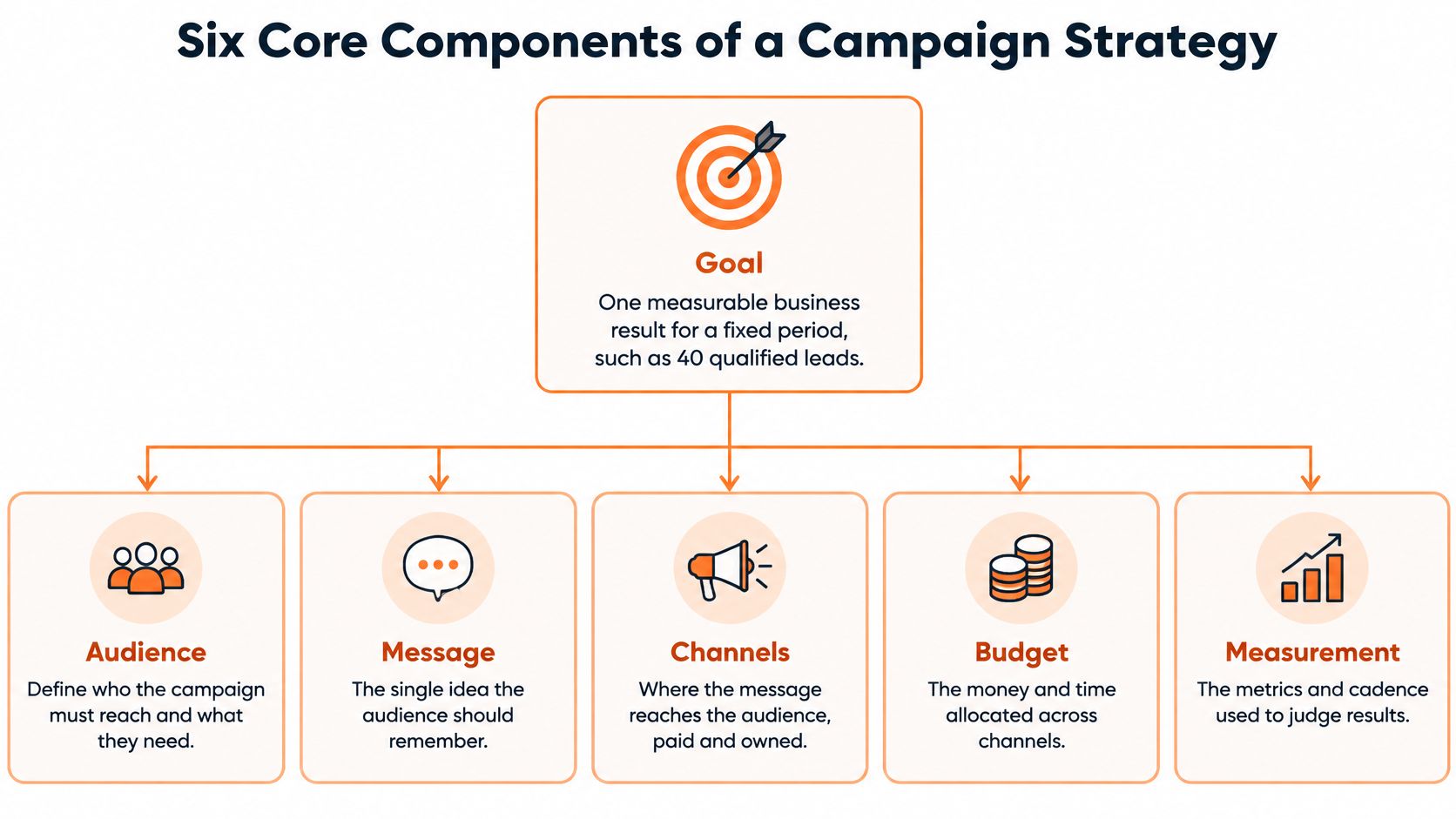
Six components carry a campaign. Miss one and the other five keep running, just badly.
| Component | Core question | Example KPI |
|---|---|---|
| Goal | What business result must move, and by when? | Qualified leads or revenue per month |
| Audience | Which segments are most likely to buy? | Share of traffic from target segments |
| Message | What single promise will persuade each segment? | Click-through rate on the priority message |
| Channels | Where will each audience meet the message? | Cost per qualified visit by channel |
| Conversion path | What action does the visitor take, and how easily? | Conversion rate on key landing pages |
| Measurement | How will results be attributed and reviewed? | Share of conversions tracked to a known source |
The hierarchy matters more than the list. One node sits on top, and the other five are judged by how much they move it.
Goal and audience set the ceiling
A goal is one measurable business result for a fixed period, not "grow our brand". Something like 40 qualified leads a month or a 15% lift in online orders within a quarter. If the phrasing is the sticking point, these examples of marketing objectives show how a number and a date turn an ambition into a target someone can miss.
Audience means two or three named segments, defined by need and buying stage rather than age bracket. A clinic's segments might be "recent injury, already seeing another physio" and "searched physiotherapy near me this week". Those two need different messages and often different channels. "Adults 25 to 54" tells you nothing about either.
Message, channels and the conversion path
The message is one promise per segment, backed by proof. Proof is a review count, a credential, a delivery window, a guarantee. A promise without proof is a slogan.
Channels get chosen after the goal and audience are fixed, never before. That ordering is where most campaigns fail, because a channel picked first becomes a solution hunting for a problem it can solve.
The conversion path is the action, the page it happens on, and the friction in between. Five form fields instead of twelve. A booking calendar that shows real availability instead of "we'll call you". A confirmation that says exactly what happens next.
Measurement closes the loop
Measurement covers the events you track, how a source gets attributed, and how often someone reviews the numbers. If no named person owns them, they stop being read within two months.
The completeness test: if a component can't be stated with a number, a date or a named owner, the strategy isn't finished.
That test takes ten minutes and can save a quarter of spend.
A short walkthrough of how these components behave once a campaign is live and reporting starts:
How the Components Work Together in One Campaign
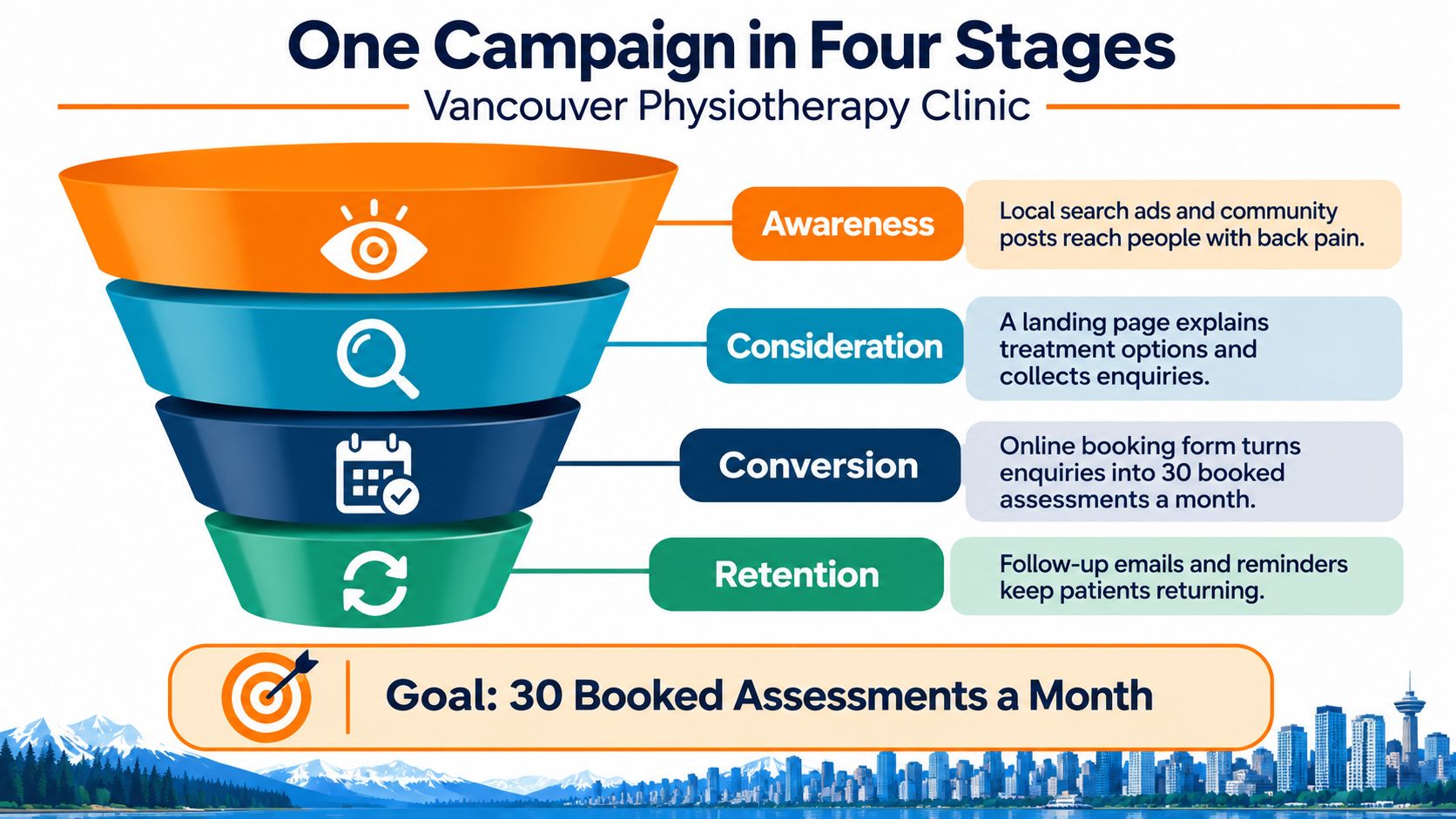
Say a Vancouver physiotherapy clinic needs 30 booked assessments a month. That single number drives every decision that follows, which is the point of writing it down first.
Across four stages, the same person moves from a search result to a booked appointment to a returning patient.
From search to booked assessment
Awareness runs on local search ads for high-intent service terms and a complete Google Business Profile with hours, photos, services and a booking link. Someone typing a specific pain-and-place query has already decided to act. The ad's job is to be there, not to educate.
Consideration is a service page that repeats the ad headline word for word, shows practitioner credentials and registrations, and lists the booking steps plus what to bring. Conversion is the booking form itself, with a short confirmation screen and a reminder email 24 hours before the appointment.
Retention starts after treatment: a follow-up message, then a rebooking prompt timed to the treatment plan. That last stage is where the compounding value sits, because a returning patient costs nothing to acquire twice.
The arithmetic behind the goal
Here's where the funnel stops being a diagram and starts being a budget decision. At 1,000 clicks and a 4% booking rate, the clinic gets 40 bookings and clears its goal. At 2%, the same 1,000 clicks produce 20 bookings. Same spend, half the result.
To hit 30 bookings at 2%, the clinic would need roughly 1,500 clicks, which means 50% more media budget for the same outcome. Reading the earlier month and adding budget is the expensive fix. Fixing the page and the form is the cheap one.
Handoff rule: the headline, the offer and the proof in the ad must match the headline, the offer and the proof on the landing page. Any mismatch leaks people at the exact moment they were ready to book.
| Stage | Clinic action | Metric to check |
|---|---|---|
| Awareness | Local search ads for high-intent service terms and a complete Google Business Profile | Clicks from local search |
| Consideration | Service page that repeats the ad headline, shows practitioner credentials and lists booking steps | Share of landing-page visits that reach the booking step |
| Conversion | Online booking form with a short confirmation and an email reminder sequence | Booking rate, 4% versus 2% in the worked example |
| Retention | Follow-up messages after treatment | Repeat booking rate |
Where funnels break, and a second example
Take an online supplement store with a goal of raising repeat purchases by 20%. The shape changes completely: paid media does very little of the work, while email and a post-purchase offer carry most of it. Same six components, different distribution of effort. That's why copying another business's channel mix rarely transfers.
The diagnostic works for both. If traffic rises and bookings or orders don't, the conversion path is the weak link, not the ad budget. The one metric to check first each week is booked appointments or orders against the pace the goal requires, not the click count.
Choosing Paid, Owned and Earned Channels
Media splits three ways. Paid media you buy. Owned media you control, such as your website, blog and email list. Earned media you get from reviews, press and referrals. Campaigns that stall usually leaned hard on one type and neglected the other two.
| Channel type | Typical role | Cost pattern | Best measure |
|---|---|---|---|
| Paid search | Captures high-intent queries | Pay per click, set by bids | Cost per qualified lead |
| Paid social | Reaches defined audiences early | Pay per click or per thousand impressions | Cost per qualified visit |
| Owned website and blog | Builds lasting search visibility | Content and upkeep time | Organic conversion rate |
| Email and CRM | Nurtures existing contacts | Low cost per message sent | Revenue per subscriber |
| Earned media and reviews | Builds third-party trust and proof | Time and PR effort | Referral traffic and branded search volume |
Paid search earns the first test because Canadian buyers still start there. Search remained the country's largest digital advertising category in 2025, generating $9.33 billion, or 43% of the national digital-ad market, according to IAB Canada's 2025 revenue survey. That concentration is an argument for proving intent-driven demand before adding a fourth social platform.
Three rules for picking channels
- Match the channel to the stage the buyer is in. Someone searching a service-plus-city term is near a decision, so paid search and a landing page fit. Someone still comparing options needs an owned explainer page and an email capture.
- Use paid media where speed matters. Launches, seasonal offers and time-limited promotions need attention this month. Paid buys that; owned content doesn't.
- Build owned channels for compounding returns. Blog content, service pages and an email list typically need six to twelve months before they carry real weight, then keep producing without a per-click bill.
Channel selection is an allocation decision, and the handoffs between channels matter as much as the picks. Our guide to omnichannel marketing strategy covers how paid, owned and earned pieces pass demand to each other.
The 30-day test and the budget behind it
Pick two or three channels that fit the goal and the budget. Give each a fixed spending cap and a 30-day window. Keep the ones that hit the target cost per qualified lead.
Set the cap by working backward. Divide each channel's monthly budget by the qualified leads it must produce, and split the total so that no single channel can swallow the whole budget before the review date.
Budget rule: give every channel a number before launch, not after. A channel that can't be assigned a cost per qualified lead can't be judged, only defended.
Run the full 30 days before forming an opinion, then roll the survivors into a 90-day cycle with the same cap and the same target. When budget tightens, drop first the channels that produce impressions and no tracked action, because they're the ones whose value nobody can prove.
How to Build a Measurement Plan That Holds Up
Measurement is a routine, not a dashboard. Seven steps, in this order.
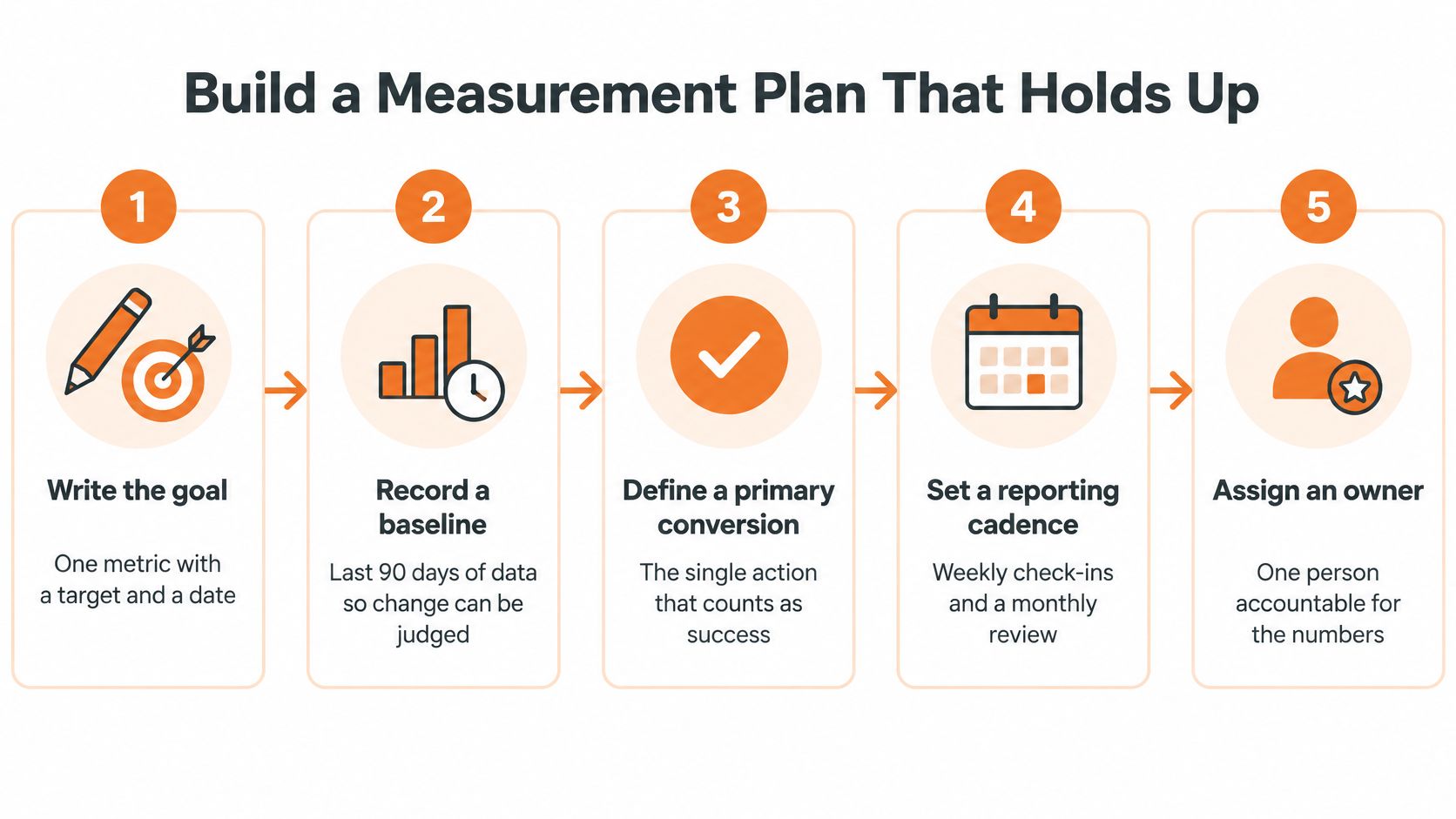
- Write the goal as one metric with a target and a date. "Book 30 assessments a month by 30 June" can be judged. "Improve our marketing" can't. The date matters as much as the number because it forces a review whether the result is good or bad.
- Record a baseline from the last 90 days. Bookings, orders, spend and cost per lead for the same period. Without a baseline, a team can't tell a strong month from an average one, and every result gets argued rather than measured.
- Define one primary conversion and two or three secondary events. The primary is what counts: a booked appointment, a purchase, a signed contract. Secondary events such as form starts, phone taps and add-to-cart explain a dip before revenue moves.
- Tag every link with source parameters and record the source in the CRM at first contact. Platforms lose the thread when a visitor switches devices or comes back a week later. The CRM record is the version that survives.
- Store consent with the lead. Under Canada's Anti-Spam Legislation, commercial electronic messages including promotional email and text require prior express or implied consent, sender identification and contact information, and a working unsubscribe mechanism in every message, as the CRTC's CASL guidance sets out. Keep consent source, timestamp, disclosure language, channel and permitted use in the CRM, suppress contacts the moment they unsubscribe, and keep transactional, promotional and partner-data audiences separate.
- Import offline outcomes back into the ad platform where you can. A signed contract or a completed sale is the outcome that matters, and importing it teaches the platform to find more of the same.
- Set two rhythms. Weekly for spend pacing and anything broken. Monthly for attribution, channel decisions and creative refresh. One named owner.
The trade-off between narrow and broad forms
A short form collects more leads of worse quality. A longer, narrowly disclosed form collects fewer, better ones. The way to settle that argument is a test, not an opinion: run one landing page with a minimal form and one that explains what the data is for and asks for the extra field.
Judge the test on qualified-lead rate, booked appointments, unsubscribe rate and consent validity, not raw lead count. The Canadian Marketing Association reports that 90% of Canadians are at least somewhat concerned about online privacy, while 59% feel more comfortable sharing data when businesses explain how it will be used and offer control over preferences (CMA report on consumer expectations for privacy and relevance). Explanation isn't a courtesy. It's a conversion variable.
When attribution can't settle the argument
Last-click attribution gives the final touch all the credit and the earlier work none. A brand campaign that primes demand will look worthless right up until it stops and paid search conversions fall with it.
When the numbers won't settle it, run a geographic lift test or holdout group: hold the campaign in one market, keep spending in a comparable one, and compare booked revenue rather than clicks. If your model needs tuning first, these marketing attribution models explain what each one overweights.
Three warning signs worth acting on:
- Leads rise while sales stay flat. Either lead quality dropped or nobody is working the leads. Check the CRM before the ad account.
- A channel looks cheap only until unqualified leads come out. Recalculate cost per qualified lead after removing duplicates, students and out-of-area enquiries.
- The report never mentions revenue. If a monthly deck stops at impressions and clicks, it isn't measuring a campaign.
Guardrails for Privacy and AI-Driven Discovery
Customers now ask a chatbot instead of reading your site. The Canadian Internet Trends 2026 report found that 46% of Canadians used a generative-AI tool or platform in the previous year, up from 33% in 2025 and 16% in 2024. Among those users, 52% used AI as a search engine, yet only 19% said they always verify AI-generated information with another source.

That gap is the risk. If the answer gets your location, hours, pricing or eligibility wrong, nobody checks it, and the booking never happens. For regulated categories, a wrong claim is worse than a missed booking.
Most campaign advice treats AI discovery as a content volume problem. Accuracy is the harder half.
Where direct promotion is restricted, as it is for cannabis, we run Google Ads with informational, value-driven ad copy, strategic keyword targeting and a heavy focus on landing page experience, then measure qualified actions rather than promotional reach.
A monthly checklist keeps the facts straight:
- Make the facts identical everywhere. Location, services, pricing, eligibility and any health claims should read the same on the website, business profiles, third-party listings and structured data.
- Test brand prompts by market each month and write down how the answer describes the business.
- Track qualified actions from AI-referred visitors, not just sessions.
- Separate brand visibility from revenue in every report, so a mention never gets counted as a sale.
- Check where an AI tool stores data before adopting it, since 67% of Canadians consider domestic data storage important, per the same Canadian Internet Trends 2026 report.
Confirm the Strategy Before You Launch
Write a one-page brief with one line per component: the goal as a number and a date, the named audience segments, the message and its proof for each segment, the channels with a spending cap and a 30-day test window, the primary conversion and the consent approach, and the measurement owner with the review cadence.
Three checks decide whether it's ready.
- Every goal is measurable in the CRM or the ad platform, not just in a slide.
- Every channel has a cost per qualified lead target, written down before launch.
- Every claim matches what your site, business profiles and structured data already say, so an AI answer can't contradict you.
Our engagements start with a full technical and content audit to uncover growth opportunities and quick wins, because a brief built on assumptions about the site tends to collapse in week two. From there, our lead generation work includes a clear quarterly roadmap detailing your objectives and the strategies to reach them, which keeps the plan honest once the launch energy fades.
One action for this week: schedule the review, complete the brief, and launch only the channels that pass all three checks.
If building that brief alone feels like guesswork, Juiced Digital starts with a full technical and content audit of your site and funnel, then ties the goal, audience, message and channels to numbers you can review monthly. The team works across paid media, technical SEO and conversion optimisation for Vancouver service businesses, e-commerce brands and regulated categories like cannabis, CBD and functional mushrooms. Visit Juiced Digital to book a free consultation and start with the audit.
