
96% of Canadian C-suite marketing and media executives reported using AI in some capacity in a 2025 survey of 100 senior executives by the Canadian Media Directors Council and Globe Media Group, reported by Strategy. That striking figure reframes the question: AI in marketing is no longer just an experiment, but using a tool isn't the same as running a reliable system.
For a Vancouver service business, an e-commerce brand or a regulated wellness company, the practical questions are what AI should do, what information it can use, and who takes responsibility for its output. Digital marketing using AI works best when it supports a defined customer journey and measurable business goal, with privacy and human review built into the workflow.
How AI Fits Each Digital Marketing Channel
AI takes on the volume and pattern work in each channel, while people own strategy, claims and final approval. It can sort information, spot patterns and suggest variations, but it can't take responsibility for whether a campaign is fair, accurate or right for a particular customer.
What AI does and what people check, by channel
| Channel | AI does | Human checks |
|---|---|---|
| AI-driven SEO | Keyword clustering, content briefs, technical audit triage, schema drafts | Fact accuracy, sources, expertise signals, brand voice |
| AI-powered paid ads | Audience segmentation, ad variant generation, budget pacing | Claim compliance, landing-page match, restricted wording |
| Conversion rate optimization | Drop-off pattern detection in session data, test idea ranking | Test design, accessibility, brand fit of each change |
| Digital PR | Journalist and outlet research, story angle ideas, outreach drafts | Story accuracy, editorial fairness, relationship judgement |
| Email and lead nurture | Contact segmentation, send-time prediction, reply drafts | Consent records, opt-outs, regulated wording |
Use AI to support the work in each channel
In SEO, AI can cluster search queries by topic and turn them into a content brief. It can also help prioritize technical audit findings and draft structured data suggestions. An editor must still check that claims are supported, sources are credible and content demonstrates real subject knowledge.
For paid ads, systems can help group audiences, generate ad variations and pace campaign budgets. A reviewer needs to check every claim and make sure the ad accurately reflects its landing page. This is especially important when a sector or platform restricts certain products or wording.
In conversion rate optimization, AI can flag patterns in session and conversion data, such as a repeated drop-off during checkout. That pattern suggests where to investigate, but it doesn't explain why people leave. A specialist should design the test, check accessibility and confirm that a proposed change still fits the brand.
Keep human judgement at the point of contact
For digital PR, a model can organize research about publications and propose story angles. A person must verify that a journalist covers the subject and judge whether the pitch is accurate and editorially fair.
For email and lead nurture, automation can segment contacts, suggest send times and draft replies. A team still needs to maintain consent records, honour opt-outs and review any regulated language. A well-organized email marketing automation workflow connects these tasks to clear review and approval responsibilities.
For a first pilot, pick one channel with useful data and low compliance risk. A brief based on public product information may be a safer test than an automated reply to a sensitive health inquiry.
Canadian Adoption Figures Behind AI Marketing
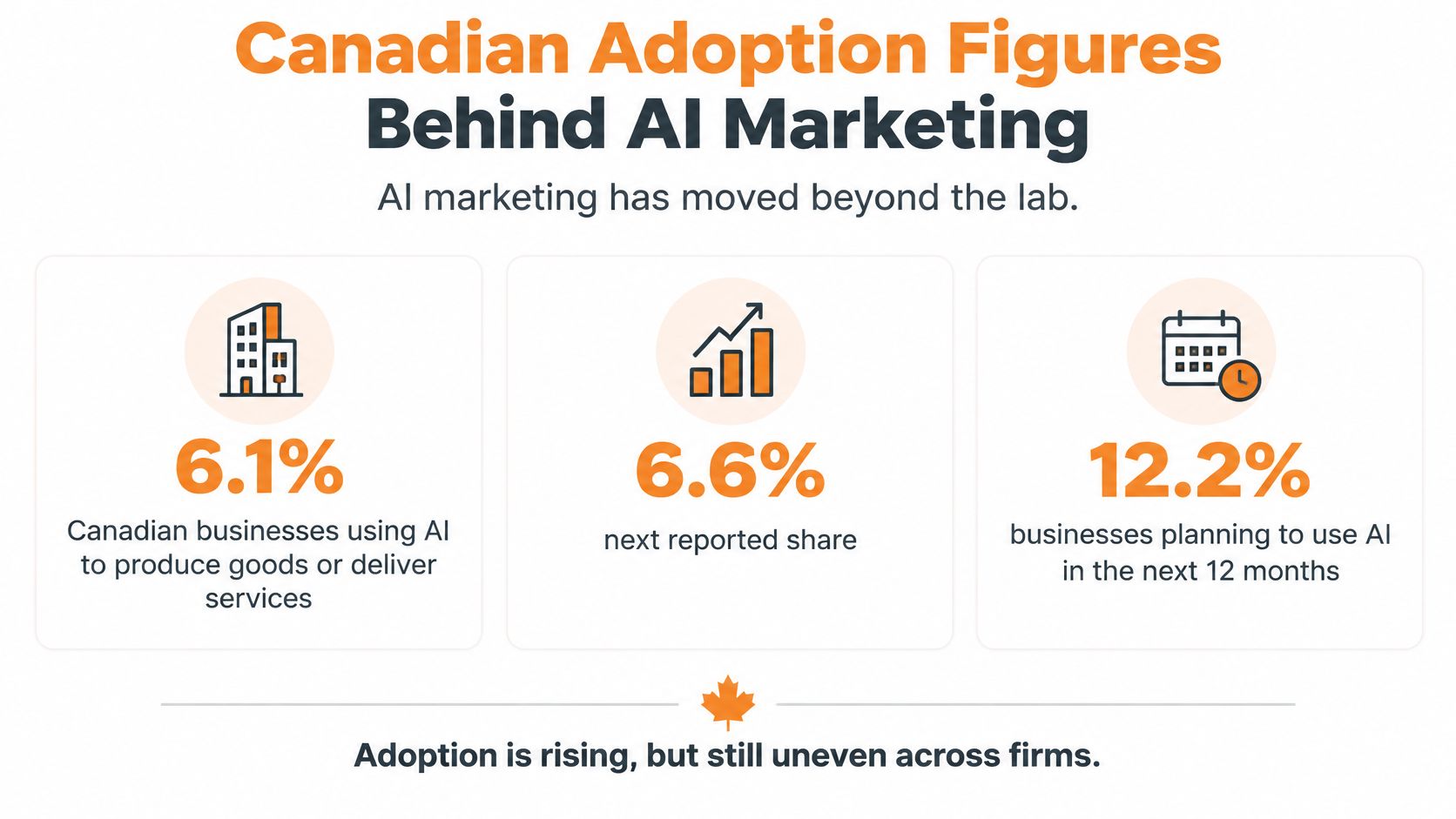
12.2% of Canadian businesses used AI to produce goods or deliver services during the 12 months preceding the second quarter of 2025, compared with 6.1% during the 12 months preceding the second quarter of 2024, according to Statistics Canada. That nearly doubled share shows AI moving into business operations, although it doesn't tell us which tools produce better marketing results.
Among businesses using AI in 2025, text analytics was the most common application, at 35.7%, while data analytics was 26.4%, virtual agents or chatbots were 24.8%, and marketing automation was 23.1%. Marketing automation's share had been 15.2% in 2024. These figures describe applications among AI-using businesses, not among all Canadian businesses.
Read adoption figures in context
The size of Canada's advertising market helps explain why marketers are looking at automation. Canadian internet advertising revenue reached $18.2 billion in 2024, up 14% year over year, according to the IAB Canada 2024 Internet Ad Revenue Survey. That is evidence of a large, growing digital advertising market, not proof that AI caused the increase or that a particular AI tool will pay off.
Professional use is also common: 74% of Canadian Marketing Association members reported using generative AI tools at least weekly at work in its readiness survey, as reported by Robert Half. This finding applies to CMA members surveyed, not every Canadian marketing team.
For a local or e-commerce business, the message is not “buy a tool because everyone else has one.” It is that AI is becoming part of ordinary marketing work, so it's useful to understand where it could help your team. The figures don't prove that any one application increases revenue.
Audit your own workflows
List whether your team already uses AI to analyse customer messages, review campaign data, handle basic questions, or automate follow-up. Mark which workflows have a named reviewer and which lack a clear measure of success.
Choose one process where a better result would matter to customers or revenue. A workflow audit is more useful than guessing which applications competitors have adopted.
Privacy and Data Limits for AI Marketing Tools
AI doesn't automatically save time or money. A customer spreadsheet may make a task easier to run, but sending it to a tool without checking the data flow can create a problem that takes longer to fix than the work saved.
The Office of the Privacy Commissioner of Canada's business survey found that Canadian business AI use increased from 6% in 2023 to 16% in 2025. Among AI-using businesses, marketing was the second-most common application, at 24%. These figures come from a separate measure of business AI use, so they shouldn't be combined with Statistics Canada's measure of businesses using AI to produce goods or deliver services.
Create a data map before connecting a tool
Lead forms, health-related inquiries, purchase histories and location information deserve particular care. For clinics, wellness brands, and cannabis or CBD businesses, a record that looks like ordinary marketing information may reveal sensitive interests or circumstances.
The following table sets out a conservative internal policy for using different kinds of information with general-purpose AI tools. It is a practical starting point, not a substitute for assessing applicable privacy requirements or the specific terms of a vendor.
Approved, restricted and prohibited AI inputs
| Input | Status | Condition |
|---|---|---|
| Aggregated campaign performance (impressions, clicks, cost) | Approved | No personal identifiers included |
| Product or service catalogue | Approved | Public-facing information only |
| Customer names, emails and phone numbers | Restricted | Only in consented, contracted tools |
| Precise location history | Restricted | Use aggregated geography instead |
| Health-related form entries and inquiry notes | Prohibited | Never sent to general-purpose AI tools |
| Cannabis or CBD purchase histories | Prohibited | Never sent to general-purpose AI tools |
Removing a name doesn't necessarily make a record anonymous. Free-text comments, specific locations and combinations of details can still identify a person. Before uploading data, check what the tool will receive, including fields and metadata that may not be visible in a simple spreadsheet view.
A Google Ads conversion tracking setup can focus on whether an agreed action occurred, rather than passing sensitive form contents into advertising systems. The marketing team should be able to measure a consultation request without copying the customer's explanation into an AI prompt.
Review vendors and approve output
Before buying a tool, ask where it stores data, whether inputs train its models, which sub-processors receive information, how long records are retained, and how deletion requests are handled. Keep the answers with the tool's approval record, and confirm that the vendor's terms match the workflow you intend to run.
Set a review sequence for claims and automated replies. A staff member checks the draft against approved business facts; a qualified reviewer handles sensitive or regulated wording; and an authorized person approves publication or sends the response. Write the data map once, review it quarterly and attach it to every tool purchase.
Practical rule: Approve the information flow before connecting the tool.
The advantage isn't necessarily producing more content. A documented process can help a business scale its marketing without exposing unnecessary customer information or publishing unreviewed claims.
How to Build an AI-Enabled Marketing System
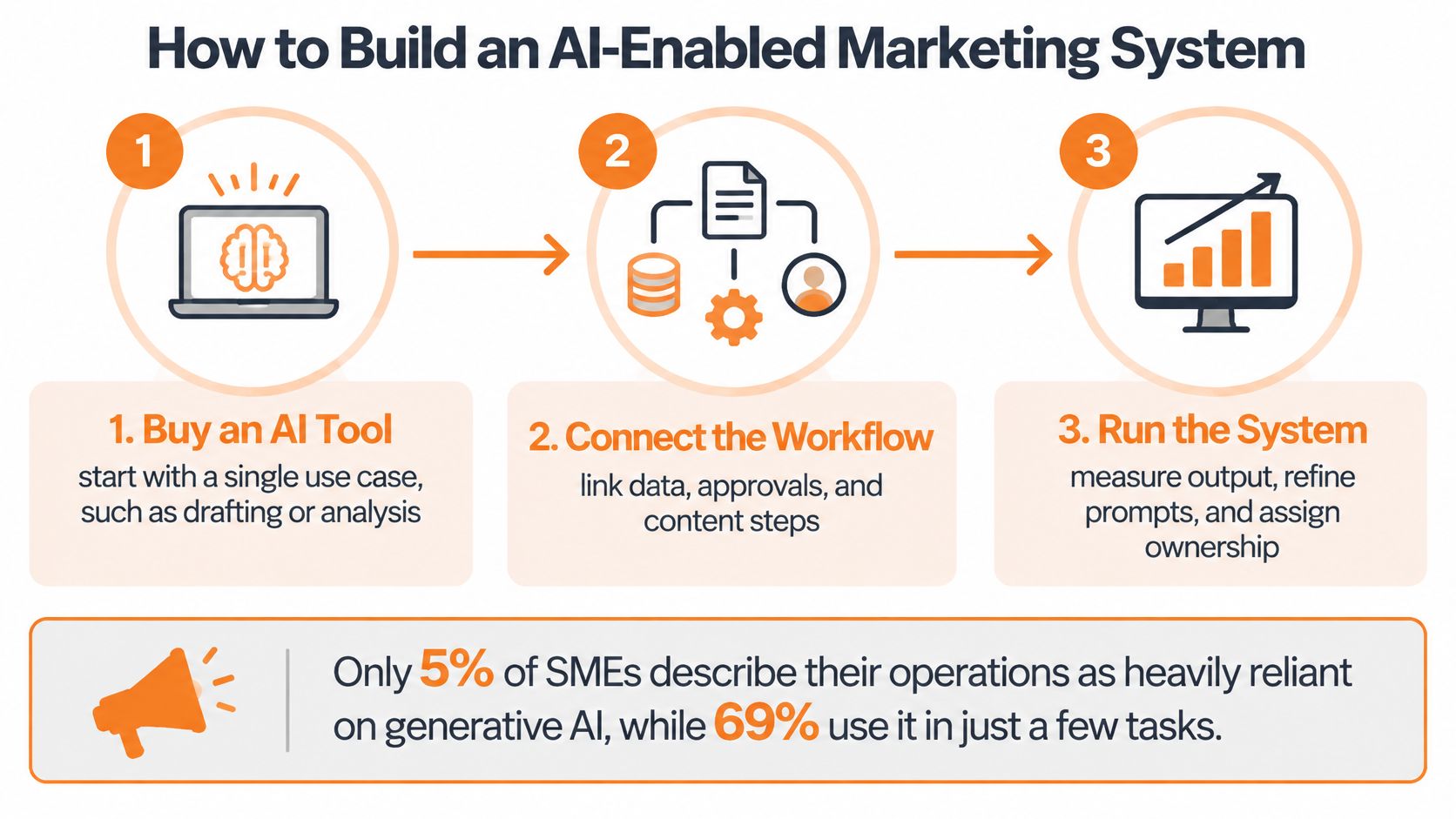
Buying an AI tool gives a team a capability; building a system connects that capability to trusted data, clear review rules and outcome feedback. Without those connections, AI use can stay scattered across a few tasks.
The Canadian Federation of Independent Business's digital transformation report found that 69% of SMEs reported low reliance on generative AI, using it in only a few business areas, while 5% described their operations as heavily reliant on it. The figures show a gap between trying AI and integrating it across operations. They don't show that more reliance automatically delivers better marketing results.
Build the workflow in steps
Connect eligible first-party data. Use CRM contacts only where the consent status and intended use are clear, and connect site analytics, search queries and conversion events that the team is permitted to use. A model can't learn safely from records the business has no right to process.
Create a product or service taxonomy. List each offer, service area, price rule and exclusion in a format staff can check. A common mistake is letting a model guess a service area, which can produce copy offering services in communities the business doesn't cover.
Generate or rank variants. Ask the model for a defined output, such as ad headlines for a particular customer concern, or a content brief for a specific search intent. If you rank suggestions against past campaign performance, treat the ranking as a prompt for review, not a promise of future results.
Validate claims and brand rules. Check promises against approved facts, confirm any regulated statements and preserve Canadian spelling. A draft can sound finished while still making an unsupported claim.
Publish through controlled channels. Require an approval gate and cap the budget for a new test. Avoid giving a tool unrestricted access to publish, change budgets or rewrite live pages.
Feed outcomes back. Track the result tied to each variant and use a set review schedule to decide what to keep or retire. Use a control or phased rollout when you need to assess whether the AI-assisted approach caused a change.
Keep the loop accountable
A workable system records where information came from, who reviewed the output, where it was published and how success will be judged. That record also makes recurring mistakes visible, such as invented service areas or claims that don't match the product catalogue.
Say a Vancouver repair business wants to speed up local landing-page briefs. It could give an AI tool approved descriptions and a list of service areas, then have a coordinator check availability before an editor develops the page. The model helps organize the work, but the business remains responsible for the promise it makes to customers.
A healthy loop creates a smaller set of approved variants, a record of rejected claims and a clear comparison on cost per qualified lead. If results aren't conclusive, record the uncertainty instead of declaring a winner.
Channel Examples From Regulated and E-Commerce Brands
A regulated brand cannot ask AI to decide what the law, platform policy or customer safety standard allows. It can ask AI to sort research, draft options inside approved boundaries and surface patterns for people to judge.

Australian CBD e-commerce and search
For an Australian CBD e-commerce company, Juiced Digital's work included keyword expansion, content optimization and technical SEO fixes addressing site performance and the mobile experience. The combination matters: content needs to match search intent, and the site needs to work well for visitors arriving on mobile devices.
In a comparable workflow, AI could cluster search queries into topic groups and help prepare briefs for review. An editor would still need to check the accuracy of product information and avoid unsupported health or wellness claims.
Measure the work using relevant organic visits, mobile usability and purchases rather than treating the number of new pages as evidence of business growth.
Cannabis e-commerce and paid advertising
For an online cannabis dispensary, Juiced Digital's SEO strategy included a technical SEO audit, content enhancement, link building, UX improvements and analytics monitoring. For an e-commerce cannabis dispensary, organic traffic grew to 3,400 clicks per month within 7 months, a 161% increase, without spending on ads.
For a cannabis e-commerce client's Google Ads, the approach used informational, value-driven ad copy, strategic keyword targeting and a focus on landing-page experience because direct cannabis promotion is restricted. Juiced Digital achieved a 3X return on ad spend in six months through smart funnel strategies despite ad restrictions.
AI-assisted keyword clustering or ad-variant ranking could organize candidate ideas for a reviewer. It cannot make restricted wording acceptable or guarantee that a platform will approve an ad. Treat those figures as evidence that disciplined execution can work under constraints, not as a promised range for every regulated campaign.
Functional mushrooms and conversion diagnosis
For an e-commerce functional mushroom client, Juiced Digital mapped the entire customer journey and identified drop-off points before making changes. That order matters: find where visitors leave, investigate why, then decide whether the fix is message match, page speed, trust signals, checkout friction or offer clarity.
A suitable AI-assisted task is grouping anonymized behaviour patterns and ranking possible causes for a specialist to investigate. A pattern in analytics is a clue for testing; a person still has to confirm the cause and approve the change.
For a functional mushroom dispensary, the marketing investment delivered a 2.6x return on investment per month. The result reflects the wider engagement, so avoid crediting AI, journey mapping or any single site change in isolation.
When you review your own funnel, ask where suitable customers leave and which channel is restricted by your sector. Those answers should guide the next test.
Deciding When AI Stays Visible or Behind the Scenes
Customers may accept automation for a straightforward booking question but want a qualified person for sensitive advice. The right level of AI visibility depends on what the interaction can affect and whether a customer needs to understand who or what is responding.
In Leger's 2025 Canadian survey, 57% of Canadians had used an AI tool, but 36% said they would rely on AI for health advice and 83% reported privacy worries. The survey suggests that people's comfort with AI changes with the decision at hand.
Choose the right role for each touchpoint
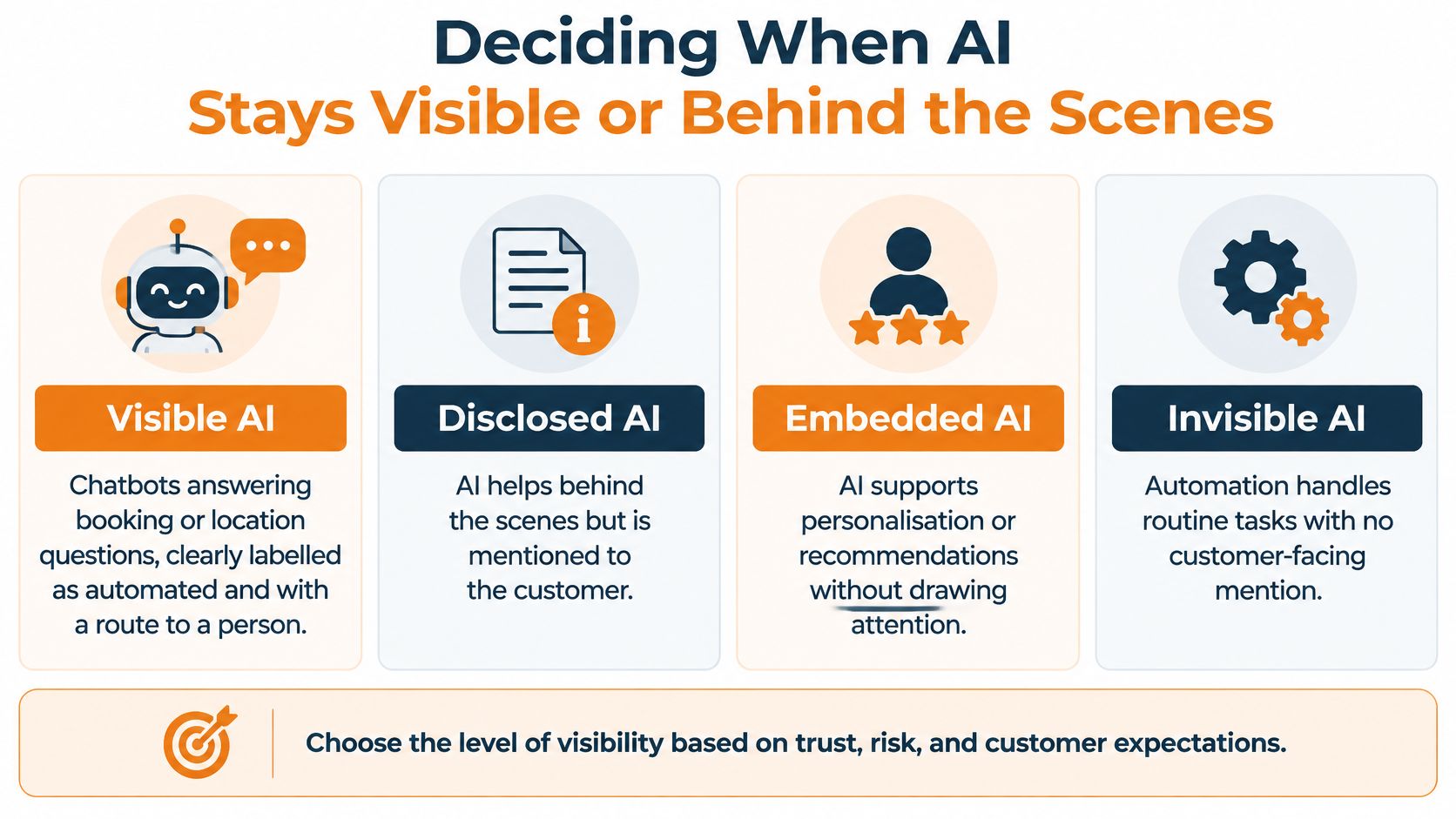
Visible AI suits basic questions about location, hours or booking steps. Label a chatbot as automated and give customers a clear way to reach a person when it can't answer.
Disclosed AI-assisted work can include content or messages where customers should know a person reviewed the material. A disclosure doesn't replace review; the named staff member still needs to stand behind its accuracy.
Behind-the-scenes support can include routine audience segmentation, bid adjustments, content tagging and send-time suggestions. Customers don't need to see each calculation, but the business should still govern the data and keep an owner responsible for the workflow.
Human-led interactions are the safer choice for health questions, product suitability involving cannabis, CBD or functional mushrooms, complaints, cancellations and clinic consultation planning. A bot can help route the request, but it shouldn't improvise sensitive recommendations.
Define the handoff before launch
Tell customers what will happen when a conversation moves to a person, and give staff enough context to respond without collecting unnecessary details. A chatbot should stop short of advice that the business expects a qualified human to give.
Could a wrong answer harm someone, mislead them about a claim or breach a rule?
If the answer is yes, route the interaction to a qualified person. AI can help customers find information and reach the right team, while human oversight protects trust where judgement matters most.
AI Marketing Tools, Benefits and Risks
Choose tools by the task they perform and the controls they offer. A tool that creates more content can still make work harder if staff can't check, approve or turn off its output.
Tool categories, benefits, risks and human controls
| Tool category | Main benefit | Main risk | Human control |
|---|---|---|---|
| Generative writing and ad variant tools | Faster variant and brief volume | Unreviewed claims and off-brand copy | Claim check before every publish |
| Audience and bidding automation | Segmentation and budget pacing at scale | Opaque optimization and data leakage through uploads | Consented lists and holdout tests |
| Analytics and session-analysis tools | Early detection of drop-off points | Correlation mistaken for cause | Specialist designs and signs off each test |
| Chatbots and virtual agents | Instant answers outside business hours | Wrong health, pricing or availability answers | Labelled as automated with a route to a person |
| Outreach research tools | Faster journalist and outlet research | Inaccurate or unfair pitches | Editor reviews every pitch before sending |
| Email and CRM automation | Contact segmentation and send-time prediction | Consent errors and legal exposure | Staff check consent records and opt-outs |
Match the tool to the marketing job
A generative writing tool can prepare SEO briefs, email drafts or ad variations, but every published claim needs review. An audience or bidding system can help manage campaign scale, but use eligible lists and test performance against a control rather than accepting an opaque recommendation on trust.
Analytics and session-analysis tools can help prioritize where to investigate. They don't establish why a visitor abandoned a page, so a specialist should design and approve the test. A chatbot can respond outside business hours to basic questions, but it should identify itself and offer a route to a person when the answer touches health, price or availability.
Outreach research tools save time organizing information about journalists and publications. An editor should confirm the pitch is accurate and fair before sending. For email and CRM automation, staff need to check that consent and opt-out rules are reflected in the system.
Check the exit route
Before adopting a tool, review its data handling against the vendor questions in your privacy process. Confirm that you can export the information you need and that a person can switch the tool off without breaking the workflow.
The common benefit across these categories is speed and capacity to test more options. The common risk is an output that looks ready but hasn't been verified.
Measuring and Piloting AI Marketing in 90 Days
A useful pilot measures whether an AI-assisted workflow contributes to commercial results, not how many drafts it produces. Define what success means before launch so that a weak result can't be reinterpreted after the fact.
For Canadian businesses planning to adopt AI, Statistics Canada reported that 25.6% identified marketing automation as an intended application in the following 12 months, according to its analysis of planned AI adoption. That figure describes planned use, not achieved performance. Your pilot needs to answer whether the specific workflow is useful for your business.
Run a controlled pilot
Choose one channel and one task. Start with the channel that has usable data and manageable compliance risk. Write down the current process, the person who owns it and the customer or business outcome you want to improve.
Set governance before connecting a tool. Complete the data map, vendor review and approval rules first. Record the baseline process, including the time spent reviewing work, so that a faster first draft doesn't hide extra work elsewhere.
Define the comparison and stop rules. Split comparable audiences into an AI-assisted group and a control group where feasible, and keep the attribution window fixed. Define a qualified lead in writing and decide in advance what performance or quality issue would pause the test.
Monitor weekly through a relevant buying cycle. Check the metrics below and look closely at lead quality and customer complaints. If a full sales or booking cycle takes longer than the test, report that limitation rather than claiming a firm result too early.
Decide whether to scale, adjust or stop. At the end of the pilot, record the decision and the reason. Scale when evidence and safeguards support it, adjust when a fixable issue is clear, and stop when the risks or commercial results don't justify continuing.
Track value, not activity
Metrics that show whether AI marketing creates value
| Metric | What it tells you | Where it matters most |
|---|---|---|
| Incremental revenue (holdout vs control) | Revenue caused by AI rather than correlated with it | Any channel test |
| Cost per qualified lead | Acquisition efficiency at the lead stage | Paid ads and lead generation |
| Return on ad spend | Revenue earned per advertising dollar | Paid ads |
| Qualified-lead rate | Share of leads that meet fit criteria | Lead generation and nurture |
| Booked consultations and cancellations | Whether leads become committed appointments | Local services and clinics |
| Complaint rate | Accuracy or trust problems caused by AI content or replies | Regulated and health sectors |
| Assisted conversions | Credit for touchpoints before the final purchase | SEO and digital PR |
Use one written definition of a qualified lead throughout the test. Compare cost per qualified lead and return on ad spend for paid campaigns; for local services, check whether enquiries become booked consultations and whether those appointments are cancelled.
Marketing attribution models can help explain which touchpoints appeared in the customer journey, particularly for SEO and PR. Attribution is not the same as causal lift: a control comparison is more useful for estimating whether the tested work generated additional results.
Report a primary outcome and a quality guardrail for each channel. If a workflow raises lead volume while lowering the qualified-lead rate, investigate before scaling. Juiced Digital's engagement starts with a full technical and content audit, and during a consultation we audit an existing website's SEO and marketing funnels to identify potential opportunities.
Juiced Digital offers AI Marketing Solutions, AI-Powered Paid Advertising and AI Search SEO, with work grounded in website and funnel audits. Visit Juiced Digital to discuss a focused AI marketing pilot with clear data boundaries, human approvals and measurable outcomes.
