
Your ads are running, your Google Business Profile gets views, and your website takes bookings, but none of those systems agree on who the customer is. A lead fills in a form, calls the next day, and your team asks for details they've already given. A product sells out in store while an ad still promotes it online. That's not a traffic problem. It's a handoff problem, and it's where most Canadian businesses lose revenue they can't see in a single channel report.
The scale explains why you can't fix this by picking one channel. Statistics Canada reported total retail spending of $865.2 billion in 2024, with retail e-commerce revenue of $73.7 billion, according to Statistics Canada's annual retail trade release for 2024. Online sales are growing fast, but most spending still happens elsewhere, so your digital marketing has to support store visits, calls and pickup as well as checkout.
What Omnichannel Marketing Means
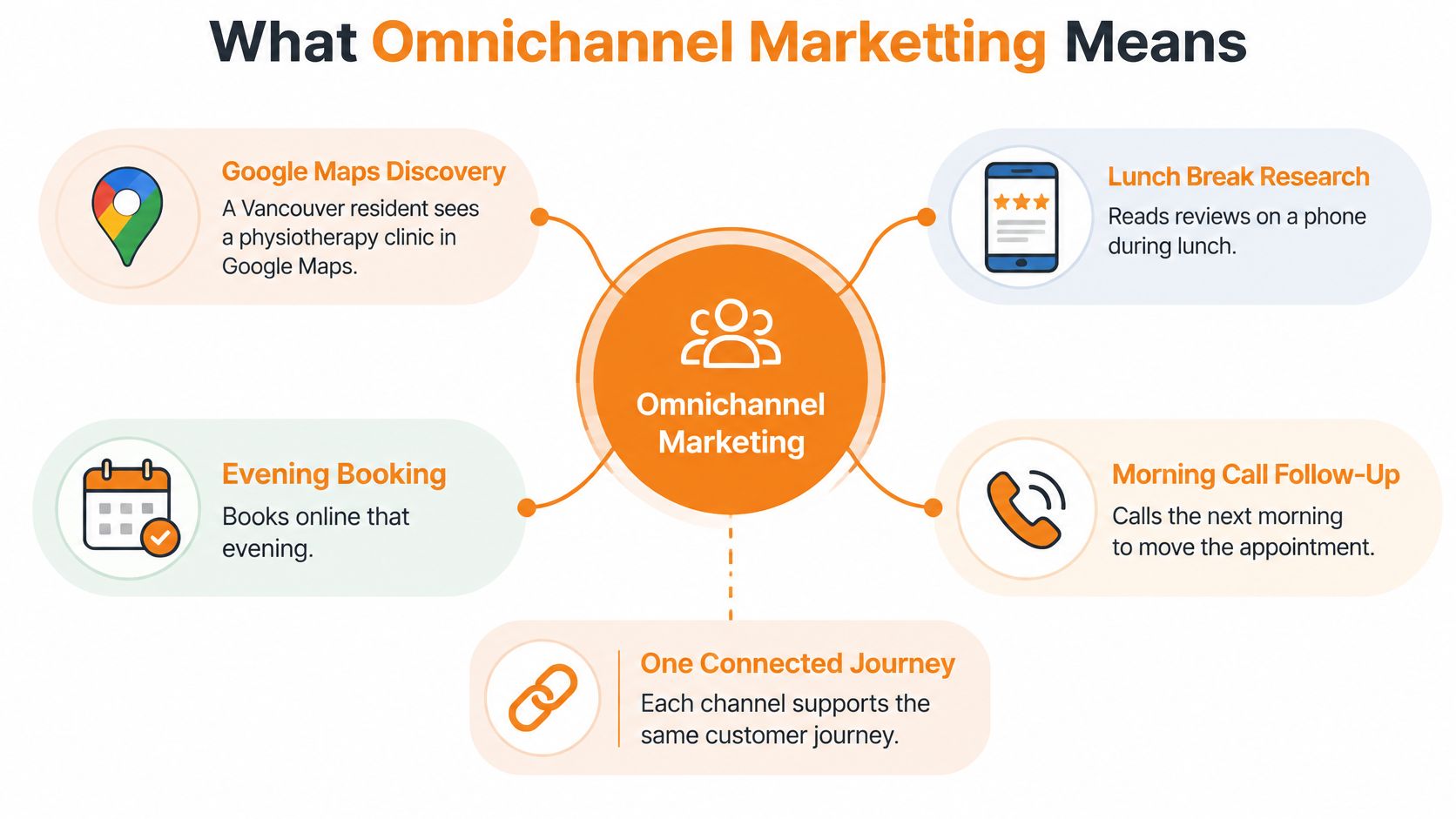
A Vancouver resident spots a physiotherapy clinic in Google Maps on the way to work. At lunch they read reviews on their phone and check whether the clinic treats running injuries. That evening they book online, then call the next morning to move the appointment because their shift changed.
If the person answering that call can see the booking, the service selected and the reminder preference, the customer experiences one business. If they can't, the customer repeats themselves and wonders whether the booking exists at all. That gap is the whole point of an omnichannel marketing strategy.
One order ticket, not three counters
Omnichannel marketing means search, social, your website, email, marketplaces, phone and physical locations share one set of customer data, offers and brand experience. The journey reads as one continuous conversation instead of a series of disconnected encounters.
Think of a restaurant where the host, kitchen and server all work from the same order ticket. The host knows the party size, the kitchen knows the allergy note, and the server doesn't ask what was ordered. Three separate counters that never talk produce the opposite result, even if each counter is individually polite and fast.
The diagram below follows that clinic journey across its four touchpoints.
Three working ideas sit underneath the definition:
- Customers switch channels mid-journey: They research on mobile, buy on desktop, collect in store and ask questions by text, without treating those as separate decisions.
- Consistency carries the handoff: Pricing, hours, availability and tone must match, because a mismatch at the switch is where trust drops.
- The outcome is the booking or purchase: A click is a step, not the finish line, so you judge channels by completed actions across the whole path.
Customers already expect this. In 2024, 88% of surveyed Canadian consumers and consumers in seven other countries wanted a consistent shopping experience across channels, according to the Shopper Experience Index cited by Chase Canada.
Before you plan anything, answer three questions in writing. Which channels do your customers touch before they buy? What does each channel currently know about them? And where does information stop travelling with the customer? If you can't answer the third one, that's your starting point, not a new campaign.
Omnichannel vs Multichannel Marketing Compared
Omnichannel vs multichannel marketing at a glance
| Dimension | Multichannel | Omnichannel |
|---|---|---|
| Channel role | Each channel runs as its own campaign | Channels hand off to each other within one customer journey |
| Customer data | Stored separately in each tool | Shared profile across web, phone, store and email |
| Messaging | Can differ by channel | Same offer, pricing and tone at every touchpoint |
| Measurement | Separate reports for each channel | Blended outcomes such as cost per booked customer |
| Best fit | One or two channels with little overlap | Customers who move between search, store, phone and app |
The difference isn't how many channels you run. It's whether they share data and a single definition of success.
Say a dental clinic runs Google Ads, Instagram and a monthly email. Each has its own list, its own report and its own version of what a lead is. That's multichannel, and it can look busy while leaking patients between steps. The same clinic becomes omnichannel when every web form, tracked call and online booking lands in one CRM that triggers confirmations, reminders and rebooking messages, and when the front desk sees which advert prompted the enquiry.
Which model fits your situation
Multichannel is enough when customers rarely cross channels, when you sell through one main route, or when your team can only run one or two campaigns properly. Adding a third disconnected channel in that position usually dilutes follow-up rather than adding revenue.
Omnichannel pays off when a customer searches online, then calls you, visits a location or buys somewhere else entirely. That's routine for service businesses taking bookings by phone and for e-commerce brands offering pickup, returns in store or repeat orders by email.
Don't buy another tool until your team agrees on shared definitions of a lead, a booking and a sale. Software can't reconcile three competing definitions.
Run a simple 30-day test instead. List every place customer data is stored, from the booking system to the spreadsheet on someone's desktop. Then count how many channels can see each record. If the answer is one, you have a multichannel setup wearing omnichannel language.
Mapping Your Audience Across Channels
Channel preference isn't a personality trait. The same person who orders electronics online will still drive to a store for something they want to inspect, and they'll phone a clinic they'd happily book on a website if the question feels personal.
Canadian spending habits confirm the split. In 2025, Canadian holiday shoppers planned to allocate 58% of their spending to physical stores and 42% to online channels, according to JLL Canada's retail holiday survey. Even a digital-first brand sells across formats, so mapping has to cover both.
Five steps to a usable journey map
- Pick three segments by value: Choose the customer groups that bring the most margin or lifetime value, not the ones that are easiest to describe. A tighter audience segmentation strategy makes this faster and stops you mapping journeys for people who rarely buy.
- Write five stages per segment: Discover, compare, decide, buy or book, and return. Keep the stages identical across segments so you can compare them.
- Name the channel at each stage: Include phone calls, store visits and marketplaces, not just the channels your analytics can see.
- Mark the friction points: Note where customers drop off, where they ask a human a question, and where they switch device or location.
- Record the data captured at each handoff: A name, a phone number, a product view, a source tag. If nothing is captured, that handoff is invisible later.
Journey map template by stage
| Stage | Channel used | Data captured at handoff |
|---|---|---|
| Discover | Google Business Profile, search | Search query, profile view |
| Compare | Reviews, service pages | Page view, review read |
| Decide or book | Phone call, online booking form | Name, phone number, booking event |
| Buy or book | Booking system, in-store | Confirmed appointment, source tag |
| Return | Text or email reminder | Rebooking, consent status |
Take a Vancouver wellness clinic as the worked example. New patients discover it through its Google Business Profile, compare practitioners by reading reviews and service pages, then call to book a first visit because they want to ask about direct billing. After that first appointment they rebook by text, because the trust question has already been answered.
That map tells you the phone is a decision channel, not a failure of the website. Cutting call handling to push everyone online would remove the step where uncertain patients convert.
A journey map shows which channel does each job. It doesn't award credit to whichever channel touched the customer last.
You should finish with one page per segment and two or three obvious gaps. Fix those first. A map with fifteen priorities is a poster, not a plan.
Choosing Channels and a Minimum Tech Stack
Most omnichannel guides assume you already own a mature CRM, a loyalty programme, an inventory system and a customer data platform. Most B.C. businesses don't, and pretending otherwise produces a plan nobody can staff.
Minimum starting stack by business type
| Business | Start with | Add next | Hold off until |
|---|---|---|---|
| Local clinic | Google Business Profile, booking form with call tracking, text or email reminders | Review requests and retargeting ads | A full customer data platform |
| Trades business | Google Business Profile, service-area pages, call tracking, quote form feeding a CRM | Local paid ads and review automation | A loyalty programme |
| Independent retailer | Accurate product feed and store hours, one email list, point-of-sale to CRM sync | Click-and-collect and local ads | AI-driven personalisation |
| E-commerce brand | Mobile-first checkout, analytics events, product feed and email flows | Paid social retargeting and marketplace listings | An advanced customer data platform |
The resource gap behind that table is real. SMEs represent 98% of B.C.'s economy, yet only 15% of B.C. businesses reported using or planning to use generative AI in 2025, according to the Greater Vancouver Board of Trade report on accelerating AI adoption in B.C.. Sequencing matters more than sophistication when budgets and data quality are thin.
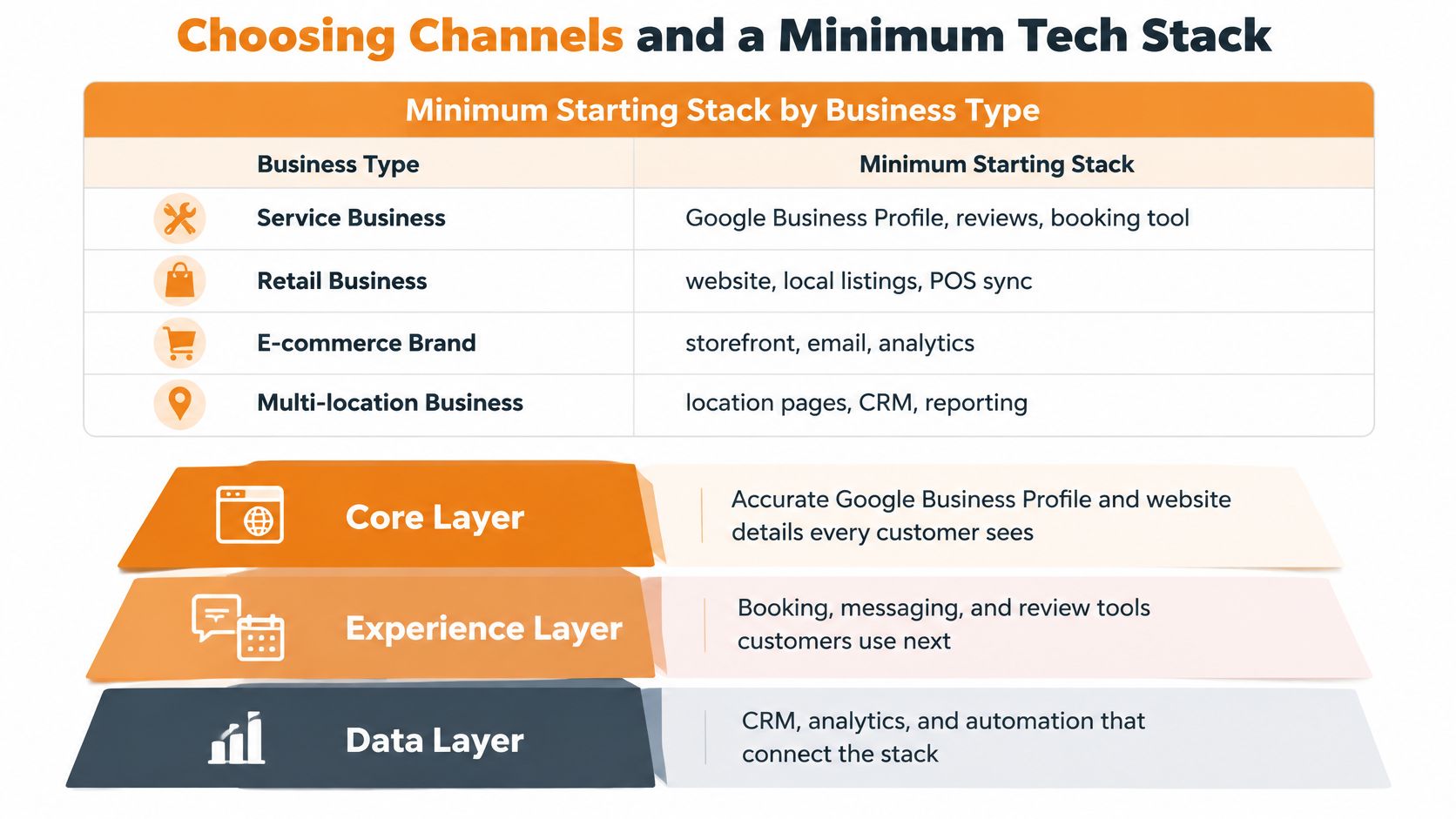
The visual below sets out the same minimum stack in the order I'd build it.
Build in three layers
The core layer is what every customer sees first: an accurate Google Business Profile or marketplace listing, a fast mobile site, correct hours, correct prices and service pages that answer the obvious questions. Errors here cost you customers before any campaign has a chance to work.
The conversion layer turns interest into a lead or sale. That means short forms, call tracking, online booking or checkout, and one shared contact list with automated follow-up by email or SMS. Solid email marketing automation belongs here, because a confirmation and a reminder sent on time will beat an elaborate segment sent to a messy list.
The amplification layer comes last: retargeting, paid social, review requests and local ads. These spend money to push more people through the first two layers, so adding them early just buys more traffic into broken handoffs.
Picking channels without guessing
Use three criteria. First, where do customers already search and buy in your category? Second, what's each customer worth, since a high-value service can justify a phone call that a low-margin product can't? Third, can your team respond within one business day? A channel nobody monitors damages trust faster than not offering it.
AI automation earns its place when it covers work that would otherwise be missed, such as after-hours replies, missed-call texts and follow-up sequences for quotes that went quiet. It adds complexity when you automate messages before lead definitions, consent status and data quality are settled. Automating a bad list produces faster mistakes and more unsubscribes.
Budget rule: If a tool can't be judged against one number, such as cost per booked customer, delay buying it.
Measuring Omnichannel Performance
Last-click reporting is the fastest way to cut the channels that are feeding your sales. When a report credits only the final online click, the local listing that started the search, the review that settled the decision and the social post that prompted both all look weak. Their budgets get trimmed, and the offline sale stops happening a few weeks later.
The behaviour behind that trap is well documented. NielsenIQ reports that 73% of Canadians shop both online and in-store, while online purchases account for 8% of total Canadian consumer packaged-goods sales, according to NielsenIQ's analysis of today's omni marketplace. If most customers move between environments, measuring one environment will mislead you.
Before you build any dashboard, write three shared definitions and pin them where your team can see them. A lead is a form or call logged in the CRM. A booking is a confirmed appointment. A sale is a paid order, including in-store purchases matched to a customer record.
Six omnichannel measures and their sources
| Metric | Source | What it tells you |
|---|---|---|
| Cost per booked customer | Ad platforms joined to CRM booking records | Whether paid media earns bookings, not only clicks |
| Assisted conversions | Analytics with call and form tracking | Which channels start journeys that close elsewhere |
| Store visits or calls | Call tracking and Google Business Profile insights | Offline outcomes linked to online discovery |
| Lead-to-customer rate by source | CRM pipeline | Lead quality, not only lead volume |
| Repeat purchase rate | Order data in the e-commerce platform or CRM | Whether channel handoffs bring customers back |
| Contribution margin by channel | Finance records joined to order data | Profitability of the channel mix after costs |
Setting up measurement in four steps
First, connect identifiers so one customer appears as one person across website sessions, calls, forms, bookings and store sales. A phone number or email address captured consistently does more for this than any attribution model.
Second, tag every phone number and form with its source, including the number on your Google Business Profile and the one in your adverts. Untagged calls are the single largest blind spot for local service businesses.
Third, build one blended dashboard showing cost per booked customer and contribution margin by channel. A multi-touch attribution view helps you see assisting channels without pretending any model is perfectly accurate.
Fourth, split conversion rate and abandonment by device and browser. Mobile and desktop journeys behave differently, and a single blended rate hides a broken mobile form behind healthy desktop numbers.
Test with a holdout, not an opinion
Pause one channel in a single service area or market for two to four weeks and compare bookings or sales against a matched area that kept running. If bookings fall in the paused area and hold in the other, you've learned something a platform report can't tell you.
Treat short tests carefully if you're seasonal. Holiday retail and spring wellness programmes swing for reasons that have nothing to do with your media, so compare against the matched area rather than against last month.
At your monthly review, change one channel budget at a time and record the result against the baseline. Changing three things at once leaves you with a story instead of evidence.
Personalisation Without Compliance Risk
More personalisation doesn't always win. A message that reveals you know something the customer never told you can end the relationship faster than a generic one, and in health-adjacent categories it can create a compliance problem as well.
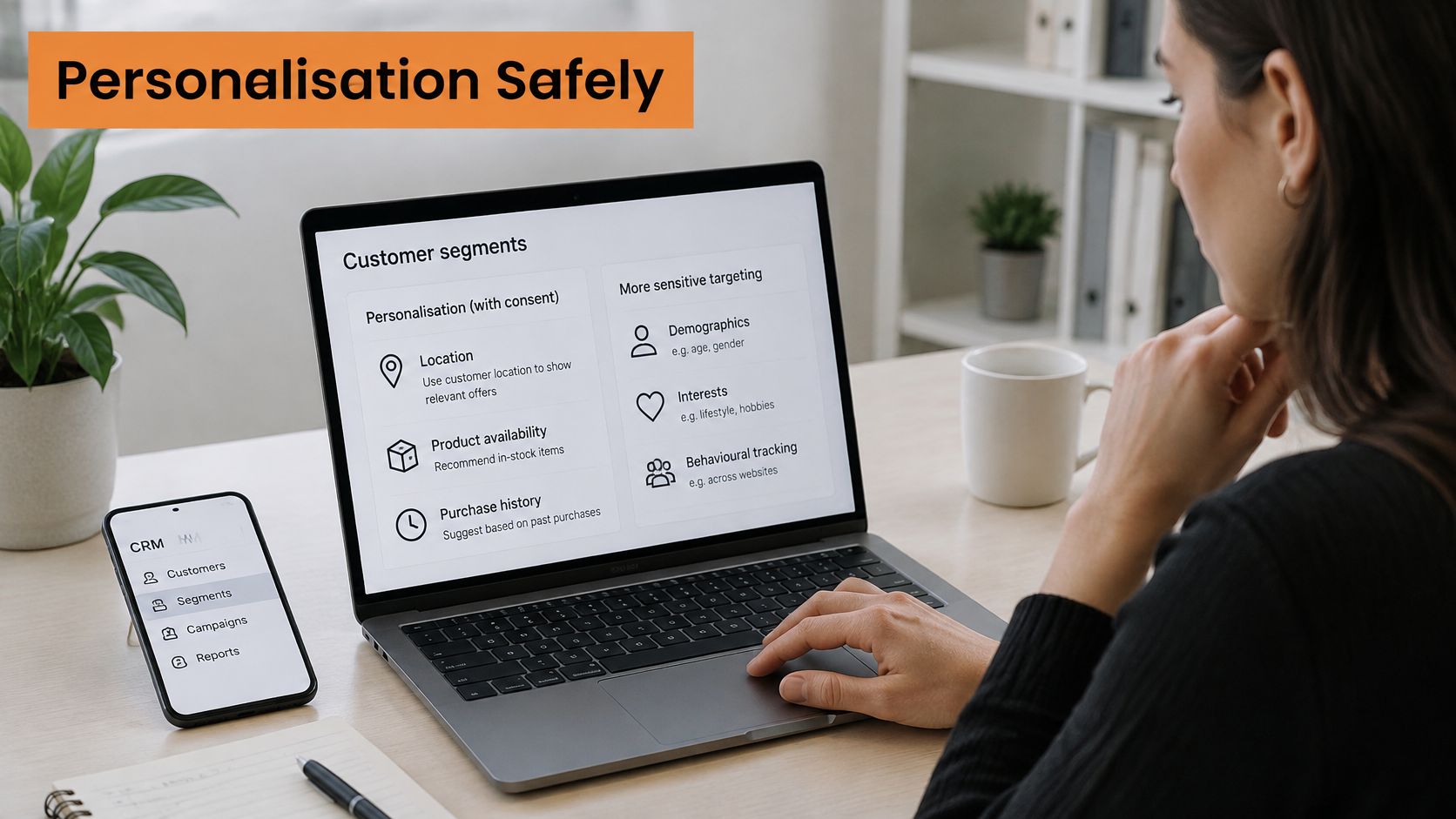
The image below shows the segmentation work that should happen before any of that data reaches an advert.
Two tiers of personalisation
Lower-risk personalisation uses location, product availability, purchase history the customer agreed to share, and service reminders such as appointment or refill timing. These help continuity and rarely surprise anyone.
Higher-risk personalisation infers sensitive facts, such as a health condition, mental health, pregnancy or substance use, from browsing or purchase patterns. Keep those inferences out of ad audiences entirely, even when a platform makes them easy to build.
Canadian guidance supports that restraint. The Office of the Privacy Commissioner says online behavioural advertising requires knowledge and consent under PIPEDA, with purposes explained clearly rather than buried in a privacy policy, in the Office of the Privacy Commissioner's guidance on online behavioural advertising. It also advises limiting what's collected and avoiding sensitive categories such as health data.
The short video below walks through how consent and audience settings interact in practice.
For cannabis, CBD and functional mushroom brands, avoid health-outcome claims in targeting and creative, follow each platform's restricted-category rules, and check the labelling rules that apply to your product. For clinics, keep patient information out of marketing tools and ad pixels unless privacy counsel has reviewed the setup.
A five-step working process
- Classify each data field: Mark it lower or higher risk before it enters any campaign tool.
- State the purpose plainly: Write why you collect it in language a customer would understand.
- Get consent for new purposes: Permission for appointment reminders isn't permission for ad targeting.
- Suppress sensitive segments: Exclude higher-risk audiences from paid media by default.
- Honour opt-outs everywhere: Apply them across email, SMS and ads within a stated period, not just in the tool where the customer clicked.
If a customer would be surprised to receive the message, cut the personalisation.
Case Highlights From Local and E-commerce Brands
Sequence matters more than spend. In six months, our work for a cannabis e-commerce client produced $120K+ in revenue growth attributed directly to organic and paid digital channels. Over the same six months it achieved a 3X return on ad spend despite ad restrictions, through smart funnel strategies rather than increasing budget.
Those figures come from the client's own reporting across that six-month measurement window. They reflect revenue attributed to organic and paid digital channels, which is the honest way to state them. Any figure quoted to you should be confirmed against the client's reporting the same way, with the window stated and a clear answer on whether offline sales are included.
Mapping before changing anything
For an e-commerce functional mushroom client, we mapped the entire customer journey and identified drop-off points before making any changes. That sounds slow. In practice it prevented the usual pattern of redesigning pages that weren't the problem while the main leak sat untouched in a later step.
Once the largest drop-off was visible, the order of work became obvious. Fix that step first, then connect search, paid and on-site conversion into one measurement view so each later change could be judged on revenue rather than traffic.
A local service pattern follows the same logic at smaller scale. Listings and call tracking get fixed first, so every new call or form arrives with a recorded source. Follow-up automation comes second, because there's little value in speeding up replies to leads you can't attribute.
How to read any case study
These are examples of method, not guaranteed outcomes. Results depend on margin, category, competition and budget, and a strategy that worked for a restricted e-commerce category won't transfer unchanged to a trades business.
Ask three questions about any case study, whether it comes from an agency or your own team:
- What changed first: The order of work tells you whether the team diagnosed or guessed.
- How was revenue attributed: Platform-reported conversions and CRM-matched revenue are different claims.
- Are offline sales included: A figure covering online sales only will understate a business that closes by phone.
If a provider can't answer all three plainly, treat the headline number as marketing rather than evidence.
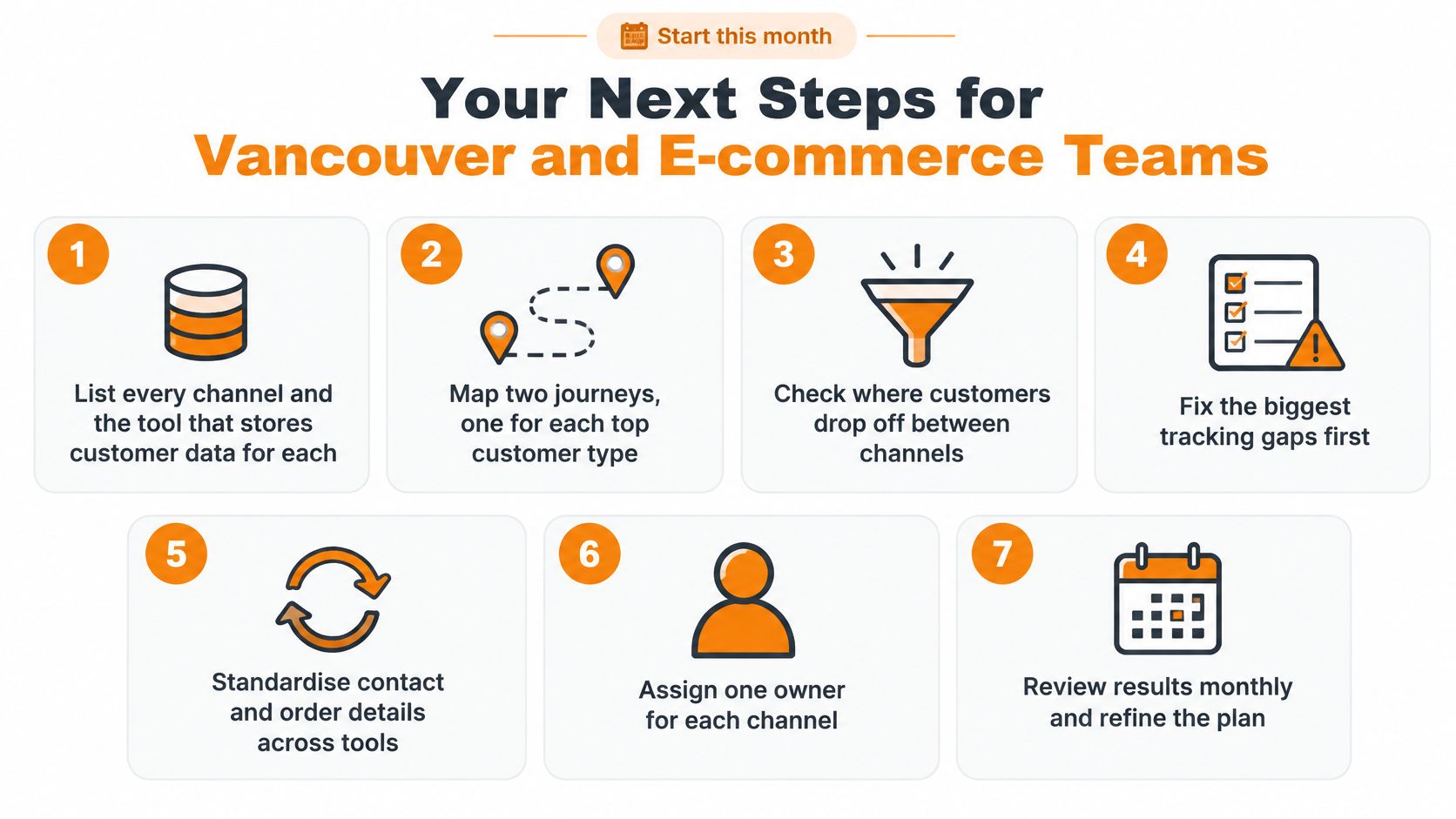
Your Next Steps for Vancouver and E-commerce Teams
You don't need a platform migration to start. You need a short list of fixes in the right order, each with an owner and a visible output.
- List every channel and its data store: Owner, your marketing lead. Output, a one-page inventory naming the tool that holds customer data for each channel.
- Map two journeys: Owner, whoever talks to customers most. Output, one page per top segment showing channel, handoff and drop-off.
- Fix listing and product accuracy: Owner, operations. Output, matching hours, prices and offers across your Google Business Profile or marketplace listings, service pages and product data.
- Add call and form tracking: Owner, web support. Output, a source tag on every tracked number and form.
- Build one blended dashboard: Owner, marketing lead. Output, cost per booked customer and repeat purchase rate in a single view.
- Run a compliance review: Owner, privacy lead or counsel. Output, a field-by-field risk list covering health-adjacent data and ad settings.
- Pilot one handoff for 30 days: Owner, the team receiving the leads. Output, a working path such as web form to CRM to text reminder, plus a short results note.
The checklist below condenses those seven steps into a format you can pin to a wall.
Our own engagement starts with a full technical and content audit to uncover growth opportunities and quick wins, and during consultation we audit an existing website for SEO and marketing funnels. That sequencing is deliberate, because we work closely with clients to understand their goals and align every strategy with measurable outcomes.
Bring three things to any outside provider: your channel list, analytics access and last quarter's results. Without them, you'll get a generic proposal built on assumptions about your customers.
Then make one decision. Start with a single-channel fix or commission a full stack review, based on what the first audit shows about where customers are being lost.
If your channels are generating enquiries that your team can't trace, follow up or attribute, we can audit the full path from first search to booked customer and show you which handoff to fix first. Our work connects local and e-commerce search, paid media, tracking and follow-up into one measurable omnichannel marketing strategy, including compliant campaigns for wellness, cannabis, CBD and functional mushroom brands. Visit Juiced Digital to book a free consultation and audit.
