
It's 7:15 on a January night in Burnaby, and the furnace has quit. You're on the couch with your phone, typing "same-day furnace repair" before you've found a coat. That search says more about what you need than your age, your postal code, or any interest bucket an ad platform guessed last month.
That gap, between who someone is and what they're trying to do right now, is the point of intent based marketing. Canadian businesses can read those signals, answer the actual need, and still stay inside privacy rules and product laws that generic playbooks skip.
What Intent Based Marketing Means and Why It Works
A Burnaby homeowner searches for same-day furnace repair at 7 pm. That query signals an immediate need more clearly than a broad profile such as “homeowners aged 35 to 54 in Metro Vancouver.” Intent based marketing uses a person's recent actions to match the message, offer, and channel to what they may need next.
Intent works like a shop clerk responding to what a customer picks up. The clerk has a useful clue, not permission to follow the customer or assume everything about them. Marketers should treat a search, page visit, cart add, or form start the same way: as a limited signal that can guide a relevant response, not as a complete picture of a person.
A useful response connects three things: the action someone took, the need it may indicate, and the next helpful step. A search might suggest someone is researching; a comparison-page visit may signal they are weighing options. In either case, the response should fit the evidence and respect the person's choices.

Smartphone research can change what people consider: useful information may bring an unfamiliar brand into the decision. It can also lead to further searches or other actions. That makes intent valuable, but not limitless. A signal only helps when a business responds in a way that fits the context and the rules governing how that signal can be used.
The test: What did this person just do, and what would they most likely need next?
Use that question before changing a bid or sending an email. If the recent action is unclear, a more personalized response is still a guess.
How to Classify Intent Signals Before You Act
Not every visit deserves the same bid, page, or follow-up. Sort the signal first, then choose one response. Five classes cover almost everything a local firm or an online store will see.
| Intent class | Typical query | Strongest signals | Right response |
|---|---|---|---|
| Informational | how much does a water heater cost | guide visits, repeat reading on one topic | guide with a price range and a link to a quote tool |
| Local | emergency plumber near Kitsilano | location terms, mobile device, after-hours visit | click-to-call page with service area and hours |
| Commercial | compare CBD oil brands | review visits, comparison page views, pricing page views | comparison page with proof, product specifications and clear next step |
| Transactional | book same-day drain cleaning | booking form start, price check, cart add | short booking form or checkout with one clear action |
| Navigational | brand name plus city | brand name in query, direct visits | direct brand page and contact details; avoid bidding on your own brand name |
Same topic, different class
A Vancouver plumber and a skincare store can share a topic and still face different jobs. "Why does my drain smell" is informational: the reader wants a cause, not a dispatch fee. "Emergency plumber near Kitsilano" is local: neighbourhood language, a phone, and an evening visit. "Book same-day drain cleaning" is transactional: the form start matters more than another paragraph of advice.
On a skincare store, "what is niacinamide" is informational. "Compare vitamin C serums" is commercial, especially after a second visit to reviews and a pricing page. Adding a bottle to the cart is transactional. Typing the brand name plus "Vancouver" is navigational: send them to the brand page and a phone number, and don't pay to intercept your own name.
A signal can change class inside one session. Someone reads a cost guide, then opens your service-area page, then starts the booking form. Treat the latest strong signal as the one that sets the page, and keep earlier reads as context. A cleaner map of these groups sits inside a practical audience segmentation strategy.
Three-step triage
- Tag the query or page. Note wording such as "near me," price, reviews, same-day, or book, plus device and time.
- Assign one class. If two seem true, pick the one closest to a booking or a purchase.
- Choose a single next action. One button, not a menu of five.
If the class is unclear, answer the question on the page and offer the next step underneath. Don't hide the answer behind a form.
Mapping Intent to Each Stage of the Funnel
The funnel is four jobs, not four slogans. Each stage has a likely intent class, a piece of content, and one action.
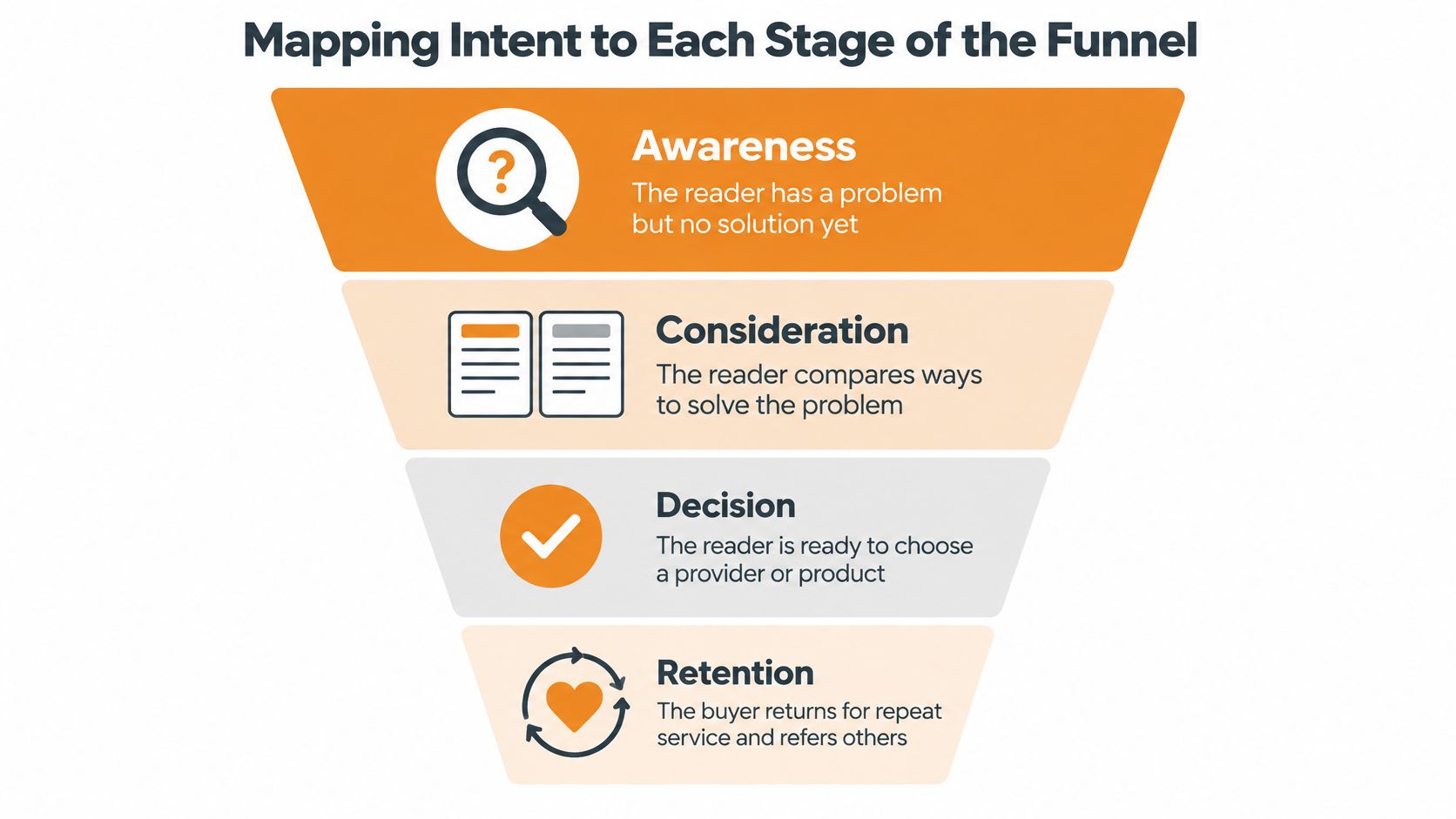
| Funnel stage | Intent class | Content that fits | Action to offer |
|---|---|---|---|
| Awareness | Informational | full guide that answers the question | quote-tool start or email signup |
| Consideration | Commercial | comparison page with reviews and proof | request a comparison or view pricing |
| Decision | Transactional and local | short booking form or checkout | book, buy or call |
| Retention | Returning visitor | reminder and order-status content | reorder or rebook |
Awareness is the reader with a problem and no chosen fix. A full guide on "why a furnace short-cycles" belongs here, with a quote-tool start or an email signup after the answer, not before it.
Consideration is comparison. A page that lines up two service plans, with reviews and a clear price range, fits commercial signals. Ask them to view pricing or request a side-by-side, not to "learn more" in the abstract.
Decision is a short path. Transactional and local signals want a booking form, checkout, or a tap-to-call. Cut extra navigation. A ready buyer who has to hunt for hours will call the next result.
Retention is the person who already bought. Order status, a refill reminder, or a rebook link matches a returning visitor. Don't greet them with the same intro guide you wrote for strangers.
A booking button on an awareness article creates friction, because the reader hasn't chosen you yet. A long guide on a page built for someone ready to pay wastes the moment. For each landing page, name the stage in the page title's working notes and name the one action that page should drive. If you can't, the page is doing two jobs and will do both poorly.
Search, Paid and Email Plays for Local and E-commerce Brands
A Vancouver homeowner searching “burst pipe tonight” needs a faster path than someone comparing skincare products. Choose the channel and message to fit the signal, then measure whether it produces a useful action.
| Channel | High-intent play | Example | Caution |
|---|---|---|---|
| Search | Service-area pages for urgent local terms | Kitsilano emergency plumbing page with response times and a booking link | Keep copy specific and avoid keyword stuffing |
| Paid search | Bids on transactional terms with call extensions | After-hours call extension for same-day drain cleaning | Limit bids on informational terms that rarely convert |
| Segment by category viewed and cart status | Cart reminder for an opted-in subscriber | Use browsing or cart signals only in ways the subscriber has agreed to | |
| Regulated paid search | Informational copy and an adult-gated landing page where permitted | Educational CBD page without therapeutic claims | Check platform and regulatory limits before launch |
Campaign research in Canada suggests many ads lift awareness more reliably than purchase intent. Judge each play by bookings, sales, and qualified leads.
Search
Build a service-area page around the urgent query, not a city page padded with neighbourhood names. A Kitsilano emergency plumbing page can state response times, the streets served, and how to book. Juiced Digital builds SEO-optimized local landing pages customized to neighbourhoods and key delivery terms in a client's service area.
Paid search
Match the bid to the likely action. For an after-hours search such as “same-day drain cleaning,” a call extension can send a ready customer straight to the phone. Informational searches may suit a useful landing page better than an expensive bid if they rarely lead to calls.
A product page view or abandoned cart can inform a follow-up, but the signal is not permission by itself. Send to opted-in contacts, and keep the message relevant to what they viewed. For example, an opted-in subscriber who viewed two serum pages could receive a short comparison, with a return visit or purchase as the measure of success.
Regulated wellness brands face extra limits on what they can promote and who they can reach. For a cannabis e-commerce client, Juiced Digital ran Google Ads with informational, value-driven copy, strategic keyword targeting, and a focus on landing page experience because direct cannabis promotion is restricted. The useful signal is the search theme; the response must still fit the rules of the channel and category.
Privacy Limits on Intent Data in Canada
Intent data is not automatic permission to personalise. A search or a page view can be a useful signal and still be personal information you may not store, join to a profile, or use in an ad.
What consent actually requires
Under PIPEDA, the Office of the Privacy Commissioner of Canada states that organisations generally need a person's knowledge and consent to collect, use, or disclose personal information, and that purposes must be explained clearly. For online behavioural advertising, implied opt-out consent may be reasonable only when people are told at or before collection, can opt out easily and in a way that sticks, and the information stays non-sensitive where practicable. Health, financial, biometric, ethnic, religious, and similar information are sensitive.
That limit bites wellness, CBD, cannabis, and clinic campaigns. Infer need from the page, the search theme, the city, and what happened in the session. Don't store a health inference or build a quiet profile of symptoms.
A consent-aware event record
Copy this checklist into your analytics spec.
- Purpose: why you record the event, in plain language.
- Timestamp: when it happened.
- Source: which page, campaign, or form.
- Retention period: how long you keep it, and when you delete it.
- Consent state: granted, refused, or unknown.
If consent is absent, suppress personalised remarketing. Optimise from aggregated conversion reports. Put a persistent opt-out where people can find it later, not only in a banner on day one.
Which signals you may lean on
Separate anonymous, consented, first-party, inferred, and sensitive intent, and write a retention rule for each. Anonymous context, such as "this URL is a pricing page," can shape the page without naming a person. Consented first-party events, such as a quote request, can trigger a follow-up. Inferred health interest should not enter a profile at all.
Quote tools, booking forms, and preference centres trade a clear benefit for a clear signal. You learn what the person wants because they told you.
Before you use a signal, ask three questions: Is it necessary, is consent in place, and could it reveal a health or other sensitive interest?
Using AI to Infer and Act on Buyer Intent
AI here is a clerk who can watch many small clues at once. It is not an oracle. The Office of the Privacy Commissioner of Canada reports that 16% of Canadian businesses used AI in operations in 2025, up from 6% in 2023, and that among businesses using AI, 24% used it for marketing. Only 17% reported building customer profiles for marketing, while 34% used customer information to personalise products or services. Many teams do not need an enterprise prediction suite. A spreadsheet rule on first-party events is a fair start, and it is easier to explain.
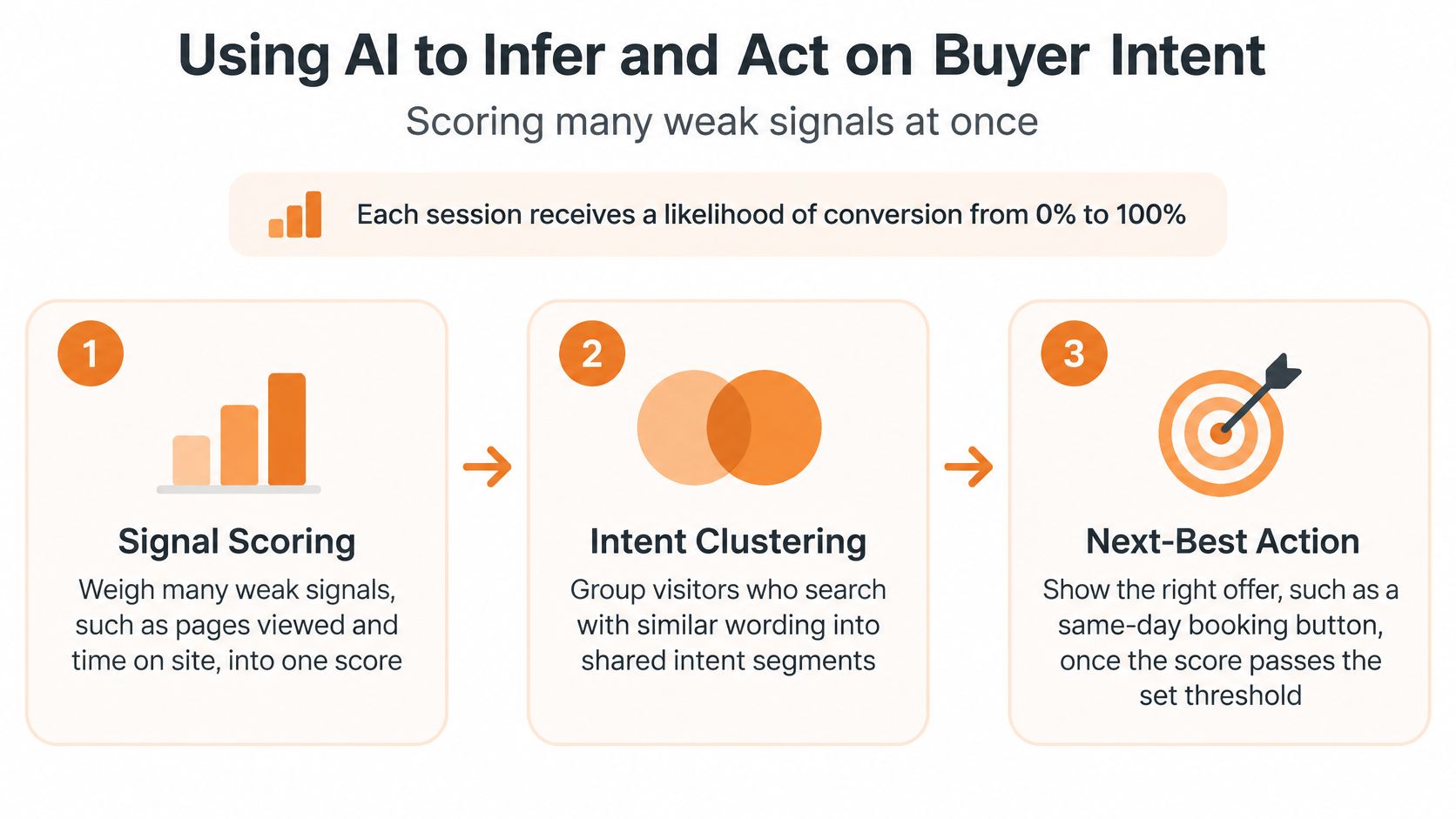
Three techniques, in plain language
Scoring is a weighted shopping list. Pages viewed, time on a pricing page, repeat visits, and query type each add points. A session crosses a line you set, and only then does a stronger offer appear. An online store might score carts and show a free-shipping threshold only to high-score sessions that are close to the cutoff.
Clustering groups people who behave alike, the way a host seats guests with the same order. Price-checkers get a specifications note. First-time visitors get orientation. A Vancouver salon might group people who open the booking page three times and never book, then send a short note about open times, not a discount to everyone.
Prediction flags who is likely to return or to go quiet. A reminder or a modest offer follows. Keep the trigger tied to a permitted event, such as a lapsed booking, not to a guess about someone's health.
Before any score runs, confirm each input is allowed under the consent state on that event. Leave sensitive health inferences out of the model entirely. Review the rules every month: false positives waste staff time, and biased training data will keep favouring the customers you already have. A practical primer on predictive analytics for marketing is a better next read than a vendor demo if your first-party events are still messy.
Measuring Intent Campaigns Beyond Impressions
Impressions tell you the ad was eligible to be seen. They don't tell you anyone moved closer to a booking. A campaign can grow recognition and still fail the only test that pays the invoice: a qualified action.
Connect each signal to an outcome you can count. Local intent should end in a booking or a call. Store intent should end in an add-to-cart and in assisted revenue. Informational intent should end in a quote-tool start or an email signup. Phone clicks and form submissions need a campaign source, or you can't tell a brand search from a paid click.
| Intent class | Primary KPI | Secondary KPI | Review window |
|---|---|---|---|
| Local service | booking or call conversion rate | map direction clicks | weekly |
| Commercial e-commerce | add-to-cart rate | assisted revenue | every 14 days |
| Transactional | purchase conversion rate | revenue per session | daily |
| Informational | quote-tool start or email signup rate | scroll depth past 50 percent | monthly |
Compare conversion rate by query class, not by campaign name alone. A weekly look suits local service because after-hours demand swings fast. Daily is enough for transactional checkout. Monthly is enough for guides, which convert more slowly.
If impressions rise and qualified actions stay flat, check two mismatches. The landing page may be built for a booking while the query was only a question. Or the page may be a long guide while the query already said "book." Fix the match before you add budget.
Once a month, write down three numbers: qualified actions by campaign source, conversion rate by intent class, and the ratio of impressions to qualified actions. If reach climbs and that ratio worsens, the extra impressions aren't buying outcomes. A clear marketing attribution model keeps those three numbers tied to the channel that earned them, instead of letting the last click take all the credit.
Capturing Demand for Regulated Cannabis and Wellness Brands
A person in British Columbia searches “best CBD for pain.” The query signals interest, but it does not grant permission to make a health claim or target someone with any message a marketer chooses. For cannabis and wellness brands, intent is a useful signal only when the response fits both the rules and the audience's consent.
Canadian guidance generally prohibits cannabis promotion, with limited exceptions. Informational or brand-preference promotion must meet conditions, such as addressing a named adult, appearing where young people are not allowed, or using telecommunications with reasonable safeguards against youth access, as explained in Health Canada's cannabis promotion rules. Misleading representations are prohibited, and public advertising cannot promote products as treatments, preventatives, or cures. Public opinion research in Canada suggests a reach-first cannabis advertising plan may not match what consumers want.
A compliant path for a hypothetical retailer
Suppose a British Columbia cannabis retailer notices the search query in its reports. The retailer can respond to the underlying interest without turning the query into a therapeutic promise.
- Explain the category. Create an educational page about how a product type is made and how to read its label. Describe format and ingredients without promising relief.
- Respect age safeguards. Offer first-party content to adults only where the channel allows reasonable safeguards against youth access. A search query alone is not consent to receive follow-up marketing.
- Keep product information within permitted limits. Where allowed, provide the product name, availability, and price, alongside retailer or location details for someone looking for a store.
- Measure useful actions. Track store-page visits or adult newsletter sign-ups rather than treating impressions as proof of demand.
Have counsel review pages and ads before launch, and keep a monthly record of claims in market so wording does not drift into treatment promises. For cannabis e-commerce, Juiced Digital uses informational, value-driven Google Ads copy, strategic keyword targeting, and attention to landing-page experience because direct cannabis promotion is restricted. The same principle applies across regulated wellness: use intent to understand what information someone seeks, then respond only through channels and messages that meet the rules.
Pick One Intent Segment and Test It This Quarter
A wide rollout hides the result. One segment, one page, and one channel will tell you whether the match is working.
- Choose one segment with clear buyer potential. Urgent local service searches, or one high-traffic comparison page, are enough. We look for high-intent wellness terms with real buyer potential when a keyword set needs to grow, and the same discipline applies here.
- Tag the signals, match one page to the funnel stage, and write the consent language that covers those events. If consent is missing, the test doesn't get a personalised follow-up.
- Run a single-channel test for four to six weeks. Use the primary KPI for that class, and review on the window you already set. Success is a higher qualified-action rate on that segment, with the privacy checks still passing.
Keep the test narrow so one change can be read clearly before you add a second segment. The lead generation work includes a dedicated account lead as your main contact, plus regular check-ins and recaps. We sit with the goals first and line the work up with outcomes you can count. If you want help with the tagging, the consent language, or the review routine, a free consultation is the simplest way to see whether the test is worth running.
Juiced Digital is a Vancouver digital marketing and PR agency that helps local service businesses, e-commerce brands, and regulated wellness companies turn search intent into qualified leads without ignoring Canadian privacy and promotion rules. We combine AI-driven SEO, paid advertising, and conversion work so the page matches the signal and the result is measurable. If you want a practical read on where your high-intent queries are leaking, visit Juiced Digital and book a free consultation.
