

If you are about to pay for an ecommerce SEO specialist, judge the hire on incremental Canadian gross profit. A rankings PDF and a screenshot of an AI mention are not the scoreboard.
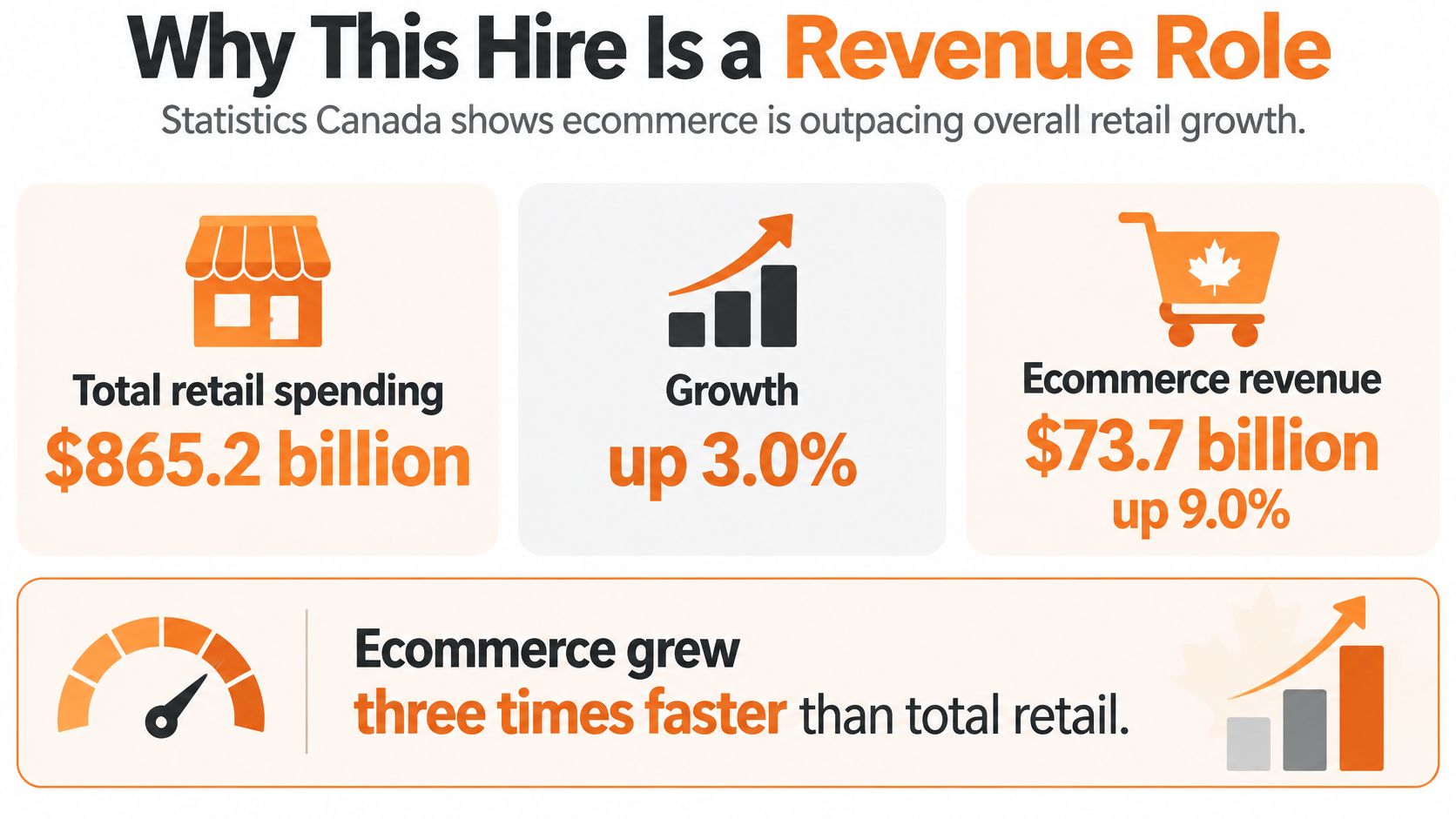
Statistics Canada reported that total Canadian retail spending rose 3.0% to $865.2 billion in 2024, while ecommerce revenue reached $73.7 billion. Online sales grew 9.0% year over year, three times the growth rate of total retail spending. The channel is not a November spike. Seasonally adjusted online retail sales were about $4.0 billion in April 2024, 6.0% of retail trade, and $3.8 billion in February 2024, 5.7% of retail trade.
That pool is large enough that a crawlable catalogue and a clean product template move real money. Rankings are a means. Revenue is the job.
Why This Hire Is a Revenue Role
The person you hire should capture demand you don't already own. Branded queries will show up whether or not you pay an SEO invoice. The commercial work is non-brand category and product demand, a catalogue search engines can crawl, and a clear line from those visits to add-to-cart and revenue.
Treat organic search as an acquisition channel, not a branding project. A generalist who reports average positions is describing visibility. A media buyer who pays for every click is renting the same demand. An ecommerce SEO specialist makes the next visit cheaper because the page, the feed, and the template already do the selling.
Five outcomes this role owns
Category discovery. Priority queries for a product type land on one strong category URL, not a stack of filters.
Technical indexation. Facets, parameters, internal search, and dead SKUs don't soak up crawl budget.
Structured product data. Price, availability, and breadcrumbs match what a shopper sees on the page.
Shopping content. Copy fits how people buy apparel, electronics, and hobby goods, rather than one keyword block pasted across the catalogue.
A revenue baseline. You know organic gross profit before anyone celebrates a ranking move.
The cadence that keeps it honest
Build the job around three recurring checks, not a one-off audit deck.
- Weekly feed review: Stock, price, and availability in the feed agree with the live page.
- Monthly indexation check: Facets, tracking parameters, and discontinued SKUs are closed, redirected only when a true equivalent exists, or left alone on purpose.
- Quarterly finance tie-out: Organic revenue is reconciled with the number finance will stand behind.
Practical rule: If the specialist can't name the revenue baseline in the first month, you hired a reporter, not an operator.
This seat fits a brand selling across British Columbia, the rest of Canada, or into cross-border markets, with a catalogue large enough that a template change or a faceted URL pattern moves money.
Engagement Models Fees and Contract Protections
Pick the engagement before you book interviews. The wrong model wastes the first quarter even when the person is skilled. These bands are planning ranges for 2026, not quotes. SKU count, Shopify versus a custom stack, bilingual or multi-province catalogues, regulated lines such as cannabis, CBD, or functional mushrooms, and whether development is included will push a fee up or down inside the band.
| Model | What you should get | Main risk |
|---|---|---|
| In-house specialist | Daily catalogue ownership with merchandising and dev | Slow hire and a single point of failure |
| Freelance contractor | Audit, priorities and hands-on support | Scope creep and limited dev access |
| One-time audit project | Baseline, roadmap and template recommendations | Roadmap dies without an owner |
| Specialist agency retainer | Strategy, technical, content and CRO tie-in | Junior staffing or a long lock-in |
How to choose a model
In-house is the right call when the catalogue changes every week and someone must sit with merchandising. You pay salary, tools, and a long search. You also accept a single point of failure if that person leaves.
A freelancer fits a defined audit plus light implementation. You get a named human and faster start. You don't get a bench when the theme breaks on a Friday.
A one-time project is for leadership that needs a roadmap and already has an internal owner who will ship it. Without that owner, the deck sits in a shared drive.
A specialist retainer is for teams that need strategy, technical SEO, content, and conversion work to move in the same month. Read any proposal against the scorecard below, then see what it leaves on your side of the table. A useful comparison of how agencies package retainers sits in this digital marketing agency pricing breakdown.
Clauses worth the argument
The cheapest hourly rate often excludes implementation. A generalist shop may also staff the account with juniors after the pitch. Put these terms in the contract before you sign.
- A 30-day exit. No multi-year lock-in.
- Named deliverables by month. Not "ongoing optimisation."
- Client ownership of content, redirects, and tracking.
- A revenue baseline set in the first 30 days.
- Rankings are not the success metric. Gross profit, or a margin proxy you both accept, is.
If a proposal can't say which of those rows it covers, it isn't ready to price.
Skills and Proof Before You Shortlist
Canadian online retail didn't snap back to a pre-2020 hobby. The International Trade Administration's Canada ecommerce guide notes a pandemic-era peak of $3.82 billion in retail ecommerce sales in December 2020, above the May 2020 high of $3.2 billion. By December 2024, seasonally adjusted ecommerce sales had risen 3.1% to $4.3 billion, 6.1% of total retail trade. The mix is split too. Fashion is about 23.3% of online activity, hobby and leisure 20.7%, and electronics 20.6%.
That mix sets the content bar. Apparel needs fit and size guidance. Electronics needs specs and compatibility. Hobby goods need buying guides, not a manufacturer paragraph.
What to demand before a call
Use this scorecard. Every row needs a file, not a claim. A rankings export, a pile of near-duplicate location or filter pages, or an AI-search add-on with no measurement plan is a fail.
| Skill area | Proof to ask for | Fail signal |
|---|---|---|
| Category architecture | One canonical URL per query cluster and crawlable category links | Indexed filter or location pages with no unique stock |
| Indexation | Plan for facets, parameters, internal search and dead SKUs | Duplicate parameters left open to crawl |
| Product data | Product and Breadcrumb schema matching visible price and stock | Markup that disagrees with the page |
| Catalogue content | Unique copy suited to apparel, electronics or hobby demand | Manufacturer descriptions only |
| Revenue reporting | Non-brand clicks, add-to-cart, revenue per landing page, assisted conversions | Rankings or impressions as the only KPI |
| Template CRO | Controlled tests on organic templates over a full purchase cycle | Traffic targets with nobody owning conversion |
Ask for four artefacts up front. A redacted URL map where each query cluster points at one canonical category or product URL. A written plan for faceted navigation and discontinued products. A Product and Breadcrumb schema snippet. A sample revenue dashboard split by device and by province.
Walk the same checks on your own site with an ecommerce SEO audit checklist so you can tell a real map from a slogan.
Shortlist rule: three or more fail signals and the candidate doesn't reach interview. Don't "see how the conversation goes." The files already answered.
How to Interview and Score Candidates
Run a 90-minute loop a marketing manager can lead without an SEO background. Send the exercise a week ahead, then make the candidate walk it live. A slide of client logos is not evidence.
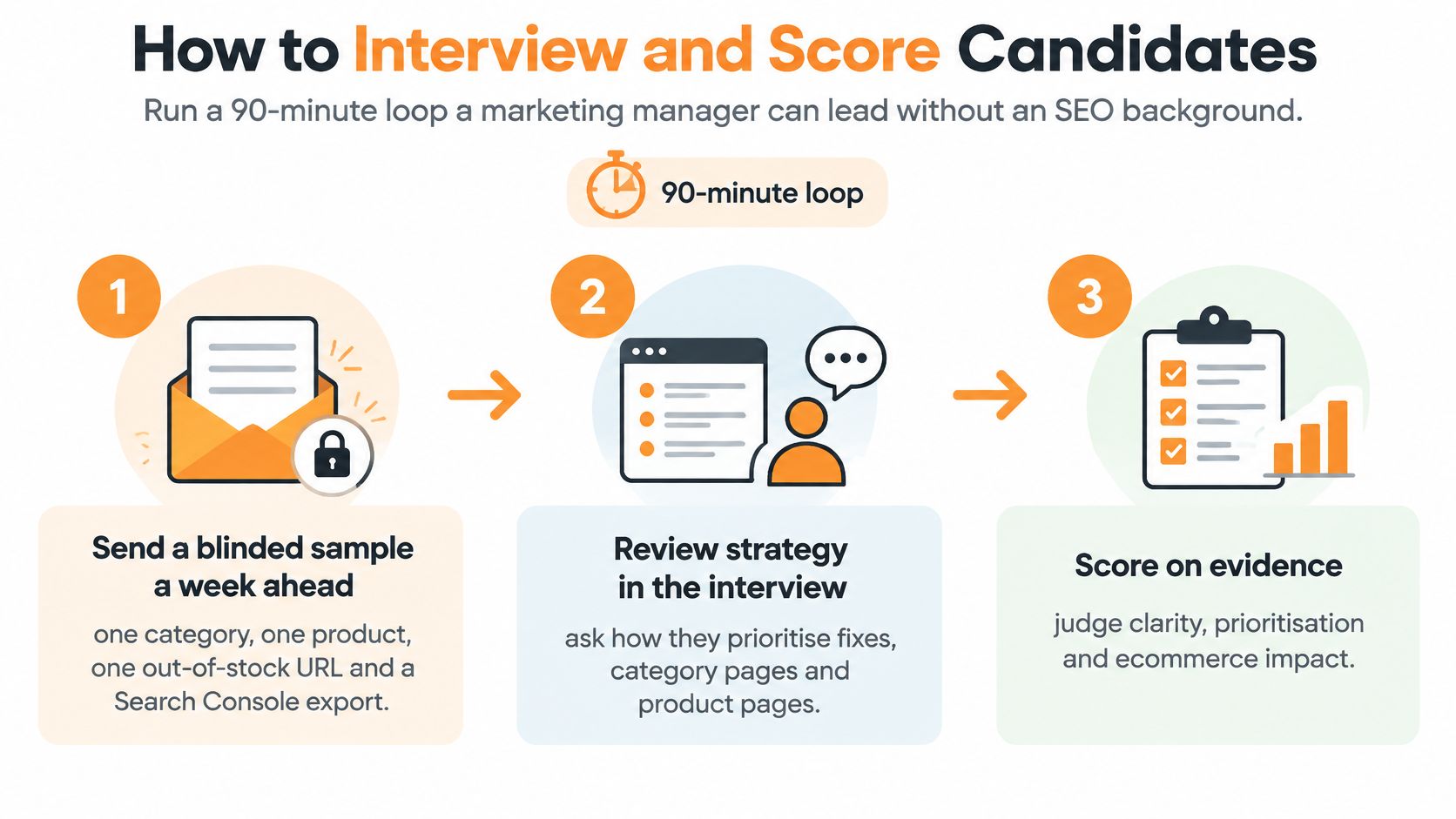
The loop, in order
- Send a blinded sample. One category, one product, one out-of-stock URL, and a Search Console export with brand queries removed.
- Demand one canonical URL for the main query cluster, plus which URLs they would noindex, redirect, or leave alone.
- Split the first 30 days from later work. What changes on the template now, and what waits until a revenue baseline exists?
- Reconcile price and stock. Schema, the visible page, and a weekly feed have to agree. Ask where they check that.
- Name a metric they would refuse as a bonus. A strong answer picks a revenue or margin measure and rejects impressions.
- Show a win by province and device. Ask what they would ignore in a national average.
- Score each answer 0 to 2 against the six scorecard rows, with a second interviewer in the room. That is 12 points from the rows, plus 2 for the refusal in step 5, so 14 in total.
Say you run a British Columbia brand that ships nationally. The keyword is identical in Vancouver and Halifax. Provincial tax, delivery promises, and local stock still change whether someone adds to cart. A candidate who optimises the national average will waste the template test.
A passing candidate reaches at least 10 of 14 and can name one change they would not make. If they can't decline a tactic, they'll spend your dev queue on theatre.
Watch a short walk-through of how a specialist should talk through category and product decisions before you run your own loop.
Onboard for a Measured First 90 Days
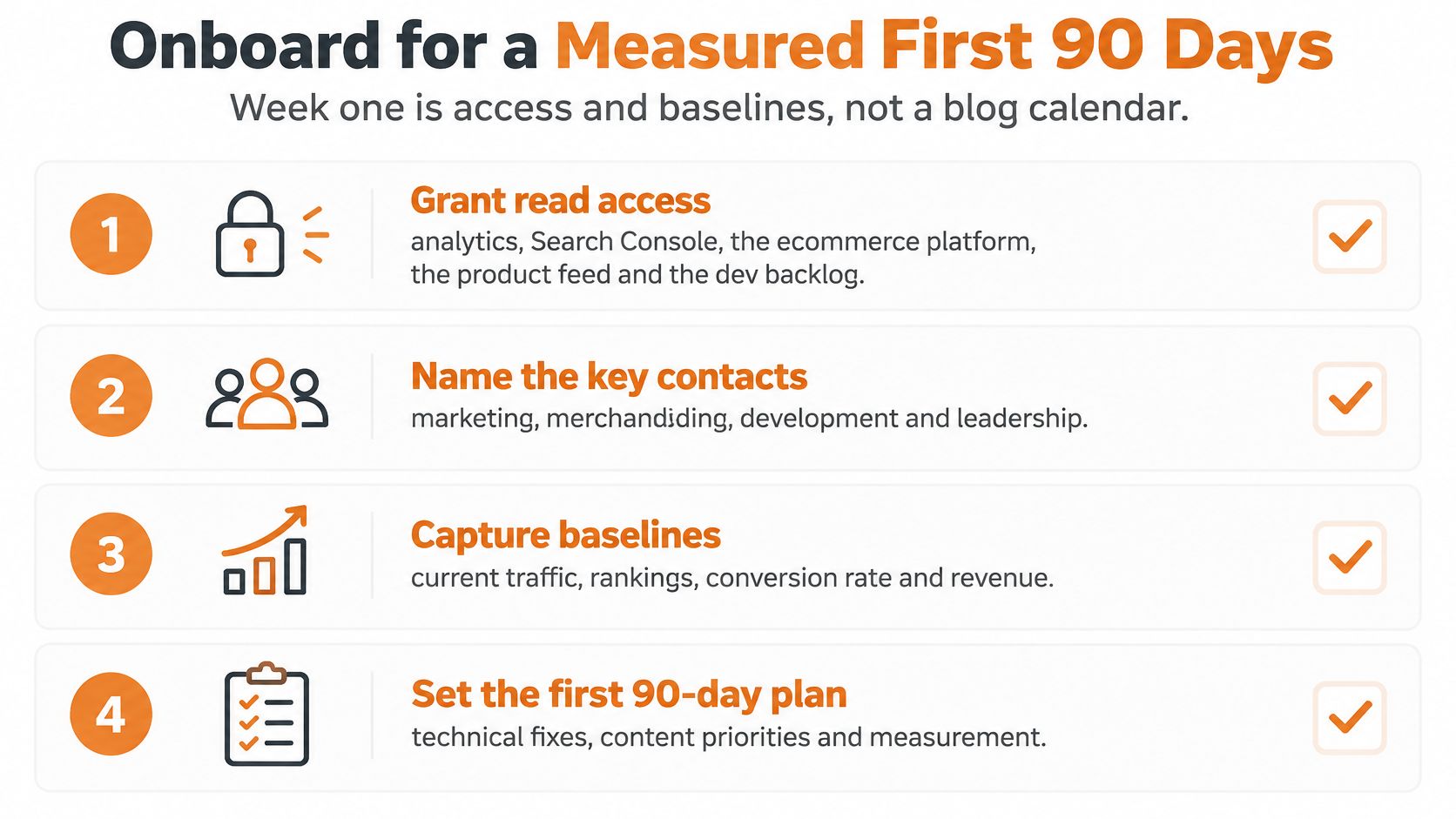
Week one is access and baselines, not a blog calendar. By day 90 you want a short backlog, a revenue baseline, and one tested template. You don't want a 40-page audit nobody will ship.
Shared work for the first quarter
- Open the doors. Read access to analytics, Search Console, the ecommerce platform, the product feed, and the dev backlog. Name one internal owner.
- Segment the truth. Split performance by province, device, brand versus non-brand, category, product, and informational intent.
- Map and cut waste. Each priority query cluster gets one canonical URL. List facets, internal search, parameters, and discontinued products that shouldn't be indexed.
- Fix the templates that earn. Crawlable category links, descriptive titles, unique product copy, Product and Breadcrumb schema, and price and inventory signals that match the page.
- Set the scoreboard before tests. Non-brand clicks, qualified sessions, add-to-cart rate, revenue per landing page, and assisted conversions. No template experiment until the baseline exists.
- Change one template group. Wait at least one full purchase cycle, then compare organic conversion rate and margin, not impressions.
- Install the weekly feed habit. Stock, price, and availability, with annotations for promotions and shipping cut-offs.
Two traps that erase the quarter
Publishing near-duplicate location or filter pages without different inventory, shipping, or buying information splits links and creates competing URLs. Letting seasonal or out-of-stock URLs vanish wholesale breaks internal links and throws away accumulated demand. Redirect only when a genuine replacement exists.
Agree the revenue definition with finance before you argue about results. Statistics Canada's daily retail release counts orders committed through websites, mobile devices, extranets, or EDI, even when payment happens offline. A separate retail trade release excludes some online transactions such as travel, accommodation, tickets, and financial services. If your checkout includes pay-later or your catalogue sits outside ordinary retail goods, the SEO number and the finance number will diverge until you write the rule down.
When AI SEO and CRO Earn the Budget
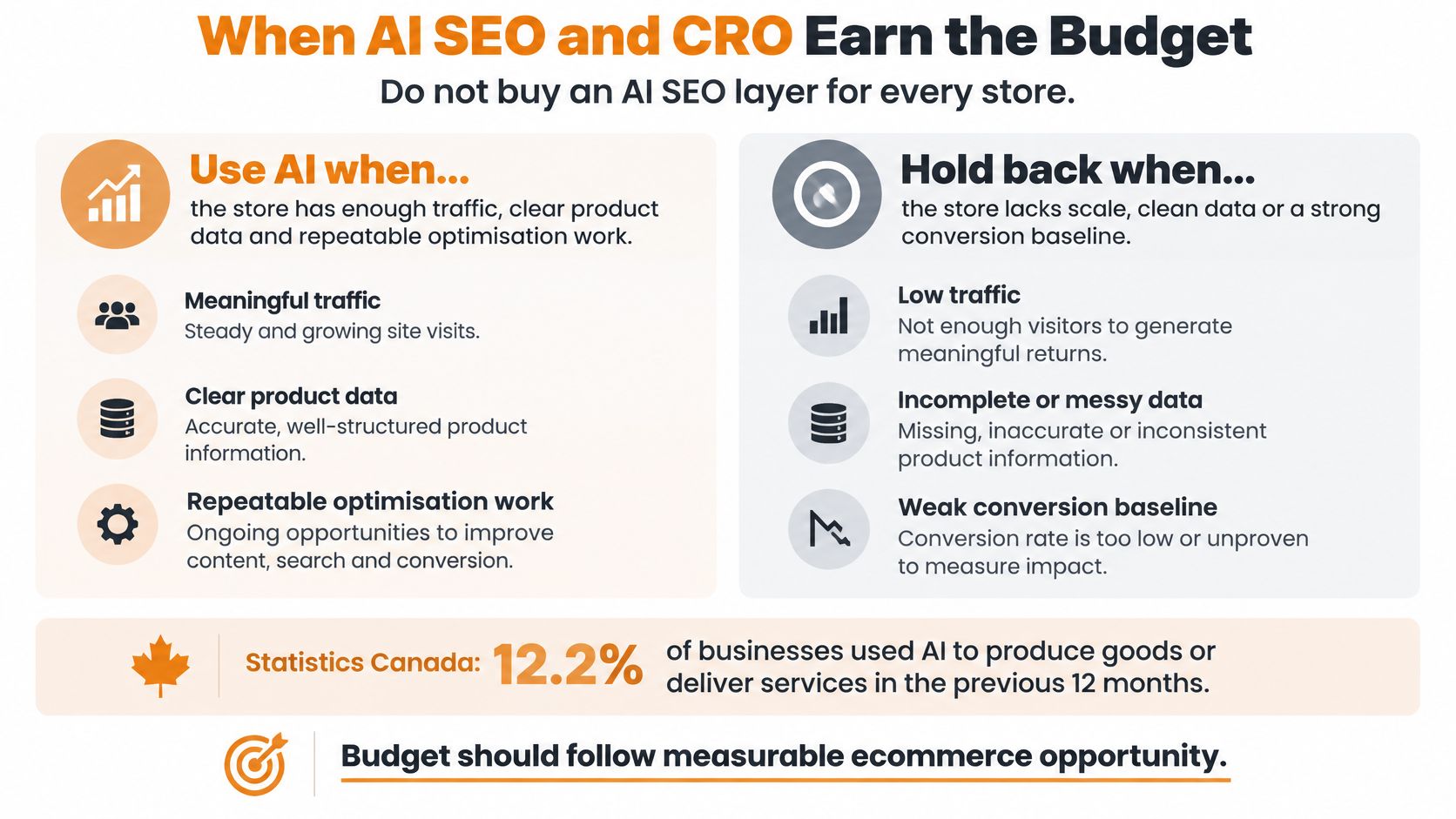
Don't buy an AI SEO layer for every store. Adoption is not proof that answer-engine tactics pay.
Statistics Canada's analysis of AI use by businesses found 12.2% of businesses used AI to produce goods or deliver services in the 12 months before the second quarter of 2025, up from 6.1% a year earlier, while 17.9% planned to adopt AI software within the following year. Most firms are still early. Your catalogue problems are older than that trend.
AI visibility is a later layer, not a substitute for a clean catalogue.
The specialist earns AI scope only after structured product data, crawlability, category architecture, useful product content, reviews, and conversion tracking are already working. Put this question in the statement of work. What evidence shows this work created incremental Canadian revenue, rather than a rebrand of technical SEO?
Accept only controlled reads by geography, query type, assisted conversions, branded demand, and product-level revenue. Reject mention counts and screenshot anecdotes. A tool that logs how often a model names you is a research note. It isn't a bonus metric.
Where CRO belongs in the same budget
Pair conversion work the same way. Test high-revenue templates on real-user speed and on-page clarity, then compare organic conversion rate and margin over a purchase cycle. Lab scores from a single desktop run are not that test.
The split is simple. SEO decides which URL should rank and whether machines can read price and stock. CRO decides whether that visit adds to cart. For regulated catalogues, compliance review sits in front of both, because a clever test that breaks a claim is an expensive test. A practical set of conversion rate optimization strategies belongs beside the SEO backlog, not instead of it.
If someone leads the pitch with an AI visibility retainer and your product schema still disagrees with the price on the page, decline the layer and fix the page.
Choose the Specialist Before You Sign
Pick one engagement this week. Hire in-house if merchandising changes daily and you can wait through a search. Use a freelancer or a fixed audit if an internal owner will implement. Use a specialist retainer if nobody inside can join technical SEO to conversion work.
Three gates, all of them, before you sign.
- The blinded catalogue exercise was passed. Files, not a logo slide.
- The contract exits in 30 days and names a revenue baseline.
- AI-search work is excluded, or tied to incremental revenue. Mentions don't count.
If your current specialist fails two of those gates, pause new content and reset scope before you add another tool. More pages on a broken index won't repair the quarter.
For a practical next conversation, book a short diagnostic with a specialist team such as Juiced Digital, which runs audits for ecommerce and regulated brands and combines AI-aware SEO with CRO without a long-term lock-in. Bring last quarter's non-brand revenue, a product feed sample, and one category URL. Leave with a model choice and a 90-day backlog, or a clear decision not to hire yet.
Juiced Digital helps Canadian ecommerce brands turn organic search into revenue with technical catalogue work, product and category SEO, and conversion testing, including compliant programmes for cannabis, CBD, and functional mushroom companies. If you want that work judged on gross profit rather than rankings or AI mentions, start with an audit instead of a retainer. Visit Juiced Digital and bring a feed sample and one category URL.
