

You've asked three agencies to price the same marketing brief. One freelancer wants a modest monthly retainer, a Vancouver agency proposes several thousand dollars, and a specialist from outside Canada sends a quote that looks built for a multinational. You're left wondering whether one provider is overcharging, another is cutting corners, or whether the proposals just describe different work.
That confusion is normal. Digital marketing agency pricing reflects team seniority, scope, channel complexity, reporting, tools, compliance requirements, and commercial risk. The right question isn't “Which quote is cheapest?” It's “What work, ownership, and measurable business outcome does each quote buy?”
Why Three Quotes for the Same Service Can Differ by 400 Percent
A Vancouver founder recently compared three SEO proposals for a local e-commerce brand. The first came from a freelancer at $1,200 per month, the second from a downtown agency at $9,500 per month, and the third from a U.S. enterprise shop at $14,000 per month. On the cover pages, all three promised technical SEO, content, reporting, and organic growth.
The founder assumed the proposals were comparable. They weren't.
The freelancer's offer covered a limited number of hours from one person. That could be a sensible choice for a site with clean analytics, stable templates, and someone in-house who can implement recommendations. It becomes a problem when the same person is expected to handle research, technical diagnosis, copywriting, link acquisition, reporting, and developer coordination inside a very small time allocation.
The Vancouver agency had a strategist, an SEO specialist, a writer, and an account lead. Its proposal also included structured reporting and more active coordination with the client's developer. The U.S. firm priced for enterprise processes, deeper documentation, broader stakeholder management, and a larger margin for approvals, governance, and risk.
The visible price is only part of the scope
Agencies create these gaps through several cost drivers:
- Team composition: A junior specialist working independently costs less than a senior strategist supported by technical and content specialists.
- Reporting depth: A dashboard can show traffic and rankings. A useful report explains what changed, why it changed, and what the team will do next.
- Tooling: SEO platforms, analytics systems, crawling software, content workflows, and reporting tools may be included, passed through, or omitted.
- Strategy: Some providers bundle planning into the retainer. Others charge separately for audits, roadmaps, workshops, or quarterly planning.
- Implementation: A recommendation has limited value if nobody is responsible for fixing templates, improving conversion paths, or publishing content.
Practical rule: Treat every proposal as a staffing plan and delivery schedule, not as a price tag.
The cheapest quote often excludes the work that makes marketing effective, such as content production, technical fixes, conversion rate optimisation, analytics quality assurance, or meaningful client communication. The expensive quote may absorb those tasks, but that doesn't automatically make it good value.
Canadian benchmarks offer useful context. Canadian agency pricing guidance places many firms around $100 to $149 per hour, with Canadian monthly engagements commonly ranging from $2,000 to $20,000 or more, depending on scope and seniority. That spread makes sense once you separate execution from strategic leadership.
The rest of the buying decision comes down to pricing structure, scope, and the relationship between cost and commercial return.
The Five Pricing Models Agencies Actually Use
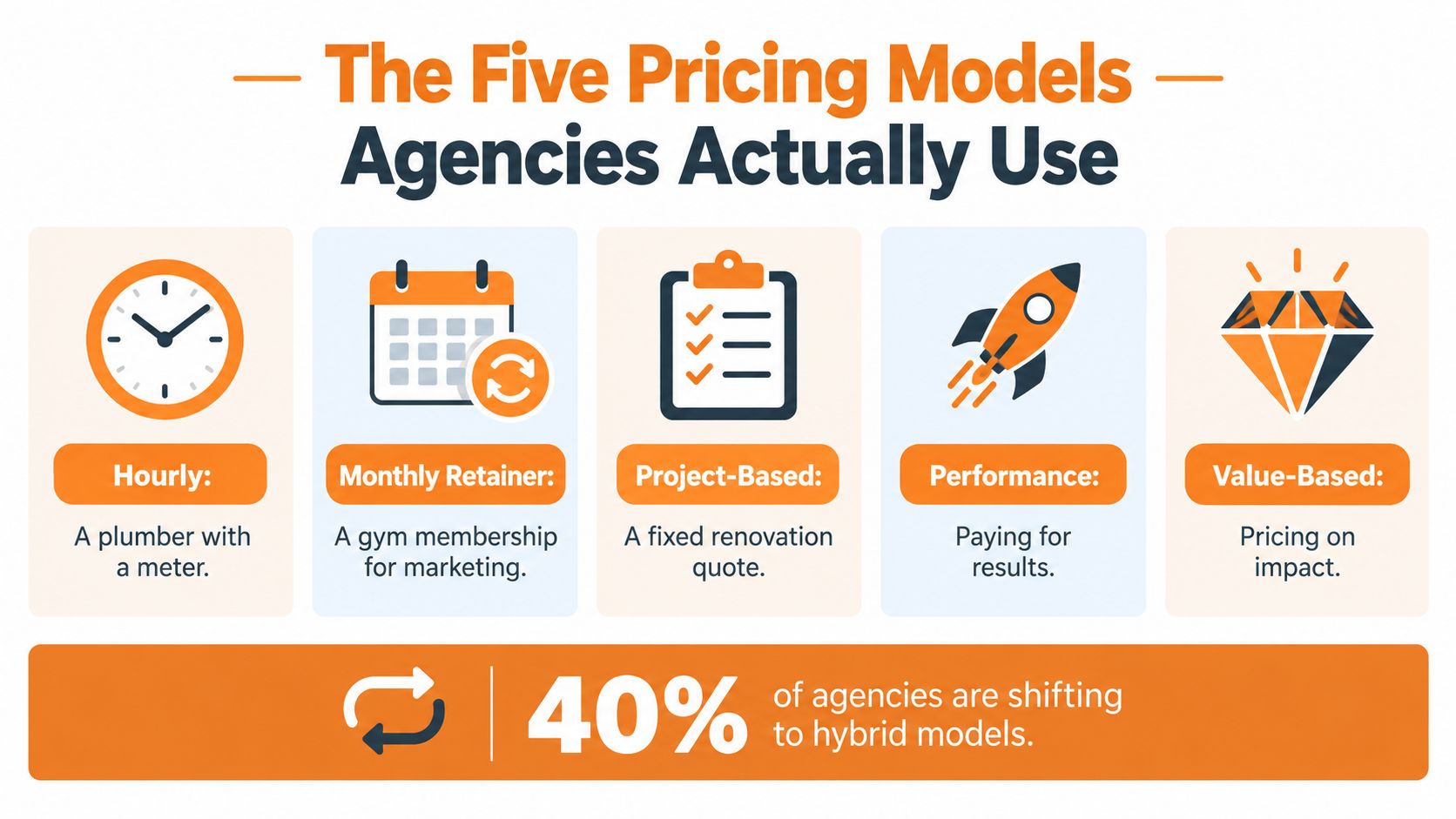
Agencies usually sell marketing through five structures. Each one shifts risk between the buyer and the provider.
Hourly pricing
Hourly work is like hiring a plumber with a meter running. You pay for time consumed, which makes the model useful when the problem is uncertain or the work is advisory.
Use it for:
- SEO and analytics audits
- Fractional marketing leadership
- Technical consulting
- Short troubleshooting assignments
- Workshops and training
The strength is flexibility. The weakness is that efficiency can become commercially awkward. A capable consultant may solve a problem quickly, while a less organised provider consumes more hours without creating more value.
Monthly retainers
A retainer resembles a gym membership for marketing. You pay for ongoing access, attention, planning, and a defined level of delivery.
Retainers fit recurring work such as SEO, content, paid media management, email marketing, and local search. They give the agency room to learn the business and make iterative improvements, but they can become expensive when the scope says “ongoing optimisation” without defining the monthly output.
Project-based fees
A project quote is a renovation estimate. The agency defines the work, timeline, deliverables, and assumptions before starting.
This works well for website redesigns, analytics implementations, technical audits, brand launches, and campaign builds. Ask what happens when the renovation changes. Extra pages, new integrations, additional review rounds, and late approvals usually trigger change orders.
Performance pricing
Performance pricing works like paying a sales representative commission. The agency receives compensation tied to an agreed outcome, such as qualified leads, tracked sales, or affiliate revenue.
It only fits businesses with reliable attribution, sufficient conversion volume, clean data, and a clear definition of what the agency controls. Rankings, impressions, and follower counts are poor performance targets because they can rise without improving revenue.
Percentage of ad spend
This structure resembles a property manager whose compensation scales with the value of the property being managed. The agency charges a percentage of the media budget, sometimes with a minimum fee.
It generally becomes more practical as paid media budgets grow, often once spend moves beyond roughly $5,000 per month. For smaller accounts, a flat fee can be easier to understand because the agency still has to perform setup, tracking, testing, and reporting even when the budget is modest.
For website-specific costs, this guide to web page design rates gives buyers another useful comparison point. The model matters, but the contract's definition of work matters more.
What Canadian Agencies Really Charge in 2026
A Vancouver retailer can receive three proposals for the same SEO and paid media brief, with a price gap of several hundred percent. The difference usually comes from seniority, implementation depth, reporting, compliance work, and how much of the execution the agency keeps in-house.
Canadian buyers should use local benchmarks as a starting point, then price the operational burden. Canadian digital marketing pricing benchmarks place junior marketing support around C$75 to C$125 per hour, senior expertise around C$150 to C$350 or more, and common retainers from C$2,000 to C$5,000 for smaller programmes and C$7,000 to C$20,000 or more for multi-regional or enterprise work.
Those ranges describe engagement economics, not equal value. Junior support can handle production. Senior expertise earns its cost when the account involves positioning, technical risk, multiple stakeholders, or a regulated category.
A practical Canadian benchmark table
| Pricing Model | Small / Local | Growth / E-commerce | Enterprise / Regulated |
|---|---|---|---|
| Hourly advisory | C$75 to C$125 | C$150 to C$225 | C$250 to C$350 or more |
| Monthly retainer | C$2,000 to C$5,000 | C$4,500 to C$12,000 | C$7,000 to C$20,000 or more |
| Paid media management | C$1,000 to C$3,000 | C$1,500 to C$5,500 | Custom scope and blended fee |
| AI tools and automation add-on | C$500 to C$2,000 or more | C$500 to C$2,000 or more | Custom scope and usage |
| Focused project | Defined audit, setup, or launch | Multi-channel build | Governance, compliance, and complex implementation |
Treat the table as a screening tool, not a quote. Ask what each fee includes, who does the work, how many channels are covered, and whether strategy, implementation, tracking, and reporting are all included.
Choose the range by operational burden
A single-location plumber, therapist, or renovation company usually needs local SEO, landing page improvements, review support, and lead tracking. A growing Shopify brand needs product-feed management, creative testing, shopping campaigns, email coordination, landing page optimisation, and revenue attribution. That workload justifies a higher retainer than a narrow local campaign.
Cannabis, CBD, and health brands sit in a different category. Compliance review, restricted advertising options, claims scrutiny, product education, and platform volatility demand more senior oversight. Do not compare a regulated-sector proposal with a generic local SEO package because both mention “content and SEO.”
The British Columbia agency market includes lean specialists and full-service teams. Buyers should confirm who performs the work, how much implementation is included, and whether the agency understands the category's legal and platform constraints. Price the proposal against the revenue opportunity and acquisition risk, not the retainer alone.
How Paid Media Fees Scale With Your Ad Spend
Paid media pricing becomes misleading when buyers compare only the management fee. Actual acquisition cost also includes ad spend, creative, landing pages, tracking, testing, and the time required to improve performance.
Percentage pricing is simple to calculate, but it says little about profitability. Canadian benchmarks generally move from about 18% to 20% at mid-level budgets toward roughly 12% to 15% at higher budgets. Smaller accounts may use fixed fees because campaign setup, tracking, and reporting still require substantial work even with limited spend.
Compare the landed monthly cost
| Monthly Ad Spend | Percentage Model | Flat-Fee Model | Hybrid Model |
|---|---|---|---|
| C$3,000 | About C$540 to C$600 | Often C$1,000 to C$1,800 | Base fee plus a reduced percentage |
| C$10,000 | About C$1,800 to C$2,000 | Often C$1,500 to C$3,000 | Lower base fee plus a reduced percentage |
| C$30,000 | About C$3,600 to C$4,500 | Often C$2,500 to C$5,500 | Negotiated base fee plus a reduced percentage |
These comparisons show why the right model changes with account size. At a lower budget, a percentage fee may not fund the labour needed for tracking, campaign structure, and creative testing. At a higher budget, a flat fee may look attractive while failing to reflect the agency's workload and account risk.
A Shopify brand spending C$5,000 monthly may suit a defined retainer if it has few campaigns and stable creative. At C$15,000, a hybrid model deserves serious consideration because testing, audiences, feeds, and attribution require more active management. At C$50,000, scrutinise every percentage point and require the agency to connect its fee to specific work.
Judge the fee against revenue efficiency, not campaign activity. A practical explanation of ROAS and revenue efficiency keeps that evaluation focused on what the advertising produces.
Cannabis and CBD advertisers face added operational work. Platform restrictions, compliance reviews, claims scrutiny, and landing-page requirements can increase senior oversight even when the media budget remains unchanged. A low headline percentage offers little value if the agreement excludes compliant creative, account-risk management, or landing-page review.
The same principle applies to comprehensive health brands. Product education and careful claims review can make a modest account more demanding than its spend suggests. Set the fee against acquisition risk and expected contribution margin, then verify which work the proposal includes.
Reading a Proposal Without Getting Sold
A proposal should let you reconstruct the agency's workload. If you can't tell who is doing what, how often, and under which assumptions, the price is not yet meaningful.
Start with the commercial summary, then ignore it temporarily. Read the scope line by line.
What each line should tell you
Strategy hours reveal whether senior thinking is included. Ask whether the hours cover planning, stakeholder meetings, research, testing decisions, and quarterly reviews, or whether strategy is reserved for a separate engagement.
Channel allocation shows whether the agency has priced SEO, Google Ads, Meta, email, CRO, and digital PR independently. Multi-channel language can conceal a shallow amount of work across too many platforms.
Content units need definition. A “content package” could mean briefs only, or it could include research, writing, editing, design, publishing, internal links, and updates. Those are different outputs.
Reporting cadence should identify the data source, recipient, frequency, and discussion format. A dashboard without interpretation isn't the same as a monthly strategy call with actions and owners.
Ad spend pass-through must sit outside the agency fee unless the proposal clearly states otherwise. Ask whether platform charges, creative production, stock assets, landing pages, and tracking implementation are included.
Find the exclusions before signing
Look for:
- Revision limits: Uncapped revisions create unpredictable labour, while tiny limits can make useful creative impossible.
- Project management: Vague wording may hide a large amount of coordination work or create a line for every meeting.
- Platforms and tools: Confirm whether software access is included, shared, or billed as a separate pass-through.
- Implementation: Determine whether the agency can make changes or only sends recommendations.
- Ownership: Confirm that the business retains access to ad accounts, analytics, creative files, and campaign data.
A proposal priced at $4,500 per month can become materially more expensive when creative production, additional landing pages, rush work, extra review rounds, tools, or platform fees sit outside the base scope. The exact increase depends on the contract, so ask for an all-in estimate based on a realistic month rather than an ideal one.
Ask this before signing: “What would cause my monthly invoice to exceed the quoted amount, and how will you obtain approval first?”
Comparing Bids the Way Agencies Wish You Would
Stop comparing proposals by their first-page total. Build a small decision matrix and score the actual buying criteria.
Give each proposal a score from 1 to 10 for deliverables, exclusions, exit terms, reporting depth, and the seniority of the named delivery team. Then assign weights based on your business model.
Use the decision criteria that match your risk
For e-commerce, put more weight on tracking, creative testing, feed management, CRO, and revenue reporting. A low fee is meaningless if the agency can't connect campaigns to Shopify sales or distinguish new customers from returning buyers.
For local services, prioritise local landing pages, Google Business Profile work, call tracking, lead quality, and implementation speed. You don't need an enterprise reporting machine if the agency can't improve the phone calls and form submissions that drive bookings.
For cannabis, CBD, and health, increase the weight assigned to compliance knowledge, claims review, content quality, platform contingency planning, and senior involvement. Restricted categories punish careless execution.
Ask questions that expose the real difference
- Who owns the Google Ads, Meta, analytics, and product-feed accounts?
- What data and creative assets do I receive when the engagement ends?
- Is reporting a dashboard, a written analysis, or a live strategy call?
- Which deliverables are guaranteed each month?
- Which team members perform the work, and how much senior time is included?
- What requires a change order?
- Can I cancel without paying for uncompleted future work?
The lowest bid often excludes strategy, creative, CRO, or account ownership. A mid-range proposal can therefore be cheaper in practice if it includes the work you'd otherwise need to buy separately.
Compare comparable scope, not competing numbers. A cheaper proposal only wins when it solves the same problem with the same level of accountability.
Red Flags That Inflate Cost Without Lifting ROI
Some agencies inflate invoices through obvious add-ons. Others do it through contract language that makes the initial quote look attractive while limiting what the team can deliver.
Start with the cancellation clause. An auto-renewing retainer with a 90-day cancellation window can trap a buyer who needs to change direction. A notice period isn't automatically unreasonable, but the agency should explain what work continues during it and whether the client can use that period to transition accounts and assets.
Watch the language and the invoice
- “Ongoing optimisation”: Demand a monthly description of campaigns, pages, tests, and decisions covered by the phrase.
- Unclear media markups: Confirm whether the agency adds a fee to platform spend, and how that fee interacts with management charges.
- Vanity reporting: Impressions, follower counts, and branded traffic can distract from leads, qualified opportunities, sales, and margin.
- Pay-per-interaction billing: Charges for ordinary Slack messages, routine calls, or every creative revision can make a supposedly fixed retainer unpredictable.
- Exclusive channel restrictions: An agency shouldn't block your internal team from working on a channel to protect billable hours.
- White-label delivery: Ask who performs the work and whether subcontractors receive the same brief, oversight, and compliance standards.
A dashboard can look polished while hiding weak commercial performance. Ask the agency to show how each reported metric connects to a business action, and what happens when the metric improves without revenue improving.
A retainer should buy a predictable operating rhythm. It shouldn't turn ordinary collaboration into a series of surprise charges.
Locked-in minimums, opaque media-buying fees, and unclear ownership can double the effective cost of an engagement without doubling its output. Read the contract alongside the proposal because the commercial risk often appears in the legal section, not the scope summary.
Reframing Price as ROI and Your Next Step
Agency fees become easier to judge when you model the customer economics first. The calculation is straightforward: identify the contribution margin from a new customer, estimate the acceptable acquisition cost, and determine how many incremental customers the programme must produce to cover both the agency fee and the media or production costs.
For SEO, use a longer measurement window because the work compounds through technical improvements, content, internal linking, and authority. For PPC, measure contribution after media and management fees. For content, track assisted conversions and qualified demand rather than treating every article as a standalone sales asset.
A $4,000 monthly retainer isn't automatically expensive or affordable. It's justified only if the work can reasonably create enough profitable demand, improve conversion efficiency, protect an important channel, or reduce waste elsewhere.
Negotiate the structure, not just the price
- Bundle related channels. SEO, content, and CRO often work better as one programme than as disconnected purchases.
- Trade minimums for performance tiers. A lower base fee can be paired with clearly defined bonuses tied to outcomes the agency can influence.
- Request rate protection. Ask for stable pricing across the initial terms, with any increase tied to documented scope changes.
- Cap creative production. Define the number of concepts, formats, review rounds, and turnaround expectations.
- Demand media transparency. Separate ad spend, management, creative, landing pages, and tracking so you can see the full acquisition cost.
For Vancouver local services, prioritise lead quality, local visibility, call handling, and conversion paths before adding more channels. Cannabis and CBD operators should budget for compliance-aware content and platform contingencies rather than treating restrictions as an afterthought. Wellness brands need credible, carefully reviewed content because generic production rarely earns trust in crowded search results.
Juiced Digital is one Vancouver-based option that combines AI-enabled SEO, paid advertising, conversion rate optimisation, and digital PR for local businesses, e-commerce brands, and regulated or natural health categories. The important comparison remains the same: match its scope, seniority, ownership terms, and measurement approach against the alternatives.
You don't need the cheapest agency. You need a proposal that states the work clearly, assigns responsibility, protects your assets, and makes the path to profitable growth visible.
Book a free audit and consultation with Juiced Digital to review your current scope, pricing structure, SEO, paid media, and conversion opportunities. Bring your existing proposals, and the team can help identify what's included, what's missing, and which investment can be tied most directly to measurable ROI.