

You're probably here because lead flow feels uneven.
One month, referrals come in without much effort. The next, your calendar goes quiet. You try a few Google Ads campaigns, post on LinkedIn, maybe send a cold email batch, then wonder why none of it turns into a steady pipeline. The problem usually isn't effort. It's that most businesses are running disconnected tactics instead of a system.
That's where a Lead Generation Agency can help, but not in the way many founders assume. A good agency isn't just a supplier of names and email addresses. It builds the machinery that turns attention into qualified conversations, and qualified conversations into revenue.
That matters more in Canada than many business owners realise. Canada has a smaller business market than the United States. One source estimates about 1.5 million employer firms in Canada versus roughly 6 million in the U.S., which changes how agencies should approach outbound and paid acquisition in markets like Vancouver and the rest of BC (Canadian lead generation market data). In a smaller market, brute force usually wastes budget. Precision matters more.
Seasonality matters too. The same source notes that Canadian lead generation velocity can fall 20 to 40% in November to December and again in July to August, which explains why some campaigns seem to “stop working” when the issue is timing and buyer behaviour, not just ad quality (Canadian lead generation seasonality benchmarks).
Introduction Why Most Businesses Struggle to Generate Consistent Leads
A founder in Vancouver often starts the same way. Referrals carried the business for a while. Then growth stalled, so they added Google Ads. A few leads came in, but many were poor fits. They tried SEO, posted on social, maybe hired a freelancer to manage campaigns, and still couldn't answer a simple question: where will next month's pipeline come from?
That's the pain point. Not a lack of activity. A lack of predictability.
Why DIY lead generation breaks down
Most do-it-yourself lead generation falls apart for three reasons:
- Targeting stays too broad. The messaging speaks to everyone, so it persuades almost no one.
- Channels run in isolation. Ads, landing pages, follow-up, and sales handoff don't work together.
- Lead quality gets ignored. Teams celebrate form fills, then realise sales can't close them.
A business owner might say, “We need more leads,” when the deeper issue is, “We need more of the right leads, and we need a process to move them forward.”
Practical rule: If sales keeps saying the leads are weak, the problem usually starts before the form submission, not after it.
Why Canadian realities change the playbook
A lot of lead gen advice online assumes a giant U.S. market. BC businesses don't get that luxury. In Canada, the addressable market is smaller, buying cycles can be slower, and seasonal dips are more noticeable. That means success often comes from tighter local intent targeting, stronger qualification, and better nurturing rather than trying to flood the top of the funnel.
For local service companies in Vancouver, that can mean focusing on people searching with clear buying intent. For regulated sectors like cannabis, CBD, and functional mushrooms, it can mean pairing compliant messaging with organic visibility and careful funnel design. For e-commerce brands, it often means improving what happens after the click instead of buying more traffic.
A Lead Generation Agency should help you build that system. Not just generate noise.
What a Lead Generation Agency Actually Does
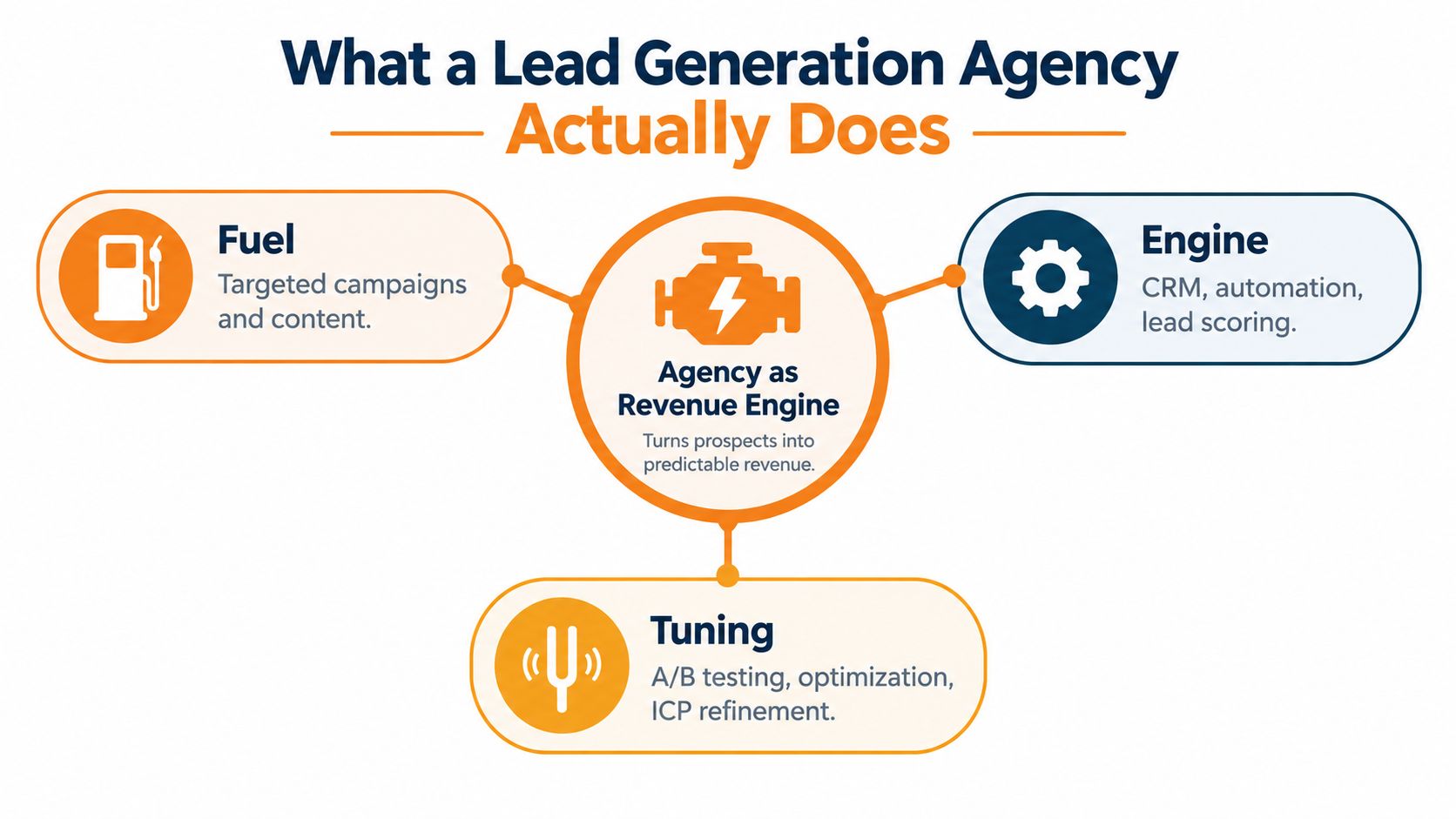
Think of a Lead Generation Agency like a revenue engine.
Fuel goes in. The engine converts that fuel into motion. Then someone keeps tuning it so it runs better over time. Most businesses only focus on the fuel. They buy traffic, rent a list, or post content. The engine and tuning are what determine whether any of that effort becomes revenue.
The fuel
Fuel is what brings people in.
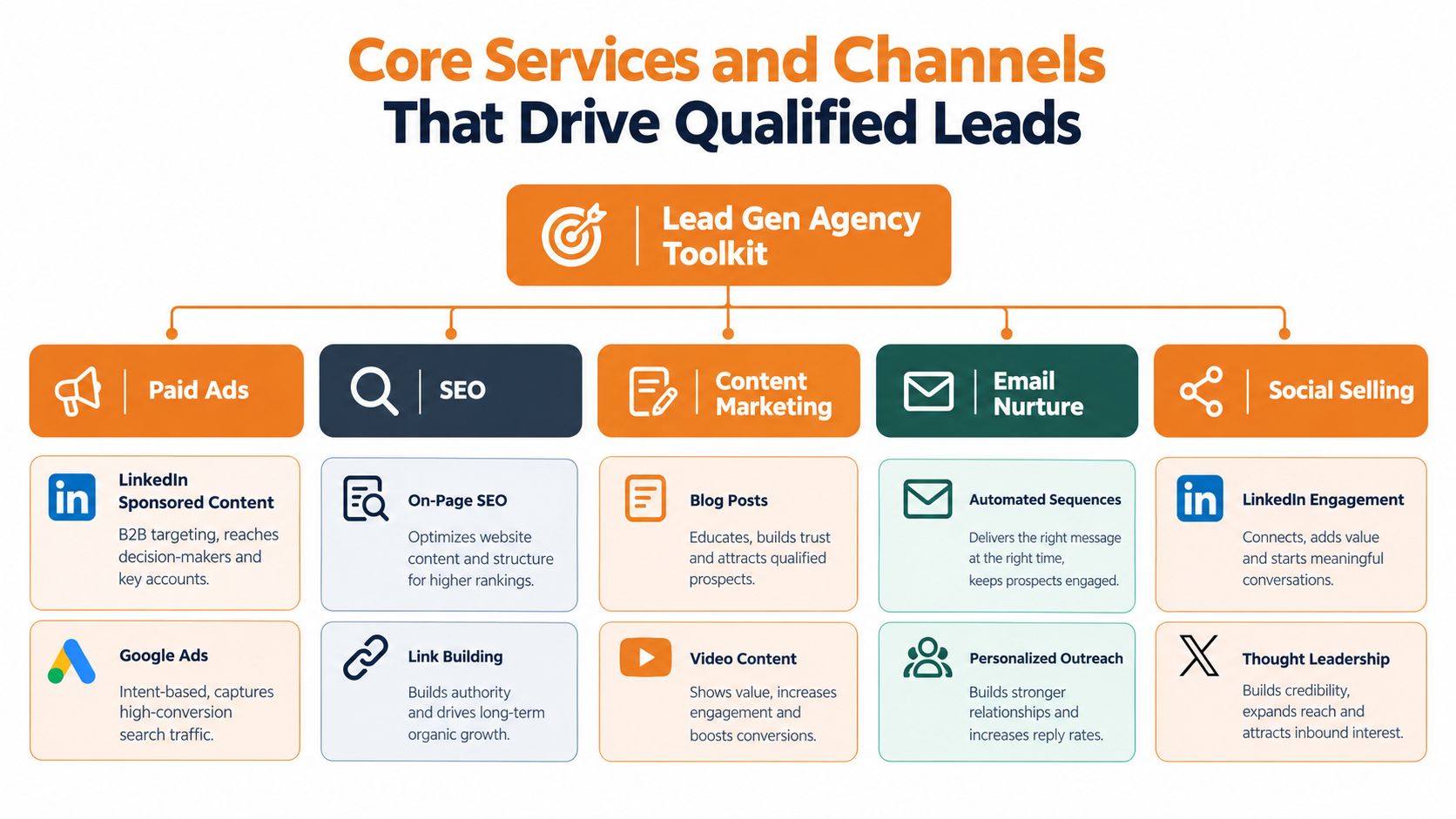
That can include Google Ads, SEO content, local SEO pages, LinkedIn outreach, cold email, digital PR, referral systems, and retargeting. Each source attracts a different kind of prospect with a different level of urgency.
A common mistake is treating all leads as equal. They aren't. Someone searching “emergency plumber Vancouver” behaves differently from someone who casually clicked an educational blog post.
The engine
The engine is the middle of the funnel. Interest gets sorted, captured, and routed.
A strong agency usually helps with:
- Offer design. What exactly are you asking the prospect to do?
- Landing pages. Does the page match the promise of the ad or search result?
- Forms and qualification logic. Are you filtering out weak-fit leads early?
- CRM and automation. Do leads go somewhere organised, or into a black hole?
- Lead scoring. Who gets immediate sales follow-up, and who needs nurture first?
Readers often get confused about terms.
MQLs, SQLs, and why the distinction matters
An MQL, or marketing-qualified lead, has shown interest and fits your general audience.
An SQL, or sales-qualified lead, is closer to a buying decision. They fit your ideal customer profile, and sales has reason to believe a real opportunity exists.
In Canada, that middle step matters a lot. Canadian B2B funnels often convert only 18 to 30% of MQLs into SQLs, according to Canadian B2B lead qualification benchmarks. So if an agency boasts about lots of top-of-funnel leads but can't improve sales-readiness, the volume may be misleading.
A full inbox doesn't mean a healthy pipeline. It may just mean your form is too easy to fill out.
The tuning
Tuning is continuous improvement.
A good agency watches where prospects drop off, which queries produce poor-fit leads, which landing page sections create friction, and which follow-up sequences move people forward. Then it adjusts.
The client still has responsibilities. You need clear goals, access to your sales feedback, and a realistic picture of your margins and close process. But the agency should own the system design, testing, and optimisation.
Core Services and Channels That Drive Qualified Leads
A Vancouver firm can spend months increasing traffic and still feel no closer to steady revenue. The usual problem is not a lack of channels. It is a mismatch between the channel, the buyer's intent, and the business's economics.
In Canada, that mismatch gets expensive faster than many owners expect. The addressable market is smaller than in the US, cost per lead is often higher, and regulated or niche sectors in BC cannot afford to buy a pile of weak inquiries just to hit a volume target. A good agency chooses channels the way a builder chooses materials. Based on the climate, the budget, and what the structure needs to hold.
Search and intent channels
Search works best when someone already has a problem and is looking for a solution. Google Search Ads are strongest at capturing that moment.
In Canada, search ads typically see a 3 to 5% click-through rate, with cross-industry averages around 3.3 to 3.5%, and average conversion rates around 4.2 to 4.4% according to Canada Google Ads benchmarks. Those numbers are useful, but they can hide a costly truth. If the landing page is vague or the form attracts poor-fit leads, paid search turns into an expensive sorting exercise.
Local intent matters even more in BC. A query like “commercial lawyer Vancouver startup financing” is far more valuable than a broad phrase like “business lawyer.” One shows purchase intent. The other may only show curiosity.
SEO solves a different problem. It builds visibility for recurring searches, local service terms, comparison content, and educational topics that buyers research before they speak with sales. It also supports AI search visibility, because answer engines still depend on clear site structure, topical depth, and credible citations to decide what to summarize.
Outbound and relationship channels
Some businesses do not get enough demand from search alone. That is common in B2B services, industrial categories, and specialized offers where buyers are few, spread out, or not actively searching every week.
In those cases, outbound can fill the gap. Cold email, LinkedIn outreach, and account-based campaigns can put your offer in front of the right companies before they raise their hand. The trade-off is precision. Outbound works best when the target list is tight, the message is specific, and the sales team can follow up quickly.
Channel costs also shape the decision. Earlier Canada cost per lead benchmarks show that referrals tend to be far cheaper than LinkedIn ads or PPC, while SEO and cold email usually sit in the middle. That matters in a smaller Canadian market, where paying more for each lead only makes sense if lead quality and close rates justify it.
A practical channel fit looks like this:
- SEO fits businesses that want compounding visibility and can build momentum over time.
- Google Ads fits high-intent searches where buyers need help now.
- Cold email fits narrowly defined B2B audiences with clear pain points.
- LinkedIn outreach or ads fits expertise-led offers aimed at professional decision-makers.
- Referrals and PR fit trust-sensitive categories where credibility shapes conversion.
A useful video overview of modern channel selection is below.
Conversion and nurture layers
Channels bring people to the door. Conversion systems decide who comes inside.
That includes the pages people land on, the questions forms ask, the speed of follow-up, and the emails or remarketing that continue the conversation after the first visit. In Canadian lead generation, this layer often matters more than adding another traffic source. A business in a narrow market cannot always buy its way to growth. It usually gets better returns by improving how existing traffic turns into qualified conversations.
An agency that understands this will usually work on:
- Landing page testing to improve message match and reduce friction
- Call tracking or form routing so sales knows what source and offer drove the inquiry
- Email nurture sequences for leads that need more time or education
- Remarketing to bring back visitors who left without converting
- Sales enablement content such as FAQs, comparison pages, and objection-handling assets
Canadian realities change the strategy. If lead costs are high and search volume is limited, raw traffic growth has a ceiling. Qualification and conversion rate improvement usually produce cleaner wins, especially for professional services, home services in Metro Vancouver, and regulated sectors.
Regulated and niche sectors need a different build
Restricted categories rarely get to run the same playbook as general business services. Cannabis, CBD, functional mushrooms, health, and adjacent sectors often face ad platform limits, tighter compliance review, and more buyer hesitation.
That changes the channel mix. SEO, educational content, digital PR, and careful on-site conversion design tend to carry more weight because they help build trust before a lead form ever appears. The agency also needs stronger qualification rules, since one poor-fit lead in a small niche costs more than it would in a broad national market.
One option in that space is Juiced Digital, which offers AI-driven SEO, paid advertising, CRO, digital PR, and AI Search SEO for local businesses, e-commerce brands, and regulated categories.
AI search is now part of lead generation
Buyers are starting to discover vendors through AI-generated summaries, comparison answers, and recommendation-style results. That changes what visibility means.
Recent Canada-specific coverage says roughly 62% of Canadian SMBs rank AI search as a top-three marketing priority for 2026, and businesses with 12 months or more of adoption are associated with 2.4 times the qualified-lead volume compared with shorter programs, while the organic CPA advantage compounds by about 6 to 9% per quarter (Canada AI search lead generation data).
For agency selection, the lesson is simple. The best channel mix is no longer just about who can buy clicks or rank pages. It is about who can help your business appear in the places buyers now trust, while still qualifying traffic well enough to make Canadian lead costs work.
Key Metrics ROI and How to Measure Agency Performance
A Lead Generation Agency earns trust by showing how spend turns into qualified pipeline, not by listing activity.
Clicks, impressions, and traffic are early signals. Revenue usually changes later, after a prospect has passed through your site, your forms, your follow-up process, and your sales team. In Canada, that distinction matters more because the addressable market is smaller and each lead often costs more to acquire. In BC and regulated categories, one weak-fit lead is not a minor inefficiency. It is wasted budget that could have gone to a better prospect.
Start with three numbers
Use this framework.
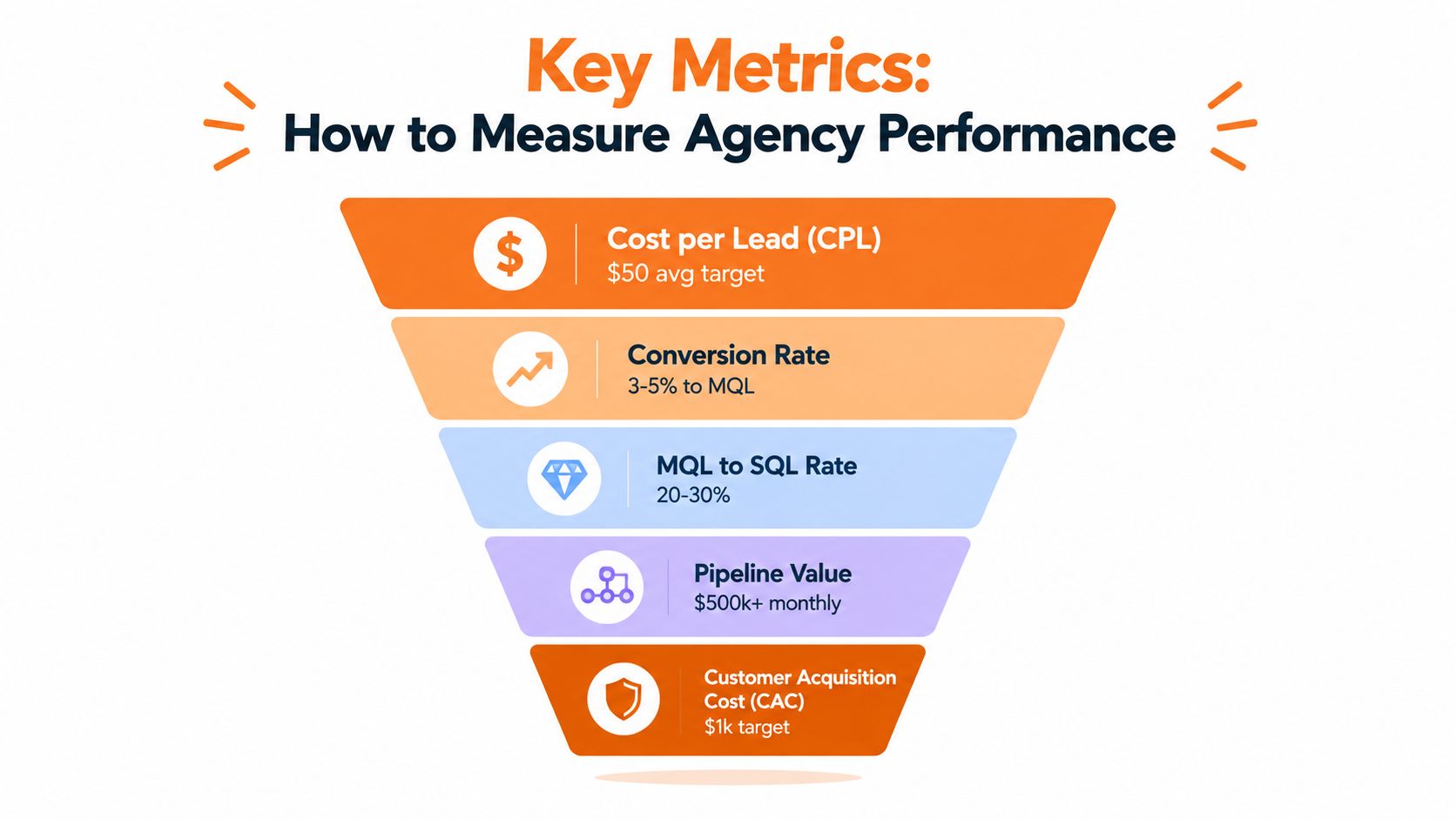
First, track cost per lead. This shows what you pay for each inquiry. If your team needs a clean way to set it up, this guide to cost per lead calculation walks through the math. Cost per lead is useful, but only if you pair it with quality. A low CPL can hide weak targeting, broad keywords, or forms that invite poor-fit submissions.
Second, track visitor-to-lead conversion rate. This tells you whether your website acts like a good storefront or a locked door. If traffic arrives and few people take the next step, the issue is often the page itself. Common causes include vague positioning, weak proof, a form that asks too much too early, or an offer that does not match buyer intent.
Third, track MQL-to-SQL rate. Agency reporting often gets more honest. If marketing generates plenty of names but sales accepts only a small share, your problem is usually qualification, not reach. In a market with higher lead costs, that gap matters more than raw lead volume.
Why small gains create outsized returns
A funnel works like a bucket brigade. If each handoff spills a little less water, more reaches the end without increasing the amount poured in at the top.
That is why conversion work often beats a traffic-first plan in Canadian campaigns. A clearer landing page, a better form, faster follow-up, and tighter scoring rules can improve results without raising media spend. This is especially true in smaller provinces and specialized sectors, where there may not be enough search volume to buy your way out of an inefficient funnel.
AI search visibility adds another layer. Traffic from AI summaries, recommendation results, and comparison-style answers can look promising at the top of the funnel, but the test is whether those visitors convert and qualify. Agencies should report that traffic separately so you can see whether new visibility is producing pipeline or just curiosity clicks.
Operational lens: If an agency reports lead totals but avoids SQL rates, lead acceptance, pipeline value, or close-rate by source, ask for the missing view before you judge performance.
A practical scorecard
Monthly reviews should be simple enough to scan and detailed enough to guide action.
| Metric | What it tells you | Good question to ask |
|---|---|---|
| Cost per lead | Whether acquisition is becoming more or less efficient | Which channels are producing expensive leads that sales does not want? |
| Visitor-to-lead rate | Whether the site converts attention into inquiries | Which pages lose intent, and what friction is causing it? |
| MQL-to-SQL rate | Whether marketing is sending sales-ready prospects | What rules define a qualified lead before handoff? |
| Lead source quality | Which channels create real opportunities | Which source produces pipeline and closed revenue, not just form fills? |
| Pipeline timing | Whether follow-up speed and sales cycle length are affecting results | Are delays in response time making good leads look weak? |
Measure the full path to revenue
Channel reports on their own rarely tell the full story. Paid search can look expensive when the issue is a weak landing page. SEO can look slow when leads sit untouched in the CRM. Outbound can look unproductive when the offer is too broad for a cautious, regulated buyer.
A better measurement model follows the whole route from first click to sales conversation to revenue. That is the standard to use when comparing agencies in Canada. In many cases, the winner is not the firm that promises the most leads. It is the one that improves qualification, conversion rate, and sales readiness well enough to make higher Canadian CPLs still produce healthy ROI.
Pricing Models and What Lead Generation Really Costs in Canada
Agency pricing gets confusing because two firms can both call themselves a Lead Generation Agency while selling completely different things.
One may run strategy, SEO, paid media, landing pages, CRM automation, and reporting. Another may sell appointments or leads. The pricing model tells you a lot about how risk is shared and what behaviour the agency is incentivised to optimise.
What pushes costs up in Canada
Canadian lead generation isn't cheap, especially in competitive cities and specialised sectors. Higher cost per lead in channels like PPC and LinkedIn often pushes agencies toward stricter qualification and tighter funnel design rather than pure volume buying.
That's why low-price offers deserve scrutiny. If the fee sounds easy to approve, ask what's missing. It may be strategy, content, sales enablement, CRO, reporting depth, or compliance work.
If you're budgeting paid acquisition specifically, this breakdown of Google Ads costs can help frame media expectations alongside agency fees.
Lead Generation Agency pricing models compared
| Pricing Model | How It Works | Best For | Watch Out For |
|---|---|---|---|
| Retainer | You pay a monthly fee for ongoing strategy and execution | Businesses needing full-funnel support and steady optimisation | Vague scopes, unclear deliverables, and reporting that tracks activity instead of outcomes |
| Performance-based | The agency gets paid when defined outcomes happen | Companies that want closer incentive alignment | Weak definitions of what counts as a lead can create quality issues |
| Pay-per-lead | You pay for each delivered lead | Simple tests, narrow campaigns, or short-term experiments | Lead quality can vary a lot if qualification standards are loose |
| Hybrid | A base fee plus performance component | Businesses that want strategic support with some shared risk | Complexity. You need clear terms for both baseline work and bonus triggers |
Which model fits which business
A local service company in Vancouver often prefers a retainer or hybrid model because local SEO, landing pages, call handling, and ongoing optimisation all matter together.
A B2B firm testing outbound into a defined list may prefer performance-based or pay-per-lead, but only if both sides agree on qualification criteria first.
A regulated brand usually needs more strategic and compliance work, so a pure pay-per-lead model can be a poor fit. Too much pressure goes to volume, not message control.
Cheap lead gen often becomes expensive when your sales team spends its week chasing people who were never a fit.
How to Evaluate and Choose the Right Lead Generation Agency
Most businesses ask the wrong first question.
They ask, “How many leads can you get us?” A better question is, “How will you define, attract, qualify, and improve the right lead for our business?”
Start with fit, not promises
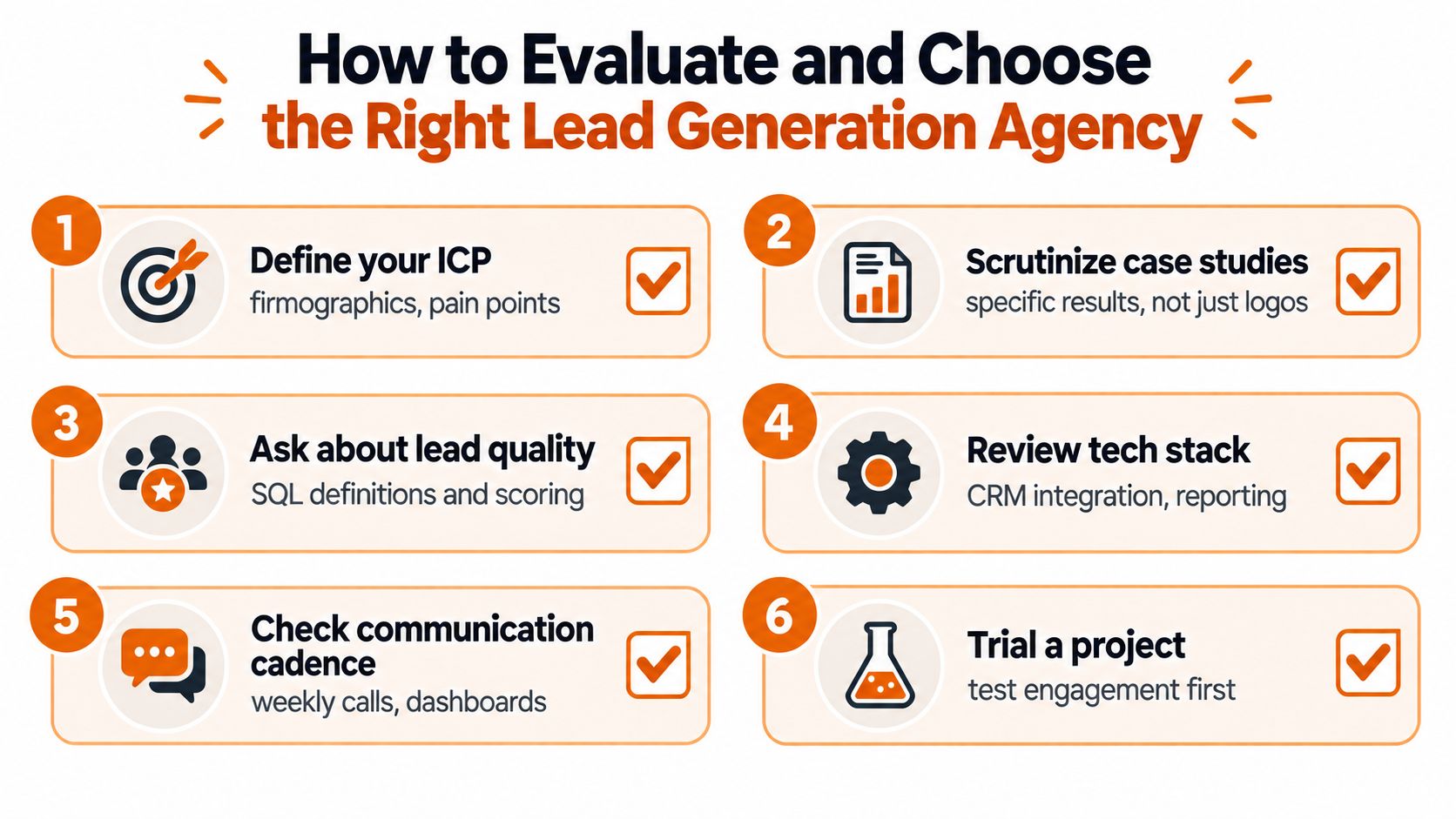
Before any discovery call, write down your own version of a qualified lead.
Include:
- Who they are. Industry, location, company size, or service need.
- What problem they have. Not just demographics, but urgency and buying trigger.
- What happens next. Phone call, booked consult, quote request, demo, or store purchase.
If an agency can't work within that definition, results will drift.
For businesses exploring AI-led visibility and future-ready search strategy, this guide on how to hire the right AI SEO agency is a helpful lens.
Questions that reveal real capability
Ask these in plain language:
How do you define a qualified lead for us?
If the answer stays broad, expect weak handoffs.What will you change first in our funnel?
Strong agencies usually spot a message, offer, page, or process issue quickly.How do you handle follow-up and nurture?
Many leads need more than one touch. Agencies focused only on top-of-funnel often ignore this.How do you adapt for local BC search behaviour or regulated categories?
This matters if you serve Vancouver or work in cannabis, CBD, wellness, or other sensitive spaces.What does reporting look like?
You want source quality, conversion movement, and sales feedback. Not just dashboards full of clicks.
Red flags that show a volume-first mindset
These warning signs come up often:
- They talk more about lead counts than close potential
- They don't ask for sales feedback
- They can't explain the handoff between marketing and sales
- They sell the same stack to every client
- They avoid discussing landing pages, forms, and nurture
- They have no answer for AI search visibility
A good agency should also be comfortable with scrutiny. Ask how they test new offers. Ask how they disqualify poor-fit prospects. Ask what happens when a channel underperforms.
The best discovery calls feel less like a pitch and more like a diagnostic session.
Local proof matters
For BC businesses, local understanding isn't just a nice detail. Search intent changes by city, neighbourhood, and service type. So does buyer trust.
An agency that understands Vancouver competition, lower Canadian market volume, and the practical realities of local service areas will usually make better choices than one importing a generic U.S. playbook.
Real Results and Your Next Steps to Scalable Growth
A Vancouver clinic invests in ads, gets form fills, and still feels stuck. The sales team says the leads are loose. The owner sees cost per lead rising. Search impressions look fine, but fewer prospects arrive ready to book. That pattern is common in Canada, where the audience is smaller, wasted clicks cost more, and visibility now depends on both classic search results and AI-generated answers.
Scalable growth works more like a well-run intake desk than a louder megaphone. You need the right people finding you, a clear path to conversion, and a way to sort serious buyers from casual researchers. In BC and other regulated or high-consideration categories, that matters more than chasing raw lead counts.
The businesses that improve results usually make four parts work together: positioning, qualification, conversion, and follow-up. If one part breaks, the whole system slows down. More traffic will not fix a weak handoff. Better ad targeting will not fix a page that creates doubt. Higher rankings will not help much if AI search surfaces someone else as the trusted answer.
Start with a simple audit.
Review these five points:
- Lead source mix. Are you relying too heavily on one channel?
- Qualification quality. Do sales and marketing use the same definition of a good lead?
- Landing page friction. Does the page answer key questions quickly and make the next step easy?
- Nurture process. What happens after a prospect shows interest but is not ready yet?
- AI search visibility. Can buyers find your brand in answer-driven discovery, not just traditional rankings?
This kind of review usually shows where budget is slipping away. In the Canadian market, the answer is often better filtering and stronger conversion paths, not more top-of-funnel volume.
A good agency should be able to connect SEO, paid media, CRO, reporting, and sales readiness into one model your team can use. That is how a business turns scattered wins into a repeatable pipeline.
If your pipeline feels inconsistent, Juiced Digital helps businesses map where leads are leaking across SEO, paid media, AI search visibility, and conversion paths, then build a cleaner system around qualified growth. If you want a practical read on what to fix first in a Canadian market like Vancouver, start with an audit or consultation.