
A founder hears “account based marketing” at a conference, returns to the office, and tells the team to “start doing ABM.” Monday arrives. Sales has one spreadsheet, marketing has another, the CRM contains outdated accounts, and nobody can explain which companies should receive a message, who owns the follow-up, or how revenue will be measured.
That confusion is normal, but it's also expensive. Account based marketing only works when the team narrows its focus, agrees on the accounts, coordinates the customer experience, and measures progress at the account level. The approach is especially practical for local services, e-commerce partnerships, and regulated B2B brands where a small number of well-chosen relationships can matter more than broad reach.
Canada's market is moving in that direction. It was estimated at USD 86.1 million in 2024 and is projected to reach USD 223.0 million by 2030, implying a 17% CAGR from 2025 to 2030, according to Canada's account-based marketing market outlook. The opportunity isn't to buy the most advanced platform. It's to build a disciplined motion that your team can run this quarter.
What Account Based Marketing Actually Is
Account based marketing is a strategy where marketing and sales jointly treat a named list of target accounts as markets of one, running coordinated plays across channels instead of casting a wide net for individual leads. In plain terms, you choose the companies first, identify the people involved in the purchase, and give the whole team a shared plan for earning the account.
Traditional demand generation usually starts with a broad audience. It tries to attract individual leads through content, search, advertising, events, or email, then passes qualified contacts to sales. ABM reverses that sequence. Sales and marketing agree on the account before they decide which people to reach, what message to use, and which action should happen next.
The differences are practical:
- List size: Demand generation reaches a large addressable audience. ABM works from a named list that may contain only a few dozen or a few hundred companies.
- Message customization: Demand generation adapts messaging by segment or persona. ABM adapts it by account, account cluster, buying committee, business problem, and timing.
- Deal ownership: Demand generation often treats marketing-qualified leads as the handoff point. ABM makes the account a shared commercial responsibility, with sales and marketing jointly accountable for movement.
Practical rule: If sales can't name the account, the buying problem, and the next owner, you're probably running targeted demand generation, not ABM.
ABM trades volume for account fit and deal velocity. That trade makes sense when each contract carries enough value to justify research, personalization, direct outreach, and multiple touches. A Canadian-focused playbook places the strongest economic case around CAD 300K to CAD 500K in annual deal value, with a named list of 100 to 500 accounts and sales cycles of 3 to 12 months. Those figures come from a Canadian B2B lead-generation playbook, and they're useful as a planning guide, not a universal threshold.
For smaller or mid-ticket deals, the same principle applies at a lighter level. Don't build a bespoke campaign for every account. Group similar prospects, personalise the offer by cluster, and reserve the deepest research for accounts with a credible path to revenue.
If you're starting from scratch, use this B2B marketing strategy guide to define the commercial objective first. Then build the account list around that objective, rather than forcing every marketing activity into an ABM label.
ABM Types and How to Choose the Right Motion
The three common ABM motions differ mainly in how much attention each account receives. Choose based on contract value, account complexity, available headcount, and the amount of custom work your team can sustain.
| Dimension | One-to-One | One-to-Few | One-to-Many |
|---|---|---|---|
| Typical account count | A small set of strategic accounts | Small clusters with shared characteristics | Hundreds of named accounts |
| Average contract value sweet spot | Above roughly $100K ACV | Roughly $20K to $100K ACV | Below roughly $20K ACV |
| Customization depth | Bespoke research, creative, offers, and executive outreach | Customised by industry, use case, or account cluster | Scaled by segment, role, and signal |
| Required headcount | Dedicated marketing and sales attention | Shared specialists and coordinated sellers | Lean team with automation and clear templates |
| Time to first meeting | Longer setup, potentially fast once the play lands | Moderate setup and repeatable outreach | Faster launch, but less individual depth |
| Realistic pipeline contribution | A small number of high-value opportunities | Several qualified opportunities across a cluster | Broad coverage and incremental pipeline |
These contract bands are decision criteria, not verified market statistics. The right cut-off depends on margin, sales effort, implementation cost, and customer lifetime value.
One-to-one for high-stakes accounts
One-to-one pays off when a single logo can materially change the quarter. For a deal above roughly $100K ACV, an account-specific microsite, executive briefing, customized business case, or direct-mail package can be rational. Sales should provide the account intelligence, marketing should build the experience, and an executive sponsor should enter when credibility matters.
The risk is obvious. One-to-one campaigns consume time quickly, and a weak target list can turn premium execution into expensive theatre. Don't use this motion because it sounds advanced. Use it when the account has a clear business trigger, an identifiable buying committee, and enough potential value to justify the work.
One-to-few for most focused programs
One-to-few is the practical default for many teams. Group five to fifteen accounts around a shared problem, vertical, technology environment, geography, or buying trigger, then create one strong playbook for the group. The campaign can include a custom landing page, a sector-specific guide, coordinated LinkedIn audiences, sales sequences, and a small event or briefing.
This structure preserves relevance without forcing the team to invent every asset from scratch. It also gives sales a useful level of context. The representative knows why each account is included and which parts of the play should be adapted.
One-to-many for scaled coverage
One-to-many works for sub-$20K deals or markets where the account universe is large enough to justify scaled execution. Use account lists, firmographic filters, industry creative, intent triggers, and automated follow-up. The message should still reflect the account's category, but it won't support the same level of individual research.
Most agencies oversell one-to-one because it sounds premium. For teams working with fewer than 500 named accounts, the stronger recommendation is a blended motion weighted toward one-to-few. Keep one-to-one for strategic outliers, use one-to-few for the core program, and let one-to-many provide coverage and learning.
Building the ICP and Aligning Sales with Marketing
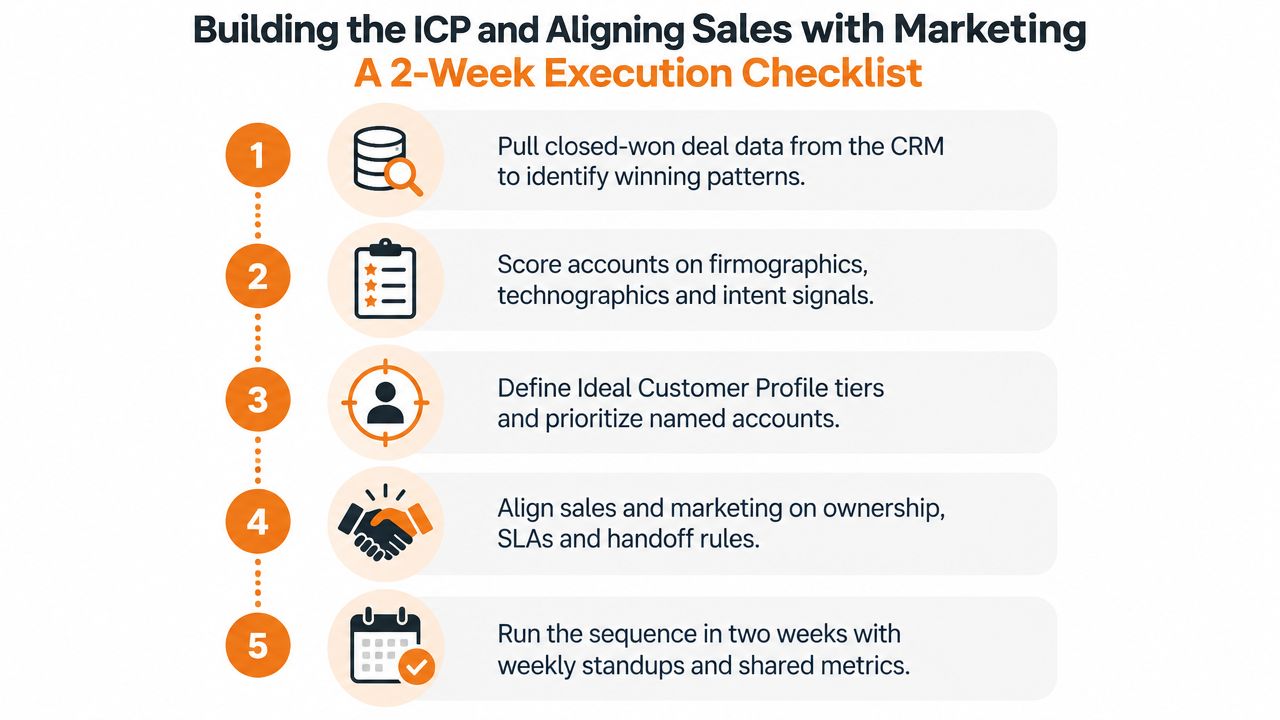
Your ideal customer profile shouldn't begin as a workshop exercise. It should begin with the accounts that already bought, renewed, expanded, or created avoidable delivery problems.
Run the work as a two-week operating sprint.
Start with evidence, then add sales judgement
Pull closed-won, closed-lost, expansion, and churn data from the CRM. Look for patterns in industry, geography, company structure, technology, buying role, sales cycle, implementation complexity, and the reason the customer chose you. Don't treat the CRM as perfectly clean. Use it as the starting evidence, then validate the patterns with the people who sell every day.
Ask three to five sales representatives which accounts feel like strong fits and why. Push for specifics. “They have budget” isn't enough. Ask what event created urgency, which stakeholder became the internal champion, what objection nearly stopped the deal, and which customers became difficult after signing.
Score accounts against two categories:
- Fit: Industry, location, company type, size, technology environment, operating model, and serviceability.
- Readiness: Hiring changes, leadership moves, expansion, public initiatives, product launches, relevant engagement, or a direct business trigger.
The output should be a one-page ICP, not a slide deck nobody opens. Include disqualifiers. If a segment regularly produces poor margins, unmanageable compliance exposure, or weak retention, say so plainly.
Produce the operating artefacts
Your team needs four concrete documents inside the CRM and shared workspace:
- ICP one-pager: The best-fit account characteristics, buying problems, disqualifiers, and evidence behind the profile.
- Tiered account list: Named accounts organised by strategic priority, cluster, owner, location, and current stage.
- Account research dossier template: A repeatable space for business priorities, relevant stakeholders, triggers, competitors, objections, and recommended messages.
- Sales and marketing SLA: The owner for each play, the response expectation, the handoff condition, the required CRM fields, and the rule for pausing outreach.
Marketing must not build the ICP alone. That failure mode is common: marketing creates a polished profile, sales doesn't recognise the accounts, sellers ignore the list, and the programme dies inside a quarter.
Use this target market profile example as a starting point, then add the fields your sales process needs.
Make alignment visible every week
A weekly standup should answer five questions:
- Which target accounts changed stage?
- Which accounts showed meaningful engagement?
- Which seller owns the next action?
- Which message or objection needs a marketing response?
- Which accounts should be suppressed, re-tiered, or removed?
If the meeting only reports clicks, it isn't alignment. Sales should challenge account quality, marketing should challenge follow-up quality, and revenue operations should keep the data usable.
ABM Playbooks for Local Services, E-Commerce, and Regulated Brands
ABM becomes easier to understand when you see how the motion changes by business model. The list, channel mix, and compliance burden should look different for a local service provider, a consumer brand selling through retailers, and a regulated producer selling to institutional buyers.
A Vancouver HVAC and plumbing company
A commercial HVAC and plumbing outfit in Vancouver wants to win property-management relationships instead of relying on one-off service calls. The team builds a list of 120 named commercial property managers, then groups them by building type, geography, and likely maintenance needs.
The one-to-few play uses Google Maps research, publicly available business information, handwritten direct mail, and a small LinkedIn remarketing audience. Marketing creates a concise service page for each cluster, while sales sends a researched note referencing the building portfolio or operational issue that matters to that group. The sequence should include a clear service offer, proof of response capability, and a simple route to a site assessment.
Budget for the work qualitatively as a meaningful per-account investment, not as a cheap lead-generation campaign. Printing, postage, research, list cleaning, creative, paid media, and seller time all contribute to the cost per account. Start with one cluster, measure meetings and qualified site visits, and expand only when the offer and list prove themselves.
A Canadian skincare brand entering US retail
A Canadian direct-to-consumer skincare brand expanding into the United States may need retail buyers more than consumer traffic. The brand selects 35 specialty boutiques and treats each as a one-to-one account, with a unique landing page, buyer-specific merchandising angle, sample kit, and outreach through a prospecting platform such as Apollo.
The message should reflect the retailer's current assortment, customer profile, price architecture, and category gaps. A buyer doesn't need another generic product brochure. They need a credible reason to believe the line can earn shelf space and support sell-through.
The channel sequence can combine personalised email, a short buyer video, direct mail, retailer-specific landing pages, and a follow-up call. The cost per account will be higher than broad e-commerce acquisition because sampling and account research are part of the motion. That's acceptable if the account can support repeat wholesale revenue and the team can track buyer conversations separately from consumer conversions.
A licensed cannabis producer selling institutionally
A licensed Canadian cannabis producer pitching provincial boards and hospital networks needs ABM discipline with a compliance gate before execution. Marketing can research procurement priorities, institutional requirements, product documentation, and the stakeholders involved, but it can't assume every familiar advertising channel is available.
Build the programme around account research, approved educational content, direct stakeholder outreach, industry events where permitted, and secure document sharing. Every asset should pass legal and regulatory review before sales distributes it. The producer should also maintain an account-level record of approvals, permitted claims, contact consent, and communication history.
The national importance of automated self-service access in Canada has older roots. The Canadian Bankers Association records the launch of Interac in 1986 as Canada's first national ABM network, founded by CIBC, Royal Bank, TD Bank, Bank of Montreal, Bank of Nova Scotia, and Caisse Desjardins, as described in this history of Canadian ABM infrastructure. Modern B2B account targeting is a different discipline, but the historical lesson is useful: infrastructure only creates value when organisations coordinate access, standards, and trust.
The Tech, Data, and AI Stack Behind a Modern ABM Program
Don't start by buying an ABM platform. Start by identifying which operational layer is failing. A small team can run a credible programme with an existing CRM, a clean account list, disciplined research, and a few connected channels.
| Layer | Function | AI Capability |
|---|---|---|
| Data | Firmographics, technographics, intent, contact records, and first-party enrichment | Clusters accounts, identifies missing fields, summarises research |
| Orchestration | Owns account lists, tiers, audiences, triggers, and play status | Recommends next actions and detects account movement |
| CRM and workflow | Stores ownership, contacts, opportunities, activities, consent, and stage | Automates task creation, field completion, and account summaries |
| Execution channels | Email, paid media, landing pages, direct mail, events, and sales outreach | Drafts copy, adapts creative, and creates account or segment variations |
| Measurement | Connects spend, engagement, meetings, opportunities, and revenue | Surfaces anomalies and produces account-level reporting |
Build the data layer first
Your data source needs coverage across the long tail of companies you sell to, not just large enterprises. Match firmographic and intent information with first-party enrichment from forms, consultations, customer conversations, event registrations, and sales notes.
Treat intent as a prioritisation signal, not proof of buying readiness. An account can research a topic without having budget, authority, or an active project. Sales still needs to validate the situation.
Use orchestration to create control
The orchestration layer should answer four questions at a glance:
- Which accounts are active?
- Which motion applies to each account?
- What trigger starts the next play?
- Who owns the next action?
If the tool can't make ownership obvious, it's creating another dashboard rather than improving execution.
AI can draft personalised ad copy, landing-page hero lines, research summaries, and seller emails. It can help a team of two manage a broad named-account programme, but it can also invent job titles, confuse subsidiaries, misread company changes, or assign the wrong product problem to an account.
Human review stays in the loop. Verify the company, stakeholder, trigger, claim, and call to action before anything reaches a target account.
Use AI in digital marketing to map practical automation opportunities, but keep final approval with a person who understands the account and the regulatory context.
Measurement requires a single account view. Paid-media engagement, website activity, email responses, meetings, opportunity stages, and revenue should resolve to the same account record wherever privacy and platform rules allow. If the systems can't connect cleanly, report the limitation rather than presenting false precision.
ABM KPIs, Reporting Cadence, and How to Prove ROI
A named-account dashboard can look busy while the pipeline remains unchanged. Raw impressions, isolated clicks, and lead volume flatter the marketing team, but they rarely tell a founder whether the target accounts are moving closer to a purchase.
Track metrics that show depth, breadth, and commercial movement:
- Account engagement rate: The share of target accounts showing meaningful activity, such as repeat visits, content use, event participation, or direct response.
- Multi-touch reach: The number of relevant stakeholders reached within each buying committee, not just the first contact.
- Stage progression velocity: How quickly active accounts move from initial engagement to meeting, opportunity, proposal, and decision.
- Pipeline quality: Opportunity value, fit, stage, next action, and seller confidence.
- Cost per opportunity: Total programme cost divided by qualified opportunities created or materially advanced.
- Win and expansion outcomes: Closed revenue, renewal, upsell, and account retention where the programme supports existing customers.
Use a reporting rhythm people can't avoid
Run a weekly account-level standup with marketing, sales, and revenue operations. Review movement, engagement, ownership, blockers, and suppression decisions. Keep it operational and short.
Hold a biweekly pipeline review with sales. Inspect the opportunities behind the numbers. Ask whether the account has multiple stakeholders engaged, whether the commercial problem is real, and whether the next step is scheduled.
Use a quarterly board-style review for cost per opportunity, sourced pipeline, influenced pipeline, closed revenue, and learnings by segment or motion. Separate sourced from influenced pipeline so finance can see how the programme contributed.
A simple sourced-pipeline formula is:
Sourced pipeline = opportunity value for opportunities where the ABM programme created the first recorded commercial response or meeting.
An influenced-pipeline formula is:
Influenced pipeline = opportunity value for target-account opportunities that received qualifying ABM engagement before or during the opportunity, regardless of the original source.
Define “qualifying engagement” before the reporting period begins. Otherwise, every touch becomes influence and the number loses credibility.
Delete vanity metrics from the executive deck unless they explain a commercial outcome. Impressions and CTR can help diagnose creative distribution, but they shouldn't anchor the business case.
The renewal question is direct: Did the accounts we targeted close faster, larger, or at a higher win rate than comparable accounts we didn't target? If you can't answer that with a fair comparison, improve the measurement before increasing spend.
Compliance Realities for ABM in Cannabis, CBD, and Wellness
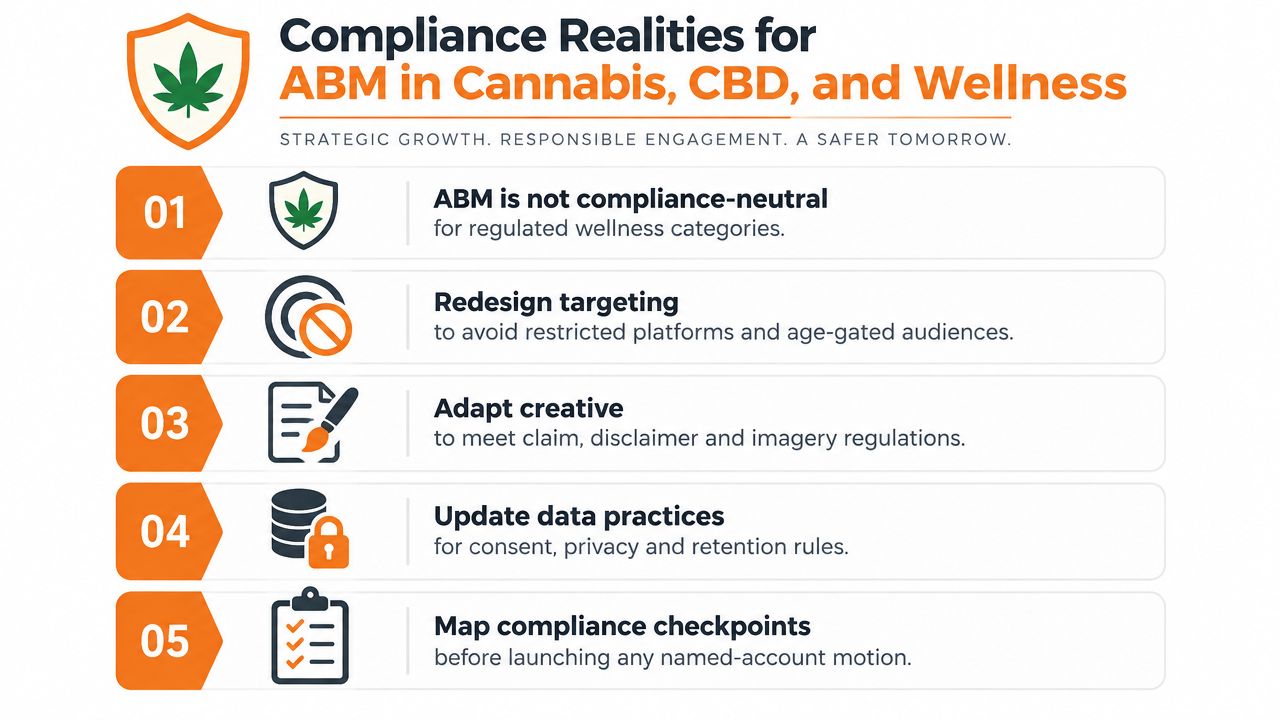
ABM isn't compliance-neutral. A named-account list can make targeting more precise, but precision doesn't remove platform restrictions, privacy obligations, age requirements, health-claim rules, or provincial controls.
Cannabis, CBD, and functional-mushroom brands need to redesign the campaign before launch. That means reviewing the target list, creative, data source, geography, consent status, suppression logic, and approval records as one system.
Treat channel restrictions as design inputs
Meta and Google may restrict cannabis terms, product imagery, claims, or promotional destinations. A campaign that works for ordinary B2B software may fail review when it includes regulated product language, even if the audience is a business buyer.
Geo-fencing requires more than drawing a radius on a map. A team should understand where advertising is permitted, whether the destination is age-gated, whether the audience can be reliably limited, and whether the platform's controls are adequate for the product and jurisdiction.
Provincial retailer restrictions also affect account selection. A marketer shouldn't add every retailer, clinic, distributor, or institution to a target list without checking whether the relationship, communication, and proposed offer are permitted.
Functional mushrooms and wellness products create a separate risk around implied health outcomes. Copy that suggests diagnosis, treatment, prevention, or guaranteed effects can create exposure even when the product category sounds natural or non-pharmaceutical.
Make privacy and consent operational
CASL and GDPR can affect outbound sequencing, depending on the contacts, jurisdictions, legal basis, and communication purpose. A seller's access to a business email doesn't automatically authorise every automated sequence.
Build consent and suppression fields into the CRM. Record the source of the contact, permitted communication type, opt-out status, jurisdiction, retention decision, and approval owner. Wellness data also deserves careful handling because behavioural or health-adjacent information can become sensitive when combined with account and individual records.
Intent data vendors often provide weaker coverage for regulated categories. They may exclude certain topics, companies, or behaviours to reduce risk. Don't interpret missing intent as missing demand. Use first-party engagement, approved public information, direct conversations, procurement notices, and verified account research instead.
Use a pre-flight go or no-go gate
Before launch, require documented approval for:
- List sourcing: Confirm that every account is relevant, legitimate, permitted to contact, and correctly classified.
- License verification: Check applicable registries, retailer status, institutional eligibility, and jurisdictional restrictions.
- Creative review: Approve claims, imagery, disclaimers, product references, landing pages, and email copy.
- Suppression logic: Exclude restricted geographies, opted-out contacts, unsuitable audiences, and accounts that can't receive the offer.
- Data controls: Define access, retention, enrichment, vendor processing, and deletion procedures.
- Audit records: Save the approved version, reviewer, date, channel, audience, and reason for approval.
If compliance can't explain why an account and message are permitted, sales doesn't get to launch the play.
Consider a CBD distributor selling into natural-health retailers. The compliant account list would prioritise verified retailers whose category mix and procurement structure fit the offer, then use educational materials focused on wholesale operations, product documentation, and merchandising support. It would avoid unverified health claims, uncontrolled consumer retargeting, and outreach to contacts without an appropriate legal basis.
For a licensed producer pitching provincial boards, the list should centre on the relevant procurement or institutional stakeholders, with approved documentation and account-specific business information. The campaign should use controlled outreach and permitted educational content rather than assuming paid social can carry the programme.
This approach may slow the first launch. It protects the account, the brand, and the sales team from preventable escalation. In regulated categories, compliance isn't a footnote added after creative production. It's the gate that determines whether the campaign exists.
Juiced Digital helps local businesses, e-commerce brands, and regulated cannabis, CBD, and functional-mushroom companies build account based marketing programmes with compliant targeting, AI-assisted SEO, paid media, digital PR, and conversion optimisation. Visit Juiced Digital to request a focused audit and turn your named-account list into an accountable growth plan.